
Chemical transfer · regenerative magnetic drive · self-priming · polymer circulation
Wenzhou Andeli Acid-Resistant Pump Co., Ltd.
Wenzhou Andeli Acid-Resistant Pump Co., Ltd. supplies magnetic-drive and corrosion-resistant pumping equipment. Its current Chinese legal name is 温州市安得利耐酸泵有限公司. The catalogue spans metal centrifugal pumps, a CWL regenerative direction, high-temperature NGCQ equipment, self-priming ZCQ pumps and compact ADL circulation units. The important purchasing choice is not simply “acid-resistant”: the liquid, duty point, inlet arrangement, wetted construction and startup conditions decide which direction can be considered.
- Current Chinese legal name
- 温州市安得利耐酸泵有限公司
- Published location
- Oujiangkou Robot Industrial Park, Wenzhou
- Company-published establishment
- 1992
- Useful selection directions
- CQB · CWL · NGCQ · ZCQ · CQF4 · ADL
Start with the liquid, then choose the hydraulic and installation direction
Andeli’s corporate page lists metal and polymer wetted constructions, including austenitic stainless steels, titanium and Hastelloy alloy directions, fluoroplastics and reinforced polypropylene. This is a catalogue-level list, not a statement that every series is available in every grade. Describe the chemical name and concentration, temperature, density, viscosity, solids and crystallisation tendency, then request a component-by-component material schedule for the selected pump.
The current company name differs by one Chinese character from the older 温州市安德利耐酸泵有限公司. An original Zhejiang government enterprise-name-change list links the two names under the same unified social credit code. Use the current legal name on commercial documents and reconcile older nameplates or literature when ordering replacement parts. The company’s current corporate page places it in Wenzhou’s Oujiangkou Robot Industrial Park; the historical name-change list is not evidence of a current factory audit or equipment approval.
Metal centrifugal transfer
CQB is a magnetic-drive centrifugal direction. Select the actual flow/head row and curve, exact wetted grades and containment arrangement.
Small-flow regenerative duty
CWL uses a regenerative/vortex impeller and is described for liquid transfer, gas/liquid mixing, circulation and boosting. Agree the actual gas content and duty; no unrestricted gas percentage is stated.
Special operating conditions
NGCQ addresses elevated temperature; ZCQ addresses a self-priming inlet arrangement. Cooling and priming requirements must be attached to the selected order.
Polymer wet end or compact circulation
CQF4 is the fluoroplastic-lined direction; ADL is a circulation family with reinforced-PP and stated PVDF options. Confirm chemical compatibility and connection details separately.
CQB: distinguish a model duty point from a family maximum
The CQB identification example CQB50-32-160 denotes a magnetic-drive centrifugal pump with 50 mm inlet, 32 mm outlet and 160 mm nominal impeller diameter. The manufacturer’s introduction describes alloy and stainless material directions and a 0–100°C temperature range. The exact alloy, seal rings, bearing and containment sleeve still need to be agreed for the chemical and selected size.
The detailed CQB table lists CQB50-32-160 at 12.5 m³/h and 32 m head, 2,900 r/min with a 4 kW motor. CQB50-32-200 is listed at the same flow, 50 m head and 7.5 kW. These are two different selections at stated conditions; the larger motor does not mean more flow at every system resistance.
The summary sheet’s flow range stops at 100 m³/h, while the detailed model table includes larger sizes. Use the selected row and its curve instead of converting that inconsistent headline into a guaranteed family limit. Published CQB curves show a 50 Hz, specific-gravity-1.0 basis. Ask for the offered curve, motor loading and suction requirement with your actual liquid density, viscosity and site electrical supply.
The construction drawing separates small units at up to 2.2 kW from arrangements at 3 kW and above. It identifies inner/outer magnetic rotors, containment sleeve, shaft, sleeve/bearings and seal rings. Obtain the drawing and spare-parts list for the delivered arrangement: a family name and nominal impeller size are insufficient to identify replacement bearings or containment parts.
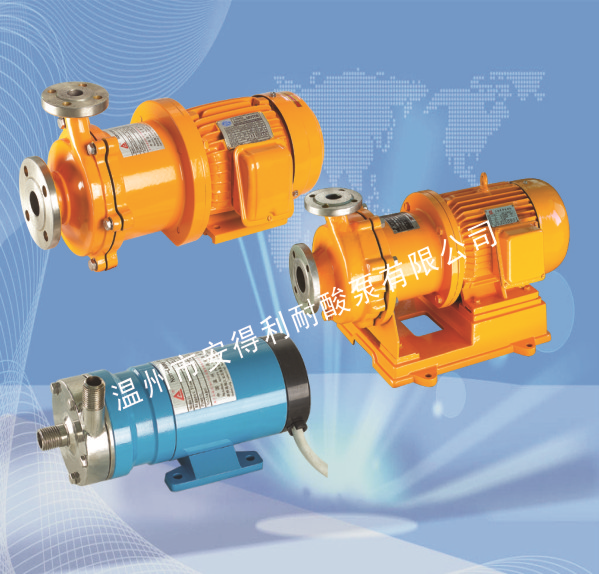
CWL: small-flow pressure duties and gas/liquid mixing need a defined operating case
The CWL sheet describes a horizontally installed magnetic-drive pump with a regenerative/vortex impeller. It identifies liquid transfer, gas/liquid mixing, circulation and boosting, and specifies liquids without solid particles. The material directions include austenitic stainless steel, Hastelloy and titanium alloy. These descriptions are starting points for selection, not proof of compatibility with a particular acid or an unlimited entrained-gas condition.
The six listed CWL rows are all at 2,900 r/min. The sheet states a temperature limit of 100°C or below. Notice that 25CWL40-1.0 is a 1.0 m³/h, 40 m selection while 25CWL15-5.0 is 5.0 m³/h at only 15 m. Do not combine the maximum flow and maximum head into one operating point.
For a mixing or gas-bearing stream, specify the liquid composition, gas identity, gas fraction and how it changes, inlet pressure, temperature and required outlet conditions. Ask for the accepted operating envelope, starting procedure and performance basis for that mixture. Industry application names such as pharmaceutical or nuclear service do not establish sanitary construction, hazardous-area certification or an approval for the offered pump.
| Catalogue code | Flow / head | Motor |
|---|---|---|
| 25CWL40-1.0 | 1.0 m³/h / 40 m | 1.1 kW |
| 25CWL15-2.5 | 2.5 m³/h / 15 m | 1.5 kW |
| 25CWL15-5.0 | 5.0 m³/h / 15 m | 2.2 kW |
| 40CWL40-6.0 | 6.0 m³/h / 40 m | 3 kW |
| 40CWL55-3.5 | 3.5 m³/h / 55 m | 4 kW |
| 50CWL40-12 | 12 m³/h / 40 m | 7.5 kW |
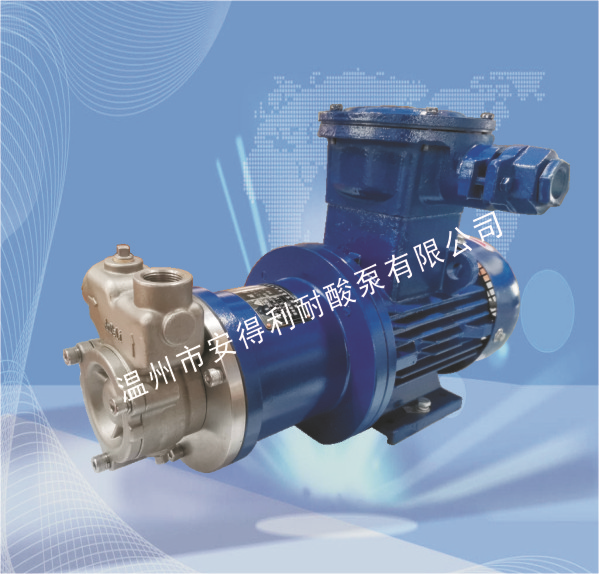
NGCQ: specify operating temperature and the cooling arrangement together
The NGCQ sheet describes high-temperature magnetic materials, a dedicated structural arrangement and a cooling system. It gives a 120–365°C temperature direction explicitly subject to the user’s requirements being stated at order. This is not permission to run any standard magnetic pump at 365°C.
State normal, startup and upset temperatures, the chemical at those temperatures, pressure, thermal cycling and the site cooling services. Request the selected magnet grade, containment/wetted construction, cooling method and connections, permitted startup/shutdown procedure and alarm/trip requirements. Include any tracing or insulation requirement in the scope; the separately named NGCQ-b insulation direction should not be silently treated as the standard NGCQ supply.
For one explicit catalogue example, NGCQ50-32-160 is listed at 12.5 m³/h, 32 m head, 2,900 r/min and 4 kW. Its sheet refers the performance curves to CQB. Agree the actual high-temperature duty curve and motor basis rather than assuming that a room-temperature water curve resolves the hot-liquid case. The headline flow/speed range and the larger model rows differ, so the order should quote the selected row and construction.
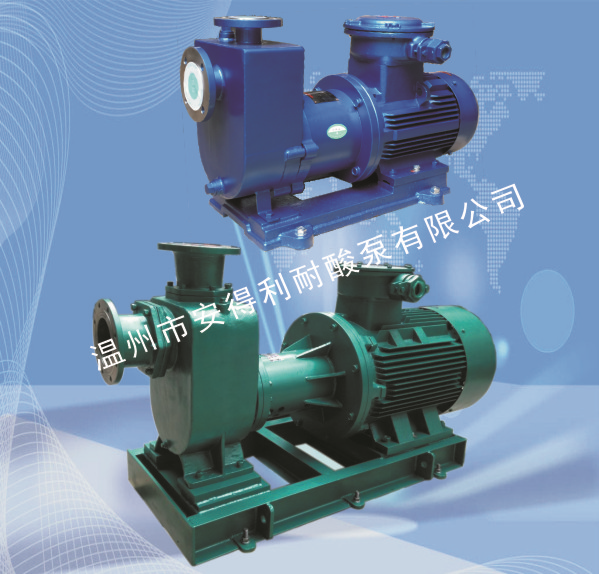
ZCQ: self-priming does not remove the need to define the startup liquid
ZCQ is described as a stainless self-priming magnetic-drive pump using an external-mixing, axial-return arrangement. The illustrated body contains suction, liquid-storage, volute, return and gas/liquid-separation spaces. Its operating explanation uses liquid remaining in the suction chamber to mix with inlet air, separates the mixture, expels air through the outlet and returns liquid to the pump.
That explanation matters because the same page also advertises operation without a foot valve or priming water. Do not interpret the slogan as approval for an empty pump to run dry. Obtain a commissioning procedure that states the initial fill, retained-liquid requirement, restart conditions, allowable suction lift and priming time for your actual liquid and pipework.
The ZCQ sheet lists austenitic stainless construction, working temperature up to 120°C, kinematic viscosity up to 100 mm²/s and pressure up to 1.6 MPa. These are stated family conditions; confirm whether the pressure is an allowable casing rating and how temperature/material change it. The pressure figure is not a guaranteed differential head. Supply the minimum source level, inlet length/diameter, leaks or air entry, discharge backpressure and isolation arrangement so the priming case can be evaluated.
The parts description includes stainless steel, ceramic, PTFE, carbon graphite and hard-alloy directions. Ask for the exact fitted bearing, sleeve, seal-ring and magnetic coupling materials. A stainless casing alone does not establish the suitability of the complete wetted path or the restart procedure after drainage.
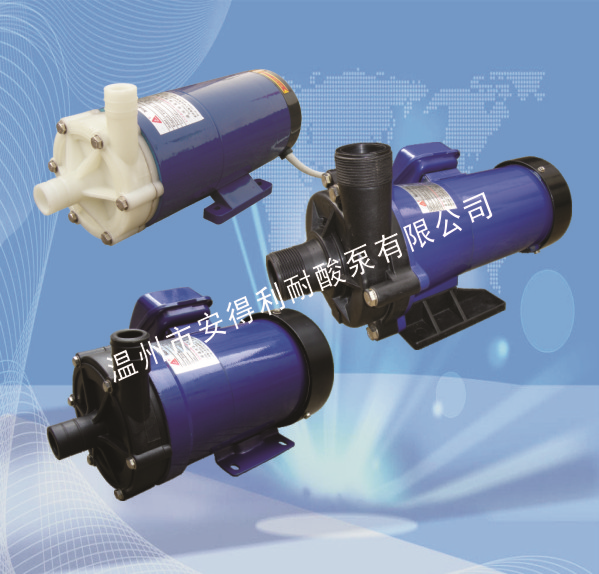
Compare the fluoroplastic-lined direction with compact ADL circulation
The CQF4 page is titled as a fluoroplastic-lined magnetic pump, while its attached specification sheet uses CQF in the model codes. Keep that nomenclature attached to the selected quotation and drawing rather than guessing that an existing CQF order is interchangeable. The sheet lists a 0–80°C temperature direction, fluoroplastic wetted construction, and separate flow, head and NPSH columns. Ask for the actual lining/polymer grade, bearing/elastomer materials and selected suction requirement.
ADL is a separate compact magnetic-drive circulation family. The published material direction is reinforced polypropylene, with a T option identified by the chemical abbreviation PVDF. The sheet’s accompanying Chinese polymer name is inconsistent with that abbreviation, so specify the actual resin grade and material certificate in the offer instead of ordering from the suffix alone.
ADL’s table separates maximum flow and maximum head from a standard flow/head point. For example, ADL100 lists maximum flow 120 L/min and maximum head 8.6 m, but its standard point is 60 L/min at 6.5 m with a 0.37 kW motor. ADL403H lists maxima of 420 L/min and 34 m, whereas its standard point is 200 L/min at 28 m with 4 kW. Neither pair of maxima is one duty point.
ADL coding distinguishes ordinary, M threaded-port, X larger-flow and H higher-head directions, with connection-frame variants also described. Request the exact hose, threaded, flanged or union connections, thread standard, dimensions and support. The published circulation sheet states 0–80°C; the accepted chemical compatibility, pressure and temperature envelope must refer to the actual resin and assembly.
| Catalogue code | Standard flow / head | Motor |
|---|---|---|
| ADL20 | 16 L/min / 2 m | 0.04 kW |
| ADL100 | 60 L/min / 6.5 m | 0.37 kW |
| ADL403H | 200 L/min / 28 m | 4 kW |
Resolve operating limits before committing a chemical-transfer installation
Andeli’s dated general working-conditions note specifies liquids without ferromagnetic material or fibres, density no greater than 1,300 kg/m³ and kinematic viscosity no greater than 30 mm²/s, with exceptions to be stated at order. It also gives 80°C and 0.6 MPa for that general description, and says a different magnetic coupling design is needed above the stated density. These generic figures do not replace the different ZCQ, CQB or NGCQ specifications: obtain a series- and order-specific accepted envelope.
Document the minimum tank level, inlet losses, vapour-pressure/temperature case, venting and startup fill, along with the required minimum operating flow and any bypass. Ask which dry-running, loss-of-flow, overload, temperature or other protective functions are required and which are included in the supplied package. A magnetic-drive description does not establish that these controls are supplied or that dry-running is permitted.
For maintenance, identify the exact pump/serial number, impeller, inner and outer rotors, containment sleeve, bearings/sleeves, seal rings and motor arrangement. Request the parts drawing, replacement procedure, cleaning/draining instructions and inspection limits for the supplied construction. For a retrofit, compare nozzle orientation, connections, mounting dimensions and removal space before using a catalogue claim of replacement compatibility.
Make the quotation answer the chemical, hydraulic and supply-boundary questions
Use the platform enquiry with the complete factory name and a selected duty brief. For comparable offers, keep the same chemical, operating cases, construction requirements and site interfaces in each request.
Process and operating cases
- Chemical and concentration, density, viscosity, temperature range, solids/fibres, gas content and crystallisation conditions.
- Simultaneous required flow/head, normal and minimum tank levels, inlet arrangement and discharge pressure.
- Normal transfer, self-priming restart, hot startup/shutdown and any gas/liquid mixing cases.
Selected construction and interfaces
- CQB/CWL/NGCQ/ZCQ/CQF4/ADL direction, complete code, exact wetted/bearing/containment materials and connections.
- Accepted curve and test-liquid basis, selected speed, motor, electrical/hazardous-area requirements and dimensions.
- Initial fill/retained liquid, cooling or tracing, minimum-flow arrangement and required monitoring/interlocks.
Scope, documents and acceptance
- Pump, motor, base, connections, cooling/protection and spares as explicit supply line items.
- Order-specific material schedule, general arrangement, parts drawing and operating/maintenance instructions.
- Agreed performance and inspection evidence for the offered configuration, including what the buyer supplies on site.
Submit through KanBeng’s enquiry form with this factory named in your request.