
Lubricating-oil transfer · viscous liquids · thermal-oil circulation
Botou Taibang Pump & Valve Manufacturing Co., Ltd.
Botou Taibang makes pump selections for oil handling and industrial heating, but these duties need different hydraulic principles. Its KCB gear and 3G screw pumps transfer lubricating liquids; NYP internal-gear selections address viscous transfer; BRY is a centrifugal thermal-oil direction. Start with the liquid at its coldest startup and normal operating temperature, then define the suction, pressure and heating system before choosing a motor or a catalogue code.
- Company identity
- 泊头市泰邦泵阀制造有限公司
- Published location
- Botou, Hebei, China
- Reviewed directions
- KCB gear · NYP internal gear · 3G screw · BRY centrifugal
- Buyer priorities
- Viscosity at startup, pressure protection and thermal conditions
Separate liquid transfer from thermal-oil circulation
The company identifies a predecessor gear-pump factory and lists residual-oil, jacketed bitumen and other oil-service directions as well. A road-building application is not a reason to put hot bitumen through a standard KCB lubrication pump. Match the liquid and heating arrangement to an approved construction rather than transferring the widest catalogue claims between series.
| Plant task | Catalogue direction | What changes the selection |
|---|---|---|
| Transfer clean lubricating oil or feed a lubrication system | KCB external gear | Oil grade, viscosity, required discharge pressure, inlet conditions and protection-valve arrangement. |
| Move resin, polymer or another viscous liquid | NYP internal gear | Actual viscosity versus temperature, permitted speed, starting torque, materials and heating scope. |
| Deliver clean lubricating liquid with axial screw pumping | 3G / 3GC screw | Viscosity-specific performance, exact construction, drive and installation; marine designation requires its own approvals. |
| Circulate heat-transfer oil around a heated process | BRY centrifugal | Flow and head together, temperature, thermal-fluid properties, suction margin and hot alignment. |
KCB-200 provides a specific oil-transfer reference point
The official KCB table lists KCB-200 at 200 L/min, equivalent to 12 m³/h, 1,440 r/min and 0.33 MPa discharge pressure with a 4 kW motor. It also lists a 5 m required cavitation allowance and 46% efficiency. Ask for the applicable liquid and test conditions before treating these as an installation guarantee; the 5 m figure is not a claim that the pump can lift oil five metres.
The neighbouring KCB-135 and KCB-300 rows use different speeds and drives. Replacing a pump by the nearest number alone can alter flow, power demand and piping duty. For an existing unit, provide its complete nameplate, rotation, ports, coupling and base dimensions along with the oil conditions.
| Model | Flow | Speed | Discharge pressure / motor |
|---|---|---|---|
| KCB-135 | 8 m³/h / listed 135 L/min | 940 r/min | 0.33 MPa / 2.2 kW |
| KCB-200 | 12 m³/h / 200 L/min | 1,440 r/min | 0.33 MPa / 4 kW |
| KCB-300 | 18 m³/h / 300 L/min | 960 r/min | 0.36 MPa / 5.5 kW |
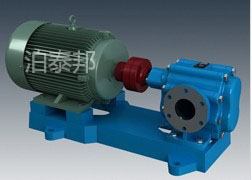
View the reviewed product family →
Agree the construction and protection before approving KCB service
Taibang describes heat-treated gears and replaceable bushings, with the pumped liquid lubricating the internal parts. Its ordinary duty description excludes solid particles, fibres and corrosive liquids. Stainless, copper-gear and explosion-protected motor options appear elsewhere on the page, but each needs an exact material, seal and hazardous-area specification; an optional motor does not establish approval of a complete flammable-liquid package.
The same source gives conflicting temperature and viscosity envelopes: an introductory passage refers to below 300°C and 75 cSt, while the duty paragraph gives no more than 180°C and 5–1,500 cSt. Do not combine these into one broad operating range. Request written limits for the actual KCB-200 construction and the oil at startup and running temperature.
The company describes the built-in protection valve as overload protection and explicitly says it is not a long-term pressure-reducing valve. Define the allowed pump and piping pressure, valve setting and bypass destination in the order. General rotary-pump guidance also distinguishes emergency relief from flow control: a blocked discharge can create overpressure, and prolonged internal bypass can heat the liquid. Obtain an approved operating procedure instead of controlling gear-pump flow by closing the discharge valve.
NYP selection starts with viscosity at a stated temperature
The NYP page identifies an internal/external rotor arrangement and relates flow to speed. Its table couples viscosity, rotational speed, capacity and drive selection. For NYP-50, one catalogue branch shows 2,000 cSt at 357–475 r/min with 10–14 m³/h and 7.5 kW; the other shows 60,000 cSt at 300 r/min with 9 m³/h and 5.5 kW. Both are listed at 1.0 MPa. These are separate selection branches, not a promise to deliver the highest flow at the highest viscosity.
Send a viscosity-versus-temperature curve or measured values, density, chemical composition and any solidifying or curing behaviour. Resin transfer after a cold overnight stop is a different starting load from warm continuous circulation. Ask for the approved speed, starting-torque calculation, seal and wetted-material schedule, and the scope of the jacket or heat tracing.
The page mixes mechanical-seal wording with magnetic-coupling features. Specify which construction is actually quoted rather than assuming every NYP has both. Food or chemical applications also need their own material, cleaning and compatibility requirements; an application list is not a hygienic certification.
Use the 3G viscosity-specific table for the actual oil
Taibang describes 3G as a rotary positive-displacement pump with a driven screw, idler screws and a liner forming moving axial chambers. The documented liquid is non-corrosive, lubricating oil or a similar lubricating fluid without solid particles. This direction is worth discussing where continuous oil transfer and pressure pulsation matter, provided the liquid supports the required lubricating film.
The official tables distinguish 75 cSt entries from 3 cSt entries and list different constructions and drives. Use the branch matching the oil and complete pump designation. Several pressure columns lack a visible unit, so the numbers should not be reinterpreted as MPa by guesswork. Request a dated, unit-labelled performance sheet and the pressure-protection arrangement.
The company describes horizontal and vertical marine arrangements and AC or DC marine motors. A 3GC designation alone does not establish classification-society approval. If the purchase is for a vessel, state the class, installation orientation, electrical supply and required documents in the enquiry.
BRY follows a flow–head curve, not the gear-pump pressure logic
BRY is presented as an air-cooled centrifugal hot-oil pump for high-temperature liquids without solid particles. The company distinguishes wetted-material constructions; temperature suitability therefore belongs to the selected material and liquid, not to every pump sharing the family name.
The BRY50-32-200 table gives three points at 2,900 r/min: 7.5 m³/h at 52.5 m head, 12.5 m³/h at 50 m, and 18 m³/h at 40 m, with a listed 5.5 kW motor. The 50 and 32 identify nominal inlet and outlet diameters in millimetres, and 200 identifies nominal impeller diameter. An A suffix denotes a first impeller trim. Ask for the curve for the supplied trim and thermal fluid instead of pairing the maximum flow with maximum head.
Define the hot system
- Thermal-fluid grade, density and viscosity at startup and running temperature; normal and maximum temperatures.
- Required circulation flow and differential head, tank arrangement, suction pressure and available suction margin.
- Heat-up sequence, expansion, pipe support, insulation boundaries and access around the air-cooled bearing region.
Approve the delivered assembly
- Exact material, seal, impeller trim, speed, motor and base arrangement.
- Hot alignment and startup/shutdown instructions for the selected construction.
- Curve and test conditions, pressure/temperature ratings, spare seals and bearing maintenance instructions.
Submit through KanBeng’s enquiry form with this factory named in your request.
Make the quotation distinguish transfer, heating and supply scope
The official company material describes gear machining, heat treatment and pump testing. Turn those capabilities into an order-specific inspection plan: gear/material identification, assembly and rotation checks, performance at the agreed liquid conditions, and protection-valve verification. Request current readable documents if a production licence or certification is required; historical website claims are not a certificate for the supplied order.
Reviewed on 8 October 2026 from Taibang’s company and KCB, NYP, 3G and BRY documentation. General pressure-protection context was checked against original pump-manufacturer technical guidance. Series comparisons and enquiry inputs are procurement analysis, not a witnessed factory or pump test.
For a transfer pump
- Oil or resin identity, composition, lubricity and particles; viscosity at the coldest start and normal operation.
- Target flow, inlet conditions, discharge/system pressure and operating cycle.
- Protection setting and bypass route, heating needs, exact seal/materials and drive.
For replacement or a complete package
- Nameplate and photos, port and base dimensions, rotation and present operating problem.
- Pump head only or motor/coupling/base package; power supply and any hazardous-area or marine requirements.
- Dated performance sheet, agreed test point and tolerances, material records where required, spares, quantity and destination.
Submit through KanBeng’s enquiry form with this factory named in your request.
Report an outdated detail · Return to the enquiry checklist ↑