
Sewage sumps · bottom-intake drainage · deposit agitation · controlled building water supply
Chengdu Chuanjiao Pump Co., Ltd.
Chengdu Chuanjiao Pump Co., Ltd. (成都川蛟泵业有限公司) documents submersible wastewater pumps and packaged water-supply equipment from Pujiang, Chengdu, Sichuan. Its WQ, QX and JYWQ(D) directions address different sump conditions, while variable-frequency and non-negative-pressure sets address building water pressure. The useful buying decision combines the particular rated row with solids, water level, electricity supply and the installation or control package.
- Chinese company name
- 成都川蛟泵业有限公司
- Published locality
- Heshan, Pujiang County, Chengdu, Sichuan
- Displayed company-licence date
- 15 December 2017
- Main order distinction
- Sump pump versus controlled water-supply set
A sewage sump and a building water booster need different orders
Chuanjiao’s documented range includes WQ sewage pumps, bottom-intake QX construction-drainage pumps, JYWQ(D) agitator-equipped pumps and packaged water-supply systems. Decide whether the task is to remove wastewater, lift settled deposits or maintain clean-water pressure before comparing motor sizes. A control cabinet or pressure vessel does not turn a sewage pump into a potable-water booster.
For a sump, describe the incoming waste, abrasive sand, fibrous material and lowest operating water level. For water supply, describe peak demand, the pressure available upstream and the pressure required at the highest or most remote outlet. The product directions below separate these purchasing tasks rather than combine unrelated family maxima.
| Task | Published product direction | Inputs that change the choice |
|---|---|---|
| Wastewater and mixed solids | WQ / WQB sewage pumps | Particle size, fibres, concentration, actual flow/head and outlet interface |
| Construction-water drainage | Bottom-intake QX | Small-particle load, working water level, head range and lifting arrangement |
| Settled deposits in a sump | JYWQ(D) automatic agitation | Deposit character, sump geometry, agitation clearance and cleanout access |
| Controlled building water pressure | Variable-frequency / non-negative-pressure sets | Incoming pressure, peak demand, pump staging, vessel and control scope |
Use the particular WQ table: a family name does not settle solids passage
The WQ product page contains several numerical sheets with different naming formats. One WQB sheet gives WQB70-18-7.5 at 70 m³/h and 18 m head with a 7.5 kW motor and a listed 25 mm passage. Another sheet gives 80WQ60-30-11 at 60 m³/h and 30 m head, 11 kW, 2,900 r/min and an 80 mm outlet. These are separate published configurations; retain each complete model code with its own table row.
Discharge diameter and particle passage are different quantities. An 80 mm outlet does not establish an 80 mm solids allowance. Request the matched curve, impeller arrangement and passage specification for the offered model. Record the minimum and maximum sump levels and pipe losses so the selected duty lies within its permitted operating range.
The original photograph shows a sewage pump alongside a guide-rail coupling arrangement. Ask whether the quotation includes the discharge elbow, coupling, guide rails, lifting chain, cable and control equipment, or only the pump. Matching an existing station requires flange and guide-rail dimensions as well as hydraulic performance.
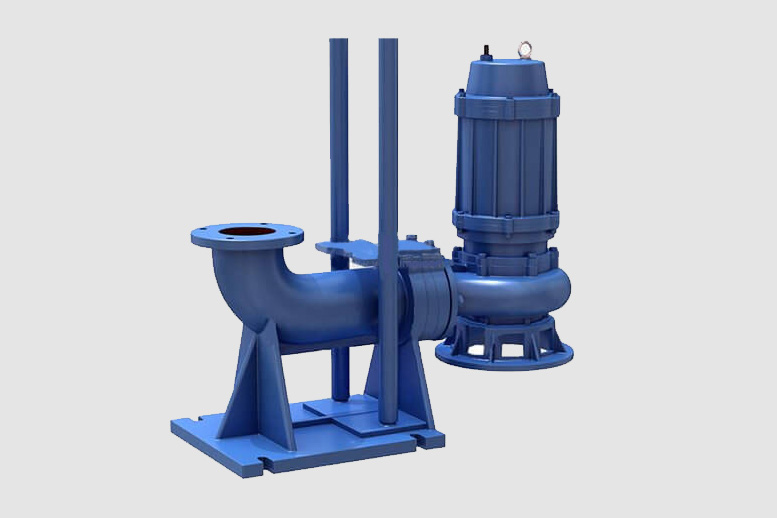
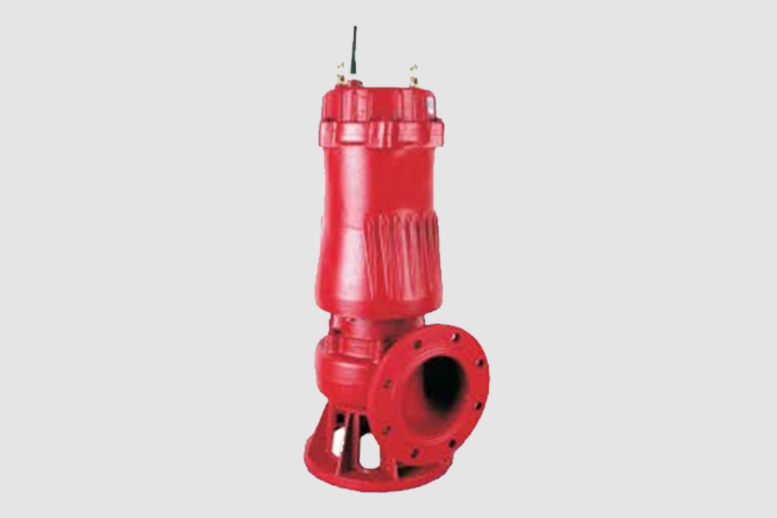
QX: compare the working point and keep the intake above buried sediment
The QX engineering-drainage sheet describes a bottom-intake structure and double mechanical sealing. Its low-power QDX4-18-0.55G row lists 4 m³/h at 18 m head, 0.55 kW and 220 V; the QX70-15-4G row lists 70 m³/h at 15 m, 4 kW and 380 V. Those two examples differ substantially in duty and electricity supply. Do not select by “QX” alone.
The description focuses on construction wastewater containing small particles. Determine particle size, abrasive content and the depth of settled material instead of assuming the construction label approves heavy slurry. Agree the inlet clearance, minimum operating water level and how the pump will be lifted and inspected.
The original sheet includes performance curves. Changing discharge elevation or pipe resistance can change the delivered flow; general wording about head fluctuations is not a constant-flow guarantee. Supply the site’s expected head range and ask for the exact curve and motor-loading limits across it.
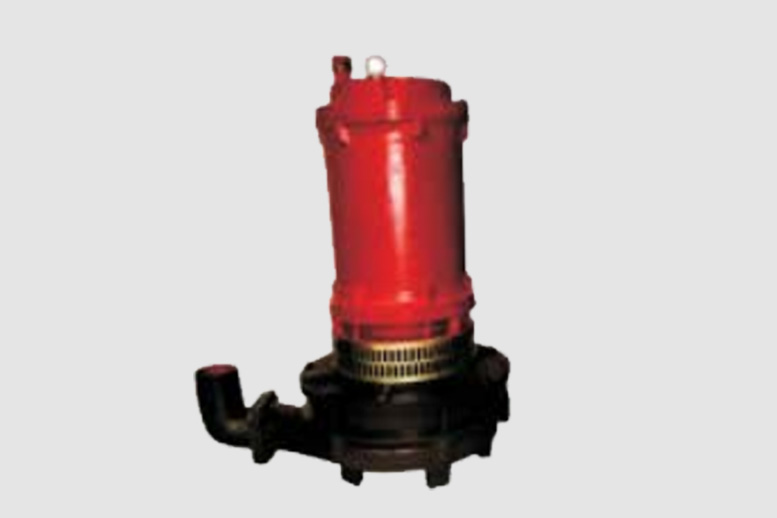
JYWQ(D) adds agitation; it does not remove the need to describe the sludge
The JYWQ(D) description adds a shaft-driven stirring device to a sewage pump so deposits can be suspended and pumped from the sump. That addresses settled material rather than simply increasing clear-water capacity. Specify what settles, how quickly it accumulates, the available depth and the distance from the agitator to the sump floor.
Its original sheet separates single-phase 220 V D variants from 380 V entries. The 50JYWQD10-8-1200-0.55 row lists 10 m³/h, 8 m head, 0.55 kW, 2,900 r/min and a 50 mm outlet. The trailing numbers and the D suffix must be retained when requesting dimensions and electrical details; the page does not provide a universal solids concentration or abrasive-wear life.
Agitating deposits changes the material entering the pump. Agree the allowable particles, fibres and concentration, any wear-part requirement and the cleaning interval. Where the job involves fibrous waste or grit, ask for the offered impeller and passage evidence instead of treating agitation as a cutting or unrestricted slurry capability.
Read a booster-set rating together with its pump count and controls
The variable-frequency water-supply page combines pumps, motors and speed control. Its table lists CJH36/16-2C at 16 m³/h and 36 m head, using two CDL8-4 pumps with 1.5 kW in the power column. CJH54/16-2C lists the same set flow at 54 m with two CDL8-6 pumps and 2.2 kW. Specify whether the offered pumps operate as duty/standby or in stages, and confirm whether the power figure is per motor.
Set flow, individual-pump flow and connected electrical load should not be interchanged. Request the pump curves, staging sequence, pressure-sensor position, low-demand behaviour and dry-run protection. Include the minimum inlet pressure, tank arrangement, available electrical supply and the outlet pressure required under peak demand.
The small automatic booster is a separate product direction. Its 2020 sample report names a 400 W cold-water automatic pump; that does not establish the rating of the larger multistage package. State clean-water quality, temperature and the intended use so materials and control functions are quoted for the correct product.
| Set | Set flow / head | Pump configuration | Listed power |
|---|---|---|---|
| CJH36/16-2C | 16 m³/h / 36 m | 2 × CDL8-4 | 1.5 kW |
| CJH54/16-2C | 16 m³/h / 54 m | 2 × CDL8-6 | 2.2 kW |
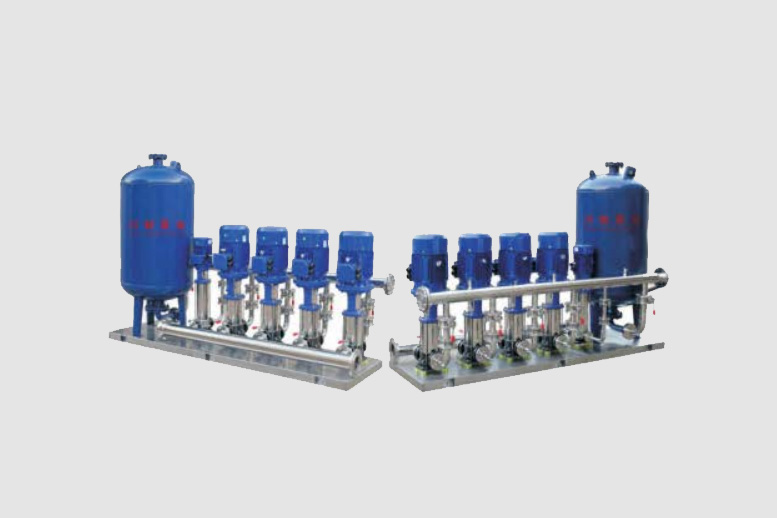
A non-negative-pressure set needs an upstream-pressure and outage plan
The separate non-negative-pressure page describes a stabilising vessel, pumps and electronic controls. Its CJW36/16-2C row lists 16 m³/h at 36 m with two CDL8-4 pumps and a stated 1.5 kW power column. Similar nominal flow/head to the CJH row does not make the upstream connection and vessel arrangements identical.
Before connecting a set to a public main, establish the local supply authority’s requirements, minimum available inlet pressure, backflow protection and permitted suction conditions. Ask for the inlet pressure-control logic, pump shutdown conditions and the actual vessel drawing. The catalogue’s package sizes are reference data, not proof of a site-approved connection.
The page’s broad statement about supply during a power cut cannot be read as motor-driven boosting without electricity. Agree whether unboosted mains bypass flow is available and at what pressure, or whether storage and standby power are required. Put the outage requirement into the order rather than infer it from a marketing phrase.
Specify sump controls, cable handling and a maintainable installation
The company’s published sewage-pump maintenance note highlights rotation, abnormal supply voltage, cable damage, frequent starts, overload and seals. Turn these into a commissioning scope: verify the nameplate supply and rotation, measure running current at the accepted duty and confirm the proposed control panel’s overload and level protections.
Provide a lifting chain or the manufacturer’s specified lifting point; do not use the electrical cable to support the pump. Keep the unit from becoming buried in sediment and agree its required immersion and cooling conditions. A float-controlled sump should have sufficient separation between start and stop levels, with the allowed starts per hour and alarm response defined for the selected motor.
For an existing station, provide photographs and dimensions of the wet well, discharge connection, guide rails and access opening. Agree how the pump will be removed, which seals and wear parts will be supplied and what inspection records and maintenance instructions accompany the unit. These details can decide whether a replacement is usable even when its rated flow and head match.
Separate the 2017 company record, older brand history and current order evidence
The business-licence copy displayed by the company names 成都川蛟泵业有限公司 and dates establishment to 15 December 2017. It places the registered address in Heshan, Pujiang County; the present contact page also places the operation in Heshan. The company’s account of more than thirty years of pump experience and a 1984 brand registration is a separate historical claim, not a reason to backdate this legal entity.
The introduction cites GB/T 25409-2010 and GB/T 24674-2009. The national standards platform lists the former as replaced by GB/T 25409-2025 on 1 May 2026, and the latter as withdrawn; GB/T 24674-2021 is listed as current. Ask which edition and test acceptance criteria apply to the offered pump. A reference to an old standard is not evidence that a new order was tested to a current edition.
The displayed September 2020 reports concern named samples, including 100WQ80-22-7.5, a 400 W automatic booster and a specified frequency-controlled supply set. Use the exact sample, test scope and date when requesting current evidence. General award plaques or historical references to explosion-proof and mining documents do not approve every present pump for hazardous-area service.
Send one brief for the actual sump or pressure-supply job
Choose a wastewater pump or a water-supply package, then attach the installation information below. KanBeng’s enquiry form carries this factory’s name into the request; it does not replace the agreed curve, component list or commissioning documents.
Wastewater and drainage
- Liquid, sediment, fibres, particle size and concentration; required flow/head and expected head range.
- Lowest/highest sump levels, intake clearance, pit drawing, pipe losses and flange/guide-rail dimensions.
- WQ, QX or agitator build; full suffix, voltage/phase/frequency, cable length and lifting method.
Building water pressure
- Peak and low demand, incoming pressure range and required pressure at the critical outlet.
- Pump count and duty/standby or staged operation; vessel, sensors, panel, manifold and valve scope.
- Mains-connection requirements, backflow protection, low-inlet response and power-cut/storage plan.
Acceptance and support
- Exact curve, motor rating/current, permitted operating range, materials and agreed standard edition.
- Offered-model test record, installation/commissioning instructions and a component list with spare parts.
- Quantity, destination, delivery scope, maintenance access and warranty/support arrangements.
Submit through KanBeng’s enquiry form with this factory named in your request.