
Segmented multistage pumps · liquid-specific variants · boiler feed · self-balancing rotors · matched spare parts
Changsha Huaneng Pump Co., Ltd.
Changsha Huaneng Pump Co., Ltd. (长沙华能泵业有限公司) concentrates on horizontal, single-suction segmented multistage centrifugal pumps and their parts. Its published location is Gejia, Liuyang, within Changsha, Hunan. The useful choice is between a clear-water D build, corrosion-resistant DF, oil-service DY, wear-resistant MD, boiler-feed DG and a self-balancing P configuration. Similar external shapes and shared model numbers do not settle liquid compatibility, axial-balancing arrangements or the spare parts needed to maintain a particular assembly.
- Chinese company name
- 长沙华能泵业有限公司
- Published location
- Gejia, Liuyang, Changsha, Hunan
- Company-stated establishment
- May 2009
- Main purchasing distinction
- Liquid variant, stage count and rotor/balancing arrangement
Start with the liquid: D, DF, DY, MD and DG are different builds
The product descriptions distinguish the following liquid duties. These are published family conditions, not approval of every seal and material combination. State composition, concentration, density, temperature and suspended material before requesting a curve. A clear-water pump should not be upgraded to corrosive or abrasive duty merely by changing its name in a quotation.
| Variant | Published liquid duty | What the quotation must settle |
|---|---|---|
| D — clear water | No solid particles; liquid below 80°C | Water properties, inlet arrangement, stage count and seal |
| DF — corrosion-resistant | No solid particles; −20 to 105°C; inlet pressure below 0.6 MPa | Actual alloy and seal compatibility with chemical and concentration |
| DY — oil service | No solid particles; −20 to 105°C; viscosity below 120 cSt | Viscosity at operating temperature, seal and motor/site requirements |
| MD — wear-resistant | Neutral mine water; published particles ≤0.5 mm and content ≤1.5% | Particle-content basis, abrasiveness and replaceable wear parts |
| DG — boiler feed / hot water | Water-like liquid without abrasive solids; below 105°C | Feedwater temperature, inlet pressure, suction margin and boiler demand |
D85-45×8: increasing flow changes both head and shaft power
The D85-45×8 detail page includes the original table below. At eight stages and 2,950 r/min, the listed head falls from 408 to 312 m as flow rises from 55 to 100 m³/h. The 360 m point belongs to 85 m³/h; it is not a constant head across the whole flow range.
Shaft power and selected motor rating are separate columns. At 85 m³/h the table gives 115.6 kW shaft power with a 132 kW motor. Electrical input will also depend on the selected motor and drive. Compare running cost at the real duty rather than treating the nameplate motor rating as measured consumption.
This is one D configuration, not the full D family. Ask for the current curve, permitted operating range, impeller diameter and installation drawing for the exact offer. The existing D-series page below provides a starting point for a water-service enquiry.
| Flow | Head | Shaft power | Published NPSHr |
|---|---|---|---|
| 55 m³/h | 408 m | 97 kW | 3.2 m |
| 85 m³/h | 360 m | 115.6 kW | 4.2 m |
| 100 m³/h | 312 m | 121.4 kW | 5.2 m |
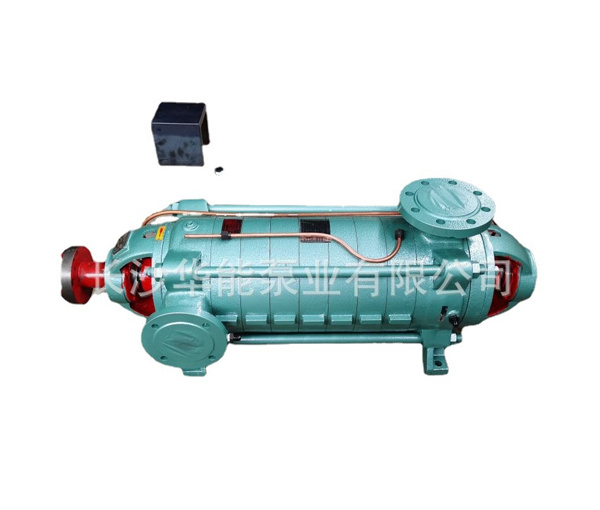
View the reviewed product family →
40DG40×10: a model code is not a 40 m³/h flow promise
Huaneng uses more than one naming convention. Its 100D16×3 example uses an inlet-diameter prefix, head per stage and stage count; the D46-30×4 convention instead starts with design-point flow. Read the code key and its corresponding table together.
The 40DG40×10 page carries a 40D/DF/MD/DY/DG40 table. Its ten-stage row gives 10 m³/h at 400 m head, with 23.7 kW shaft power and a 30 kW motor at 2,950 r/min. The adjacent points are 6 m³/h at 410 m and 12 m³/h at 385 m. Those are the useful published comparisons; the first “40” must not be assumed to mean 40 m³/h.
For boiler feed, specify the temperature at the pump inlet, tank pressure and lowest operating level, feedwater condition and required flow against system pressure. Obtain suction calculations and material/seal details for those conditions. A generic family table does not establish a safe suction lift for hot water.
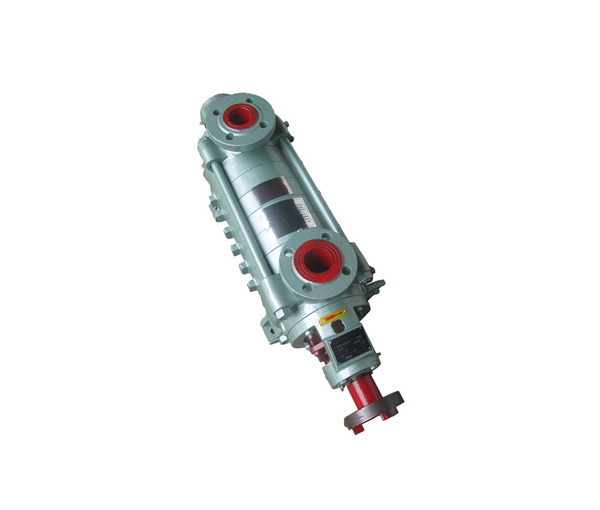
DF, DY and MD: hydraulic similarity does not settle material selection
The DF46-50×4 listing describes a stainless-steel, mechanical-seal arrangement. Its original four-stage table has a 46 m³/h point at 200 m head, 39.77 kW shaft power and a 45 kW selected motor at 2,950 r/min. The same row also lists 30 m³/h at 222 m and 55 m³/h at 184 m. These are alternatives along a water-based table, not simultaneous maximum values.
“Stainless steel” does not specify an alloy suitable for every chemical. Request the wetted-part bill of materials, elastomer and mechanical-seal face pairing against the named liquid and concentration. Include the inlet pressure because the DF text gives a separate limit below 0.6 MPa.
For oil-service DY, state viscosity at the actual pumping temperature, density and the installation’s electrical requirements. For MD, identify particle size, concentration measurement basis and abrasive character. The published 1.5% content figure does not state a mass/volume basis; clarify it instead of treating MD as an unrestricted slurry pump.
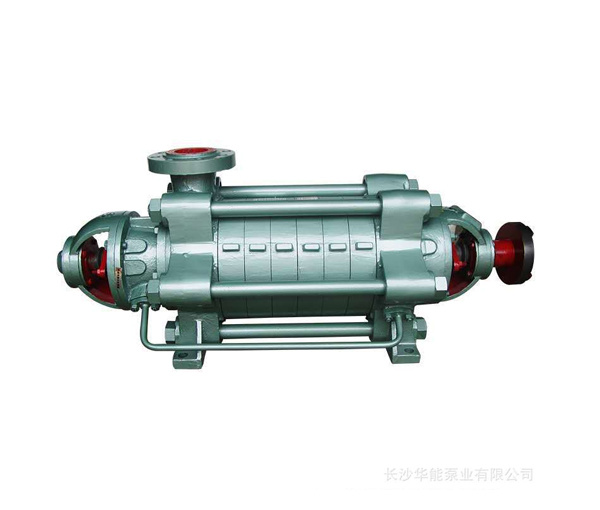
Specify the rotor arrangement before ordering a self-balancing replacement
The P-series description uses opposed, symmetrically arranged impellers to balance axial force and removes the conventional balance-disc system and balance return pipe. Its model key identifies P as the self-balancing configuration. This changes the maintenance parts and assembly, not just the suffix on a standard D purchase order.
The original D155-67(P) table illustrates the effect of stage count. At 155 m³/h and 2,950 r/min, three stages list 201 m head, 124.4 kW shaft power and a 132 kW motor; four stages list 268 m, 149.9 kW and a 185 kW motor. Obtain the exact stage configuration and accepted curve instead of quoting the complete family’s maximum head and flow together.
The source allows oil- or grease-lubricated bearing arrangements according to service. Agree the bearing housing, lubricant, maintenance access and seal configuration. For a retrofit, supply the old general-arrangement drawing, nozzle orientation, foundation dimensions, coupling and motor details. Do not assume a new P rotor fits a conventional D casing or existing spare-parts stock.
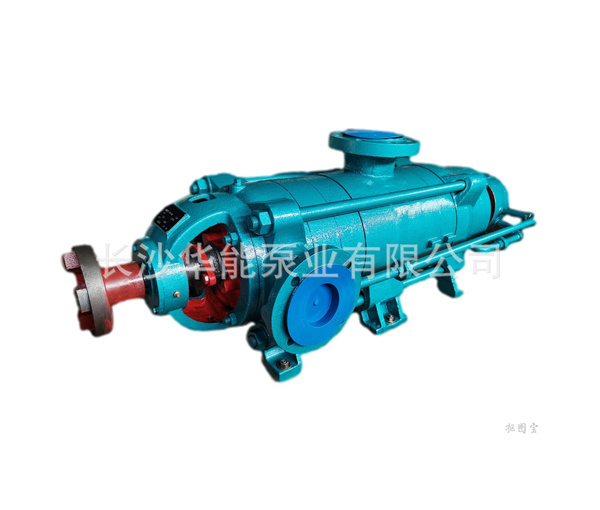
Separate suction calculations from the JNK/JNRK circulation choice
Huaneng’s installation note distinguishes geometric suction lift from a test-based suction vacuum figure, and calls for pipe-loss, elevation and water-temperature corrections. Provide the lowest liquid level, inlet pressure, suction pipe size/length/fittings and temperature. Ask the supplier to compare available suction margin with the selected curve’s requirement. The 4.2 m NPSHr above is not permission to place a D pump 4.2 m above the water.
For air-conditioning or heating circulation, the separate JNK/JNRK page identifies single-stage pumps: JNK up to 80°C and JNRK up to 105°C. Its JN(R)K150-320 A example uses 150 mm inlet size, nominal 320 mm impeller diameter and an A trimming suffix; those dimensions do not specify flow or head.
The page describes back-pull-out servicing with the casing and connected pipes retained while the coupling is disconnected and the motor moved. Leave the required withdrawal space in the layout. For a closed heating loop, specify circulation resistance, inlet static pressure, temperature and the selected impeller trim rather than order a multistage boiler-feed pump on temperature alone.
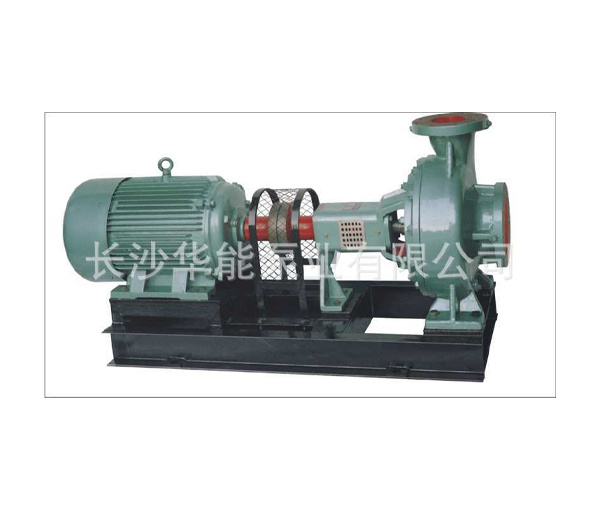
A spare impeller or balance disc needs dimensions, not only a D-series name
The parts page lists shafts, impellers, balance discs, rings and mechanical-seal parts, with material choices including iron, alloy iron, copper alloys and stainless steel. The production page shows machining equipment and lists machining, turning, milling, welding, surface treatment and assembly. These publications support a parts-and-assembly discussion; they do not prove the current stock or delivery time of a particular component.
For a replacement, send the complete pump code and serial/nameplate photographs, stage count, rotation, sectional drawing and the worn part’s dimensions. Identify shaft fits, impeller bore/key, wear-ring clearance, balance-component pairing and seal dimensions. Confirm the final material grade and inspection record. A similar-looking spare can change clearance, rotor balance or seal alignment.
A conventional balance-disc spare and a self-balancing P rotor belong to different arrangements. Agree whether the supply is a bare component, assembled rotor, pump without motor or complete aligned set. Include assembly checks, hydraulic test points and the parts required for the intended maintenance interval in the order scope.
Contract with the Liuyang entity and keep dated records in context
The company introduction dates establishment to May 2009, and the contact page locates the operation in Gejia, Liuyang. Hunan’s original 2025 third-batch technology-based SME register lists the exact Chinese company name at entry 363. That dated administrative record corroborates the enterprise name; it is not a product-performance certificate or a witnessed factory test.
Ask which entity will supply, assemble, test and invoice the offered package, and confirm the destination’s spare-parts and warranty route. For any required certificate, request the current holder, scope and validity document. General website quality statements and older staff or production-value figures are not used here as current capacity guarantees.
Send a brief that distinguishes the pump build from the complete package
Liquid and operating duty
- D, DF, DY, MD, DG or P arrangement; liquid name, concentration, density and temperature.
- Oil viscosity at temperature, or mine-water particle size, concentration basis and abrasion.
- Required flow/head points, operating schedule, inlet pressure/lowest level and suction pipe losses.
Assembly and replacement interfaces
- Full model, stage count, speed, impeller trim, nozzle orientation and selected wetted materials/seal.
- Bare pump, rotor, individual spare or complete motor/base/coupling package; voltage and frequency.
- Old nameplate/drawings and measured part dimensions for a retrofit; access for rotor or back-pull-out removal.
Acceptance and support
- Offered curve and operating range, shaft versus motor power, suction-margin calculation and agreed test points.
- Material/part inspection records, assembly/alignment scope and any required current certificate.
- Quantity, destination, delivery scope, recommended spares and warranty/maintenance arrangements through the platform enquiry.
Submit through KanBeng’s enquiry form with this factory named in your request.