
Split-case water duty · condensate suction · multistage interfaces · system energy assessment
Changsha Teyi Pump Co., Ltd.
Changsha Teyi lists industrial water pumps and system-improvement services. Separate pump replacement from circuit assessment, then compare suction conditions, series suffixes, thermal construction and installation fit.
- Chinese company name
- 长沙特一制泵有限公司
- Published locality
- Changsha, Hunan
- Equipment directions
- S · N/NB · D family · SR · IS
- Project direction
- Pump-system energy improvement
Separate a replacement pump from a system-improvement project
Changsha Teyi Pump Co., Ltd. presents its Chinese company name as 长沙特一制泵有限公司 and uses the 特一制泵 brand. Its stated location is Changsha, Hunan. The company describes two business directions: pump products and pump-system energy improvement. Its product pages cover split-case S variants, condensate pumps, D-family multistage pumps, hot-water equipment and IS single-stage pumps.
A like-for-like replacement starts with the existing nameplate, flange arrangement and operating curve. A system-improvement project starts with measured demand and the behaviour of the whole circuit. Decide which task you are buying before comparing proposals: an efficient pump at the wrong duty can leave the original operating problem unresolved.
| Task | Documented direction | Decisive input |
|---|---|---|
| Water transfer or cooling circulation | S split-case; IS single-stage | Duty range, suction conditions, piping and maintenance space |
| Recovering condenser condensate | N / NB product direction | Absolute suction pressure, liquid temperature and inlet losses |
| Pressure rise through several stages | D / DM / DG / DF / DY | Exact suffix, liquid, temperature and port orientation |
| Hot-water circulation | SR and other hot-water listings | Actual offered construction, pressure, sealing and cooling |
| Reducing energy use | System assessment and retrofit direction | Measured demand, power, control and operating schedule |
S, SM, SF, SY and SL change more than the name
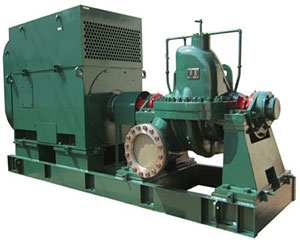
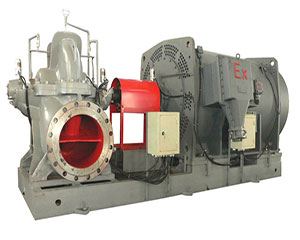
The S page identifies a single-stage, double-suction, split-case pump. In its example 500S35A, 500 is the suction diameter in millimetres, 35 the design-point head in metres and A the first impeller trim. This code example does not provide flow, speed or motor power for an order.
The same page distinguishes SM as the wear-resistant direction, SF for corrosion resistance, SY for oil and SL for vertical installation. It lists cast iron for S, ductile iron/cast steel/stainless steel options for SY and SM, and NiCr cast iron or stainless steel for SF. A suffix does not select the exact alloy, permissible solids or seal arrangement: specify these against your liquid.
The standard published temperature limit is 80°C. A separate high-temperature discussion describes centre support, a thicker casing, seal cooling and oil-lubricated bearings for service up to 200°C. Do not apply that temperature to an ordinary S pump or to the photograph. Obtain a configuration-specific pressure/temperature and auxiliary-services schedule.
The horizontal split arrangement keeps the suction and discharge piping connected during casing access. The source describes grease-lubricated bearings on the normal construction, packing with a water-seal arrangement and an optional mechanical seal. Confirm the supplied rotation, maintenance lifting space, lubrication and seal-water requirements, particularly when replacing a pump in an existing station.
N-series selection begins at the condenser, not the motor
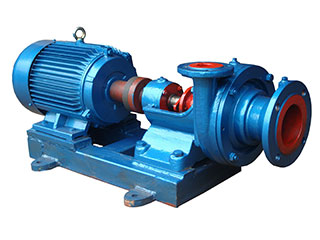
The condensate product detail describes horizontal single-stage and two-stage overhung centrifugal pumps for condenser condensate or liquids with similar properties. Its construction list distinguishes single-stage N models from 3N6×2 and 4N6×2 two-stage units. Several named models, including 100N160 and 150N130, are described with an inducer. Establish the full offered model and curve rather than treating the N/NB listing label as a universal construction.
For example, 4N6×2A uses 4 for the inlet diameter divided by 25, N for the horizontal overhung condensate direction, 6 for single-stage head divided by 10, ×2 for two impellers and A for an impeller cut. The code is not a substitute for the actual paired flow/head curve.
Give absolute pressure at the condenser, water temperature, the lowest liquid level relative to the pump, inlet pipe and valve losses, and the required operating range. Ask for the offered NPSHr curve and a review of available suction margin at startup and minimum level. The documented options include packing or mechanical sealing and replaceable shaft sleeves; specify seal and cooling connections in the order.
The source distinguishes rotation for 200N32 from other listed models. State the direction viewed from the motor end and include a drawing when replacing the drive or pump. Temperature, suction-pressure and cooling requirements need confirmation on the exact model sheet; the family prose alone does not define them for every N/NB variant.
Match the multistage suffix to liquid and pipe orientation
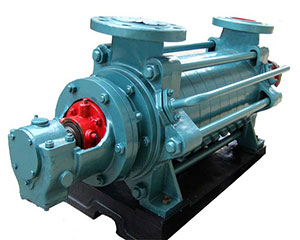
Teyi’s D-family detail separates five applications. D is for clean water without solids; DM allows a small amount of solids in a water-like liquid. DG is the clean-water elevated-temperature direction, DF the corrosive-liquid direction and DY the petroleum-product direction. The table below preserves the temperatures and port arrangement stated in that particular source.
These are family descriptions, not offered duty points. Obtain the complete flow/head curve, stage count, speed, selected motor and suction limits. For DM, quantify particles and wear; “a small amount” is not an allowable particle diameter or concentration. For DF or DY, identify the exact wet-end material, seal faces and auxiliaries against the chemical or oil properties.
Compare pipe orientation before pricing a replacement. D/DM are described with a horizontal inlet and upward outlet; DG/DF/DY with both ports upward. Attach the old foundation and flange drawings, coupling and dismantling access. Do not assume that matching the nominal flow or the letter D makes the new assembly fit.
| Variant | Liquid direction | Source temperature | Port arrangement |
|---|---|---|---|
| D | Clean water, no solids | 0 to +80°C | Horizontal inlet; upward outlet |
| DM | Water-like; limited solids | 0 to +80°C | Horizontal inlet; upward outlet |
| DG | Clean water, no solids | −20 to +150°C | Inlet and outlet upward |
| DF | Corrosive liquid, no solids | −20 to +150°C | Inlet and outlet upward |
| DY | Petroleum product, no solids | −20 to +400°C | Inlet and outlet upward |
Request the thermal assembly, not only a hot-water label
The SR technical detail describes single-stage/single-suction and two-stage/single-suction overhung arrangements, floating-ring sealing and oil-lubricated bearings. Its title mentions service within 200°C. For a heating-water circuit, request the actual selected model’s temperature/pressure schedule, seal and bearing-cooling connections, startup conditions and required maintenance access.
The separate R page discusses IRG equipment and a different externally cooled arrangement. That text is not a reliable dimensional or temperature specification for the photographed R pump. Keep SR, R and IRG construction drawings separate when reviewing a quotation.
The IS detail is clearer: a horizontal single-stage, single-suction pump for clean or water-like liquid without solids, with a back-opening arrangement that allows casing access while the suction and discharge pipes remain connected. Confirm the coupling and rotor-withdrawal clearance on the offered assembly. A stated ISO 2858 design reference is not a product certificate or proof that every spare from another maker is interchangeable.
Measure the circuit before promising a saving
For Teyi’s system-improvement direction, prepare a baseline that records simultaneous flow, inlet/outlet pressure, electrical input, running hours, valve positions and the number of pumps operating. Include required pressure at the most demanding user, minimum and peak demand, bypass flows and any cooling or production constraints. Agree what useful service must remain constant during the comparison.
Review pump, motor, piping, throttling, parallel-pump operation and control together. Ask whether the proposal changes the impeller, replaces the pump, changes speed or adjusts the distribution circuit, and request a before/after test method under comparable conditions. A component efficiency claim alone does not quantify your annual electricity saving.
ASME’s published assessment scope treats the entire pumping system from energy input to useful work; DOE’s current MEASUR tools include pumping assessments. These are methods for evaluating an installation, not evidence that Teyi has achieved a particular saving. For the order, define measurement locations, instruments, operating cases, acceptance and annual-cost assumptions rather than adopting a marketing percentage.
Make replacement fit and test evidence part of the purchase
For an installed S or D pump, submit the full nameplate, impeller trim, original operating curve, foundation and flange dimensions, rotation and coupling arrangement. If buying an impeller, shaft, sleeve, bearing or seal assembly, attach the old drawing or measured interfaces and identify wear, corrosion or leakage. Brand or family names alone do not establish parts interchangeability.
Request a configuration-specific curve and agreed performance test points, material identification for the wetted parts, the assembly drawing and the operation/maintenance instructions. Distinguish the pump-only price from motor, baseplate, coupling guard, seal/cooling services, controls, installation and commissioning. Identify who provides each connection and how the replacement can be maintained in the existing station.
Send a brief that separates equipment, suction and retrofit needs
Submit the requirement through KanBeng with Changsha Teyi identified. Use the relevant group below and attach the drawings or measured operating data so the enquiry describes a real project rather than a broad pump keyword.
S / IS replacement and spares
- Full model and trim, paired flow/head and speed, liquid and temperature, inlet pressure and power supply.
- Foundation/flange drawings, rotation, coupling and lifting/withdrawal access; photographs of the old nameplate and affected parts.
- Selected material and sealing, motor/baseplate/guards, test records, spares, quantity and destination.
Condensate, multistage or hot-water service
- Exact N/NB, D-family or SR/R construction; normal/startup liquid temperature and pressure, chemistry and solids.
- Condenser absolute pressure and lowest liquid level for condensate; complete suction-loss information and required curve.
- Port drawing, stage count, seal/bearing cooling and lubrication, piping connections and acceptance conditions.
System energy improvement
- Measured flow, pressures and input power together; hours, demand cases, valve positions and parallel-pump schedule.
- Required service at the end user, bypass and distribution constraints; scope of proposed pump/drive/piping/control changes.
- Before/after measurement and acceptance method, included installation/commissioning, outage window and project destination.
Submit through KanBeng’s enquiry form with this factory named in your request.