
Boiler feed · corrosive multistage duty · hydrolysis feed · molten-salt systems
Guilin Lixin Water Pump Co., Ltd.
Guilin Lixin Water Pump Co., Ltd. documents multistage boiler-feed and corrosion-resistant pumps alongside high-temperature process equipment. Its Chinese identity is 桂林市漓心水泵有限公司, and its illustrated catalogues use the GLPUMP brand. The useful purchasing distinctions are liquid chemistry, temperature, stage duty, cooling services and the actual supplied seal arrangement.
- Chinese company name
- 桂林市漓心水泵有限公司
- Published locality
- Guilin, Guangxi
- Multistage directions
- DG · DF / DGF · DFR
- Hot-process direction
- FYG molten-salt pumps
Choose the liquid route before the number of stages
Guilin Lixin’s company account describes pump manufacture, casting, machining, assembly and performance testing, together with continuation of product and spare-part work associated with the former Guilin pump business. A legacy pump order still needs its original drawing and nameplate; that account does not establish that every historical design is unchanged or every old part is interchangeable.
The catalogue offers several routes for raising pressure. DG is a boiler-feed/hot-water direction; DF and DGF address corrosive liquid without solid particles; DFR is a hydrolysis-tower feed direction with a dedicated mechanical-seal cooling description. Their temperature statements belong to separate constructions. Do not apply the hottest family limit to all of the company’s pumps.
The public GLPUMP catalogues identify 桂林市漓心水泵有限公司. Keep this exact Chinese name on the quotation and material/test documents, alongside the English name. The pictured products and stated limits below come from those documents; material options, test-station claims and quality-management wording still need order-specific supporting records.
| Direction | Published fluid/temperature condition | Purchase implication |
|---|---|---|
| DG | Boiler feed or similar hot water, generally ≤110°C | Declare hotter service and obtain the offered configuration |
| DF / DGF | Corrosive liquid without solids; DF ≤80°C, DGF ≤150°C | Chemistry, material and cooling requirements differ |
| DFR | Water or similar medium, ≤170°C | Mechanical seals and cooling loops form part of the package |
| FYG | Molten-salt catalogue direction | Agree salt composition and temperature; no universal rating assumed |
DG25-50×6: read the three operating points together
The DG family introduction gives 6.3–185 m³/h and 50–698 m head. Its DG25-50 performance sheet is more useful for a specific comparison: the six-stage row contains the three duty points below, all at 2,950 r/min with a 198 mm impeller. The paired flow, head and power entries should stay together when comparing quotations.
At the 25 m³/h entry, the six-stage row lists 300 m head, 48% efficiency, 42.5 kW shaft power and a 55 kW motor. At 30 m³/h, head falls to 285 m while shaft power rises to 46.6 kW. The shaft-power column and selected motor-power column describe different quantities; neither should be replaced with an invented single “power” rating.
The sheet gives NPSHr as 2.8 / 3.2 / 3.4 m across these points. These are pump requirements, not permission to install at an equivalent suction lift. Provide feed-tank pressure, temperature, elevation and suction-line losses so the offered duty can be checked with an appropriate margin. The top graph is marked as a single-stage curve, while the table identifies complete stage configurations.
| Flow | Head | Efficiency | Shaft power | NPSHr |
|---|---|---|---|---|
| 15 m³/h | 318 m | 37% | 35.1 kW | 2.8 m |
| 25 m³/h | 300 m | 48% | 42.5 kW | 3.2 m |
| 30 m³/h | 285 m | 50% | 46.6 kW | 3.4 m |
View the reviewed product family →
DG cooling and lubrication are part of the purchase
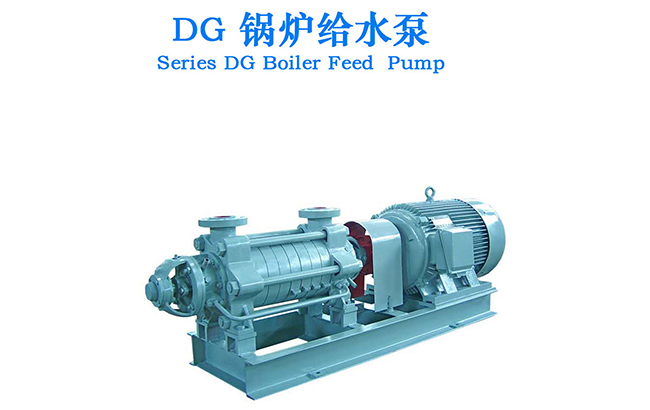
The DG construction description gives a horizontal segmented casing with rolling bearings at both ends and top-entry/top-discharge ports. It provides cooling jackets at the front and rear stuffing boxes and bearing housings, with cooling water required during operation. Specify the site’s cooling-water temperature, pressure, quality and availability when requesting the package.
Packing is the general stated shaft-seal arrangement; mechanical seals are to be specified separately. Most listed DG directions use grease lubrication, while DG85-67 and DG155-67 use oil lubrication. A spare-parts or replacement order must keep the actual seal and bearing arrangement, not just the DG prefix.
For balance-disc constructions, the assembly table specifies rotor axial movement by model group: DG6-25, DG12-25, DG25-50, DG46-30, DG46-50 and 40DG-40 list 2 mm; DG85-45 and DG25-30 list 3 mm; DG85-67 and DG155-67 list 4 mm. Obtain the selected model’s assembly and coupling instructions. These values describe rotor movement and are not a universal coupling-gap setting.
DF and DGF differ in temperature and suction-port layout
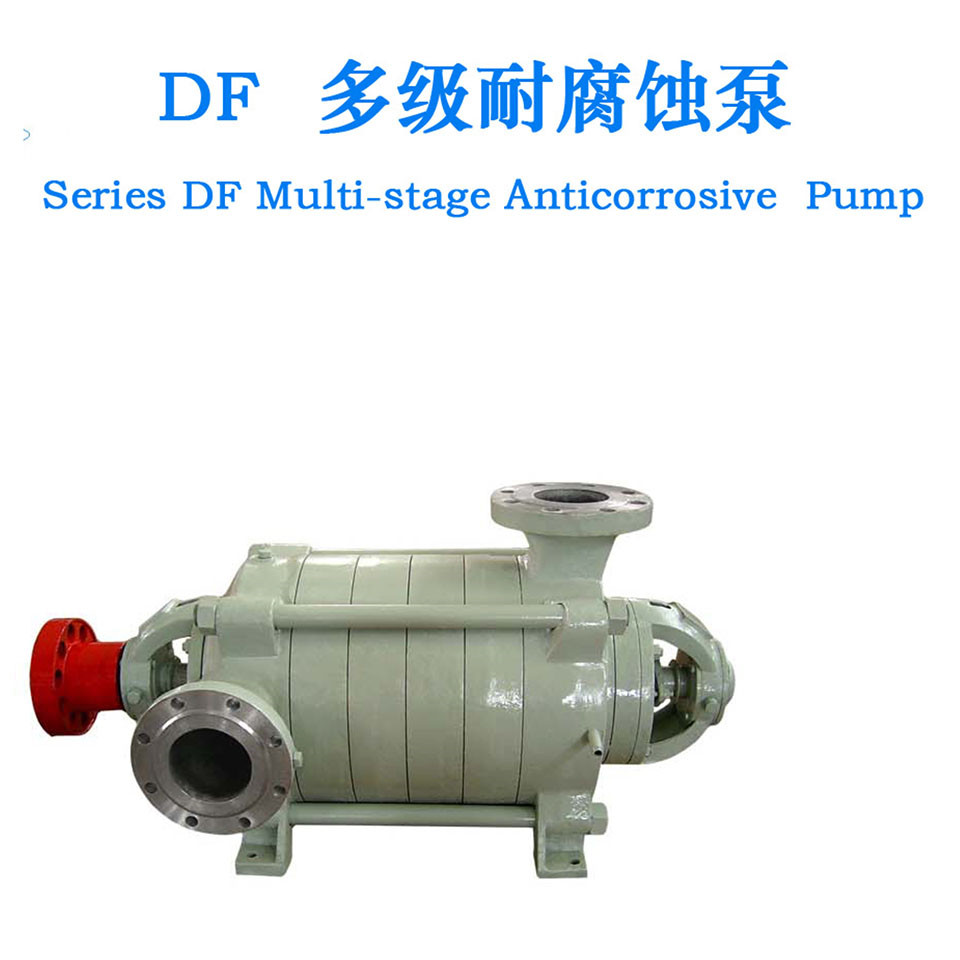
The DF/DGF introduction lists a family envelope of 6.3–500 m³/h and 50–650 m head for corrosive liquid without solid particles. It limits DF to 80°C and DGF to 150°C. Specify the full liquid composition and concentration, including contaminants and operating/startup temperature, so the selected material schedule is relevant to the actual corrosion duty.
The construction pages show vertical top discharge for both directions, but DF uses a horizontal side inlet and DGF a vertical top inlet. The DGF front and rear stuffing boxes have cooling jackets requiring cooling water. These details can change both piping fit and the site utilities needed to operate a replacement.
The naming examples are easy to misread: in 50DF-8×4, 50 means inlet diameter in millimetres, 8 single-stage head and 4 stages. In DF25-50×5, 25 instead means flow in m³/h, followed by single-stage head and stage count. Keep the entire code and drawing rather than assume the first number always means flow.
The document allows packing or mechanical seals and identifies oil-lubricated exceptions including DF85-67, DGF85-67, DF155-67 and DGF155-67. Obtain the exact wetted-parts and seal-material list, lubrication schedule and cooling diagram with the offered pump. A generic “stainless steel” description does not establish the complete corrosion-resistant construction.
View the reviewed product family →
DFR hydrolysis feed includes two described Plan 23 loops
The DFR application note describes a single-suction horizontal segmented multistage pump for urea-project hydrolysis feed and similar service. Its stated working medium is water or a liquid with similar physical and chemical properties, at no more than 170°C. It gives 316L for wetted components including the casing and impeller; this description is not approval for every urea-process liquid or concentration.
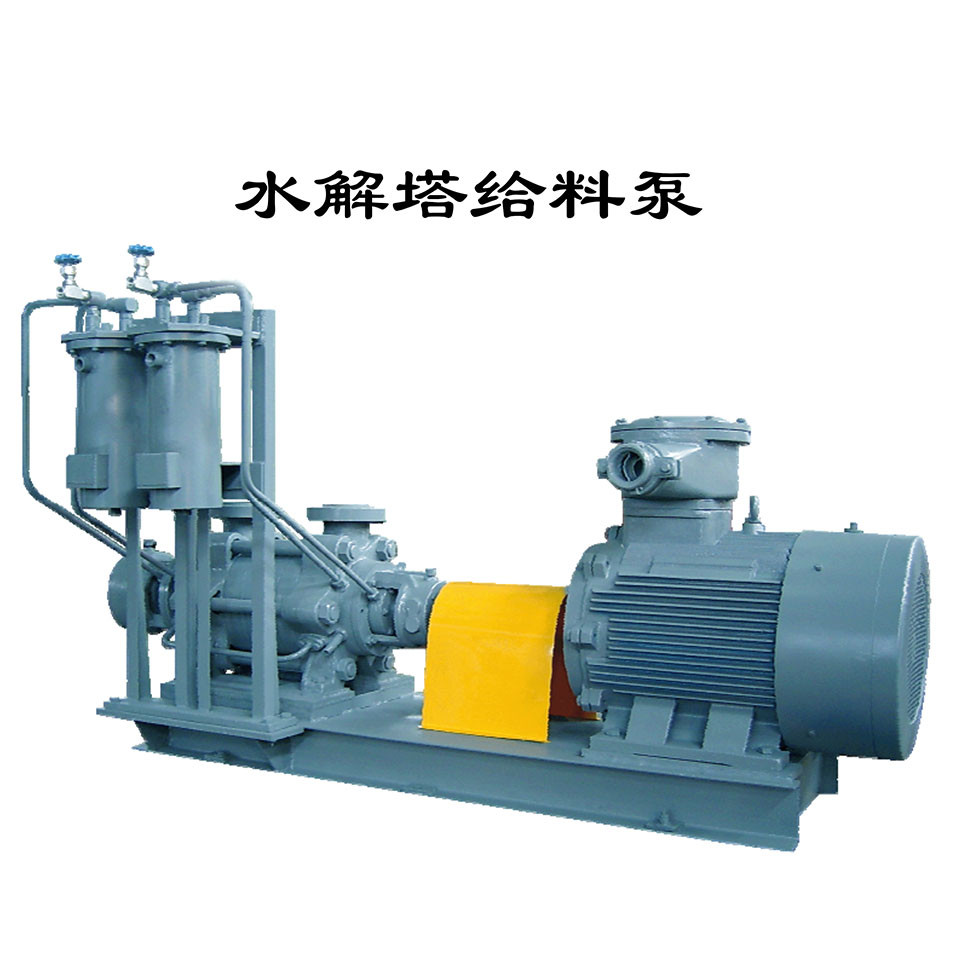
The note specifies mechanical seals and two Plan 23 recirculation arrangements, with a circulation device sending hot seal-chamber liquid through a cooler and back. It also provides cooling jackets at the seal chambers and bearing housings. The supplier’s stated objective of keeping the seals below 50°C depends on the actual cooling design and site conditions, so request a heat-duty calculation and operating requirements.
Plan 23 is a cooled recirculation loop serving the seal chamber, rather than a direct claim that the entire process liquid is cooled. Agree the cooler, piping, venting, instrumentation, cooling-water supply and included scope. The note’s reference to an API plan does not establish certification of the complete pump to an API standard.
The illustrated DFR operating instructions identify fluctuating hydrolysis-feed flow as a potential cause of the pump running dry and damaging the mechanical seals. They call for an inlet buffer tank and show examples of 3–4 m³ for 10–15 m³/h feed, 5 m³ for 25 m³/h and 6 m³ for 45 m³/h. Treat these as the document’s examples: establish actual process fluctuations, usable tank volume, level control and dry-running protection for the project. The cooler instruction also lists approximately 3 m³/h cooling water at 0.2 MPa and requires venting before startup; confirm these services for the offered cooler.
For the offered DFR, obtain the flow/head curve, pressure rating, seal data sheet and detailed material schedule in addition to the temperature statement. A purchase should define who supplies and commissions both seal loops and the jacket-cooling connections, and how the pump is protected if cooling is lost.
FYG molten-salt duty needs a thermal and material brief
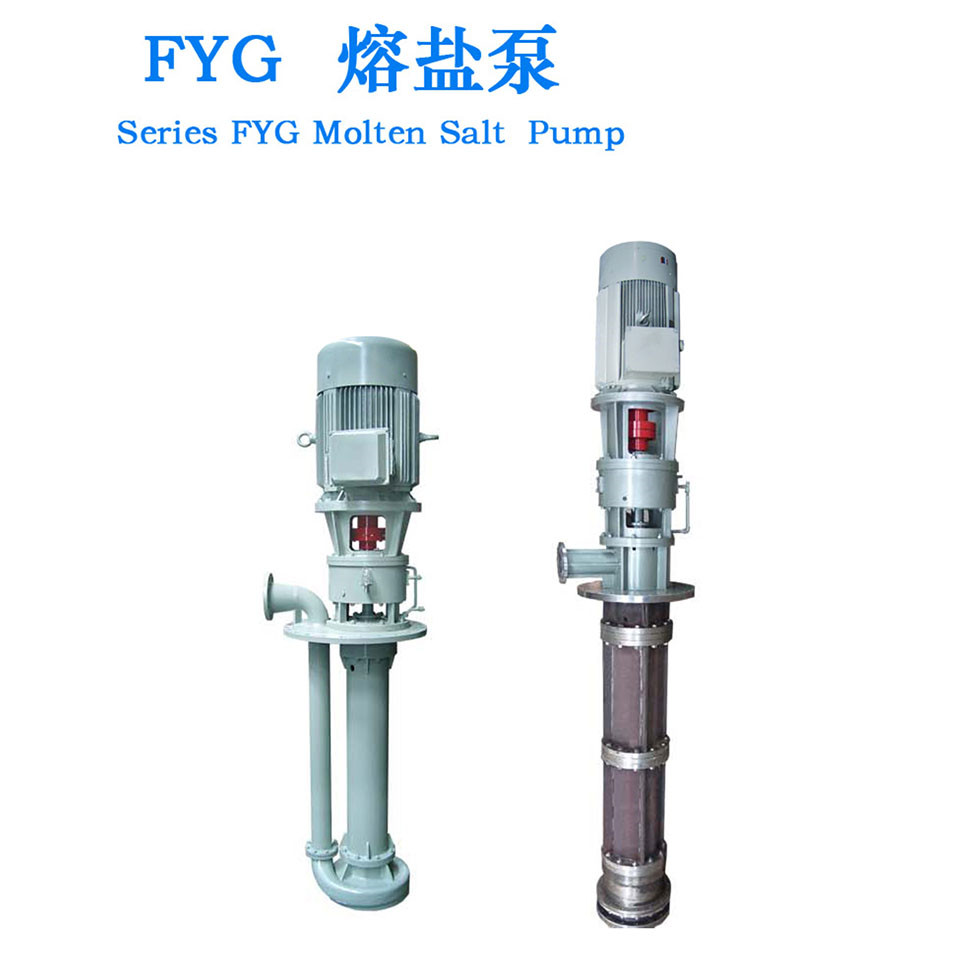
The FYG product image shows vertical molten-salt pump arrangements with different lower assemblies. The company’s process-equipment account places molten-salt circulation among chemical-plant and heat-transfer applications. The accessible FYG cover does not provide a numerical temperature, flow or pressure rating; these need an offered-model sheet rather than a guessed limit.
Include salt composition, normal and startup temperatures, freezing/crystallisation behaviour, lowest vessel level, mounting depth and required duty. Ask for the material schedule, shaft/bearing arrangement, thermal expansion allowances and the specified startup/shutdown procedure. Confirm how the system keeps the pump and surrounding piping in an operable condition during interruptions.
The GH chemical-process image shows a horizontal pump, while the separate JH catalogue direction uses an auxiliary-impeller dynamic seal. They are not substitutes selected by a shared “chemical pump” label. For either route, provide the chemical conditions, suction pressure and solids, then obtain the exact seal arrangement—including how leakage is controlled when a dynamic-seal pump stops.
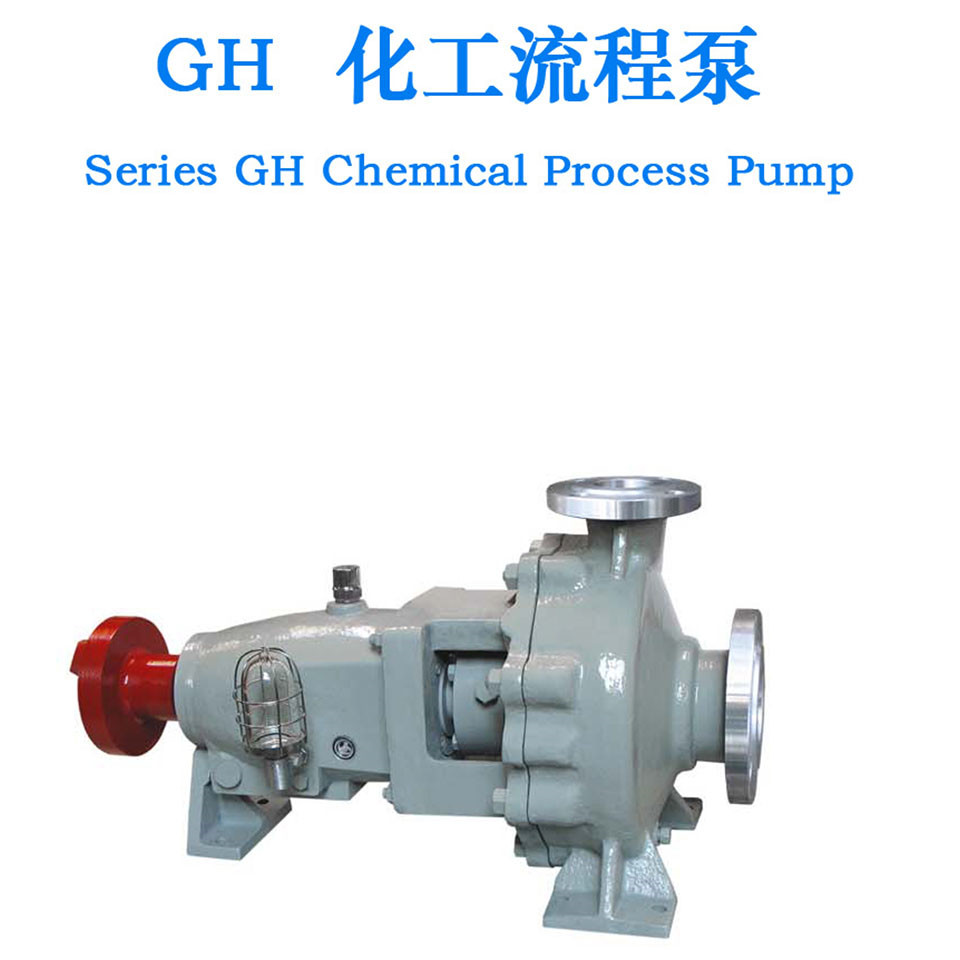
Legacy replacement work needs drawings, axial movement and utility checks
The D installation note requires independent support of inlet/outlet piping and alignment of motor and pump shafts. For its balance-disc construction, it asks for 3–5 mm remaining coupling clearance after the rotor has been pulled toward the motor end. Apply the offered model’s complete instruction rather than treat this as a universal gap measured in any rotor position.
The operating notes prohibit controlling flow by throttling the suction valve and warn against prolonged operation with the discharge closed or nearly closed. The DG instructions also call for gradual warming before starting on hot liquid. Obtain the permitted flow range, minimum-flow protection and the approved heating/start sequence for the supplied pump.
A bearing-lubrication schedule must identify the pump and lubricant: the D note lists grease changes every 2,000 operating hours, and D85-67/D155-67 oil changes after the first 100 hours and then every 1,500 hours. These documented intervals are not an automatic service schedule for every other family or operating condition.
For an older Guilin pump, attach the nameplate, sectional drawing and part numbers, with measured impeller, shaft, balance disc/drum, bearing and seal interfaces as relevant. Ask for a matched replacement drawing and material specification. Do not infer a current manufacturer’s founding date, present certification or exact production capacity from historic catalogue references.
Send the thermal, hydraulic and interface requirements together
Use KanBeng’s enquiry form with the correct factory identified and a brief for the actual service. When several pump families are required, separate their technical schedules so water temperature, corrosive chemistry and molten-salt behaviour do not become one ambiguous specification.
Boiler feed / multistage pressure
- Flow/head range, feed-tank pressure and temperature, suction arrangement, supply frequency and chosen stage count.
- Exact curve with shaft and motor power separated, NPSHr and margin review, casing/seal pressure rating.
- Cooling water, packing versus mechanical seal, bearing lubrication, minimum-flow protection and startup instructions.
Corrosive / hot process
- Liquid or salt composition, concentration, solids, temperature range and crystallisation conditions.
- DF/DGF/DFR/FYG exact configuration, material list, seal plan, cooler/jacket scope and utility schedule.
- Port orientation, submerged assembly or mounting drawing, thermal requirements and agreed test duty.
Legacy parts / documentation
- Old nameplate, serial and sectional drawings; measured part interfaces, material and dimensional requirements.
- Confirmed current offered configuration, inspection and test records, applicable approvals where required.
- Spares list, commissioning responsibilities, cooling-loss protection and maintenance instructions.
Submit through KanBeng’s enquiry form with this factory named in your request.