
Construction dewatering · sewage handling · cooling water path · wear parts
Zhejiang Guda Pump Co., Ltd.
Zhejiang Guda Pump Co., Ltd., legally 浙江固达泵业有限公司, publishes a water-pump range from Wenling, Zhejiang. Its engineering and drainage directions deserve separate attention: QXN routes pumped water around the motor, KBZ combines a strainer and wear-resistant hydraulic parts, WQ serves sewage duties, and separate WQ(D)AS pages describe agitation and cutting. For a buyer, the first choice is what reaches the inlet and how the installation keeps the selected pump cooled and serviceable.
- Chinese legal name
- 浙江固达泵业有限公司
- Published location
- Zeguo, Wenling, Zhejiang
- Company-history origin
- 1986, as stated by the company
- Selection focus
- Solids, cooling path, duty curve and installation
Separate site drainage from sewage and a fixed pipeline duty
Guda’s product menu includes construction submersibles, deep-well pumps, surface pumps, sewage pumps, multistage pumps and vibration pumps. Those menu headings are a starting map, not permission to use one construction with every liquid. Describe whether the job is lowering water in an excavation, removing sewage from a sump, or circulating water through a fixed pipe circuit.
For excavation work, list the grit and solids likely to enter, the intake screen, minimum water level, hose route and changing lift as the pit empties. For sewage, add fabric, fibres, settled deposits and the actual solids passage required. For a pipeline pump, provide the suction arrangement, existing pipe resistance and fluid temperature. The published QXN, KBZ, WQ and TNF/THF pages have different temperature, immersion and construction limits.
Changing excavation level
QXN and KBZ need the selected curve, cooling level, solids passage and handling dimensions.
Sewage sump with deposits or fibres
WQ, agitation and cutting are different hydraulic arrangements; confirm the actual assembly.
Fixed water pipeline
TNF/THF has its own temperature limits, ports and suction conditions; it is not a hot-water assumption.
QXN: use the water-around-motor arrangement without assuming dry-running permission
The QXN page describes a hydraulic section below the motor, with pumped water flowing around the motor to cool it. This is relevant when the water level falls during dewatering. It does not remove the need to agree a continuous operating level, adequate cooling flow, shutdown level and the response to a blocked intake or loss of water.
The published family conditions are water up to 40°C, pH 6.5–8.5, three-phase 380 V ±10%, and separately offered 50 Hz or 60 Hz supplies. The stated maximum immersion is 20 m and the standard cable is 15 m; other voltages and cable lengths are on request. Specify the installed cable route and joint arrangements separately from the immersion limit. A 50 Hz curve should not be reused for a 60 Hz order.
The original 50 Hz table labels maximum capacity and maximum head separately. The examples below help compare outlet, power and passage choices; they are not simultaneous flow/head duties. Select a working point on the correct curve and include hose losses. Smaller passages also make screening important: the QXN10-50/3-3 row lists 6 mm, while QXN25-18/2-2.2 lists 8 mm.
| Catalogue code | Motor / outlet | Separate maximum endpoints | Passage / net weight |
|---|---|---|---|
| QXN25-18/2-2.2 | 2.2 kW / 2½ in | 37 m³/h; 21 m | 8 mm / 46 kg |
| QXN10-50/3-3 | 3 kW / 2 in | 29 m³/h; 56 m | 6 mm / 58 kg |
| QXN40-100/3-18.5 | 18.5 kW / 3 in | 78 m³/h; 100 m | 10 mm / 214 kg |
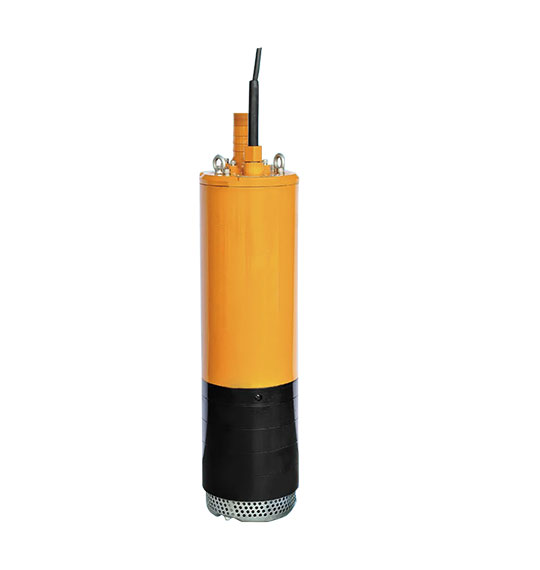
KBZ: distinguish hydraulic wear parts, seals and continuous running level
The KBZ construction drawing identifies cast-iron motor and pump bodies, a high-chrome-alloy impeller, a ductile-iron inlet plate, a steel strainer and an AISI 420 stainless-steel shaft. The wear arrangement is relevant to drainage containing abrasive material, but it is not a quantified sand-concentration or service-life guarantee. Describe particle hardness, size and concentration when requesting the hydraulic configuration.
The same drawing separates seal arrangements by power: SiC–SiC / carbon–SiC at up to 2.2 kW, and SiC–SiC / SiC–SiC from 3.7 kW. That distinction matters to a spare-parts order. Identify the exact pump code and serial number instead of buying a seal solely under the KBZ family name. Include the impeller, inlet plate and seal parts in the maintenance schedule.
The dimension drawing labels W1 as the continuous running water level. Its KBZ23.7 row gives a 50 mm outlet, 283 mm overall width A, 628 mm B dimension and W1 of 150 mm. The KBZ43.7 row changes the outlet to 100 mm and B to 642 mm, retaining W1 at 150 mm. Use the supplied dimensional drawing to set controls and removal space; those values do not define a universal stop level for every KBZ.
The product page states water up to 40°C, maximum water depth 25 m, an 8 m cable and three-phase 380 V ±10% with 50 Hz or 60 Hz options. Agree which frequency and protective arrangement are supplied. The large immersion depth and short standard cable describe different constraints, so a deep installation needs a separately specified cable solution.
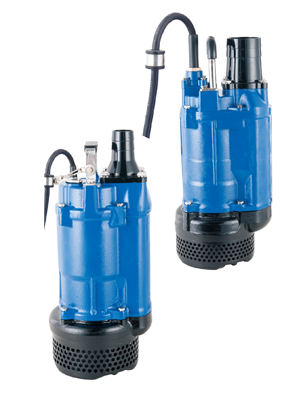
WQ: compare complete rated rows before choosing power or pipe size
Guda’s WQ page describes a non-clogging sewage impeller and a chrome-plated shaft, with applications including municipal and industrial installations. “Non-clogging” does not specify a free passage or make all fabric and sludge equivalent. Provide a solids description and require the selected impeller, passage and coupling dimensions for the actual sump.
The published WQ conditions are water up to 35°C, pH 6.5–8.5, maximum immersion 10 m and an 8 m standard cable. The page lists liquid density as 1.3 g/cm³ without defining the full operating qualification. If density or viscosity is significant, request a motor-load and hydraulic selection for the actual fluid rather than treating that figure as blanket permission.
The table has distinct 220 V single-phase and 380 V three-phase rows. For example, WQD10-10-0.75 and WQ10-10-0.75 each list a 10 m³/h, 10 m rated duty and 50 mm outlet, but different supply voltage. The examples below show why a shared kW rating does not determine the duty or pipe interface. They are catalogue rated points, not maximum endpoints.
| Code | Rated flow / head | Motor / speed | Outlet / voltage |
|---|---|---|---|
| WQ9-22-2.2 | 9 m³/h / 22 m | 2.2 kW / 2,900 r/min | 40 mm / 380 V |
| WQ50-7-2.2 | 50 m³/h / 7 m | 2.2 kW / 2,900 r/min | 100 mm / 380 V |
| WQ65-20-7.5 | 65 m³/h / 20 m | 7.5 kW / 1,450 r/min | 100 mm / 380 V |
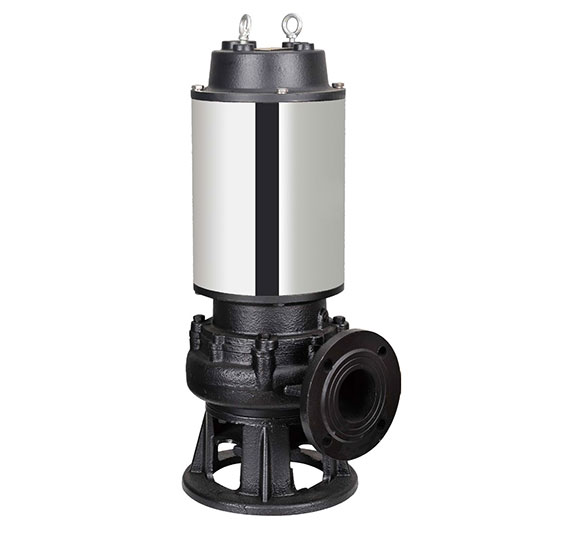
Treat agitation and cutting as separate WQ(D)AS configurations
One official WQ(D)AS page describes an agitator that keeps heavy solids from settling. Another page using a similar family name specifies an open impeller and a high-chrome-alloy cutting knife. The useful procurement distinction is the inlet assembly actually fitted, rather than assuming that every AS-marked pump both agitates deposits and cuts fibres.
The agitation table’s WQAS25-10-2.2 row lists 25 m³/h, 10 m, a 65 mm outlet, 2.2 kW, 2,900 r/min and 380 V. The cutting table lists WQAS15-18-2.2 at a rated 15 m³/h and 18 m with a 2 in outlet, 2.2 kW, 2,900 r/min and 380 V. These examples illustrate different duties and port notation; they are not interchangeable quotations.
The cutting page gives liquid up to 40°C and a maximum immersion of 5 m. Keep those limits with that configuration instead of importing WQ’s 10 m limit or KBZ’s 25 m limit. Ask for the cutting assembly drawing, adjustable clearances, permitted material, replaceable wear parts and access for servicing. Do not interpret a cutting knife as approval for arbitrary metal or hard debris.
For a deposit-removal job, explain how the sump fills and where solids settle. For fibrous waste, describe the fibres and intermittent load. Ask the supplier to identify whether the proposed arrangement has an agitator, a cutter, or another hydraulic construction, and include that drawing and model-specific maintenance instructions in the order.
Deposits at the sump bottom
Confirm the agitation arrangement, sump geometry and whether deposits are actually reached.
Fibres and fabric
Confirm the cutting assembly, its clearances and the selected hydraulic duty.
Spare-parts interchange
Use the full assembly drawing and part numbers; an AS suffix alone is insufficient.
TNF/THF: keep temperature, suction and curve selection separate
The TNF/THF pipeline page limits fluid temperature to 35°C and ambient temperature to 40°C. A pipeline application name alone does not establish a hot-water or aggressive-liquid specification. State the actual fluid and indoor or outdoor environment, then request the offered wetted materials and seal construction.
The original chart is labelled 2,900 r/min and the table uses separate maximum flow in L/min and maximum head in metres. TNF130 lists 2.2 kW, 1,000 L/min maximum flow, 16 m maximum head and 3 in inlet/outlet. THF150 lists 4 kW, 400 L/min maximum flow, 43 m maximum head and 2 in inlet/outlet. Their different curve shapes matter more than comparing kW alone; neither pair of maxima is a simultaneous operating point.
The table also has a 7 m maximum suction entry. An installed suction lift needs its own inlet-pressure and priming assessment, accounting for liquid temperature, altitude and suction-pipe losses. Do not treat the table entry as an unrestricted site guarantee. Include the suction level range and ask for the required inlet conditions for the selected duty.
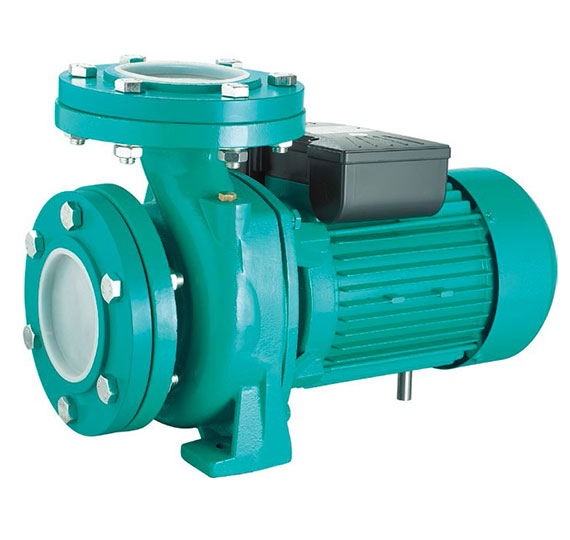
For replacement work, compare flange or threaded interfaces, centreline dimensions, rotation, supply frequency, supports and service clearance. A photograph identifies a catalogue arrangement, but the approved drawing defines what fits the existing installation.
Use the company history and patent record for the claims they actually support
Guda’s company page places its pump-manufacturing history in 1986 and publishes a Zeguo, Wenling address. That is a company-history statement, rather than an independently established incorporation date. Staffing and building-area figures on a historical page do not establish today’s capacity, available production slots or delivery date for a buyer.
An original CNIPA grant publication, CN107514367B dated 29 March 2019, names 浙江固达泵业有限公司 as the patent holder. It describes a cutting sewage submersible pump with adjustable cutting clearances. The document supports a dated engineering record under the exact company name; it does not establish that every current WQ(D)AS unit uses that construction or carries a particular product approval.
For an actual cutter order, require the offered assembly drawing and maintenance limits. For QXN or KBZ drainage, require the frequency-specific curve, continuous running level, wear-part schedule and electrical documentation for that code. For WQ or TNF/THF, specify the test duty and interface drawings. Those order documents are the basis for acceptance of the supplied pump.
Give Guda a site brief that resolves the cooling, solids and supply boundaries
Send the requirement through KanBeng with the full factory name. Include the water source, inlet material, operating levels and required flow/head range. If the installation changes as an excavation deepens or a sump empties, describe those cases explicitly rather than submitting only a single motor power.
Agree the complete scope: pump, cable and any approved extension, controls, discharge connection, lifting arrangement and installation hardware. Confirm which components are included and which are site work. For an abrasive or cutting duty, add an identified wear-parts set and model-specific maintenance instructions. Record the selected voltage and frequency on the offer and nameplate documents.
Site and liquid
- Normal and lowest water levels, lift, hose or pipe route and required duty range.
- Temperature, pH, solids size and concentration, grit and fibres.
- Cooling route, continuous running level and shutdown/control cases.
Exact offered configuration
- QXN, KBZ, WQ, agitation or cutting arrangement and full code.
- Voltage, frequency, cable route and protective/control scope.
- Port and coupling drawings, removal clearances and lifting/access plan.
Acceptance and maintenance
- Selected curve and agreed test flow/head conditions.
- Confirmed materials, seal or cutter parts and permissible wear limits.
- Included equipment, model-specific instructions and essential spare parts.
Submit through KanBeng’s enquiry form with this factory named in your request.