
Rotary-vane vacuum · laboratory equipment · backing duty · vapour handling
Zhejiang Taizhou Qiujing Vacuum Pump Co., Ltd.
Zhejiang Taizhou Qiujing Vacuum Pump Co., Ltd., legally 浙江台州求精真空泵有限公司, publishes XZ single-stage and 2XZ/2XZ-B two-stage rotary-vane pumps from Huangyan, Taizhou. The useful distinction is between a compact evacuation pump, a two-stage laboratory or instrument pump, and a larger backing arrangement. Decide from the required pressure under gas load, evacuation time and vapour exposure, then specify the exact assembly rather than choosing by model number alone.
- Chinese legal name
- 浙江台州求精真空泵有限公司
- Published location
- Toutuo, Huangyan, Taizhou, Zhejiang
- Company-history origin
- 1986, as stated by the company
- Published product directions
- XZ · 2XZ · 2XZ-B
State the gas load and pressure before choosing the pump
The company describes electronics manufacture, medical analytical instruments and refrigeration as application directions. Its company introduction also describes 2XZ as an auxiliary pump for single-crystal furnaces. These are starting points for an equipment enquiry: an auxiliary pump must match the main vacuum system’s allowable backing pressure and control sequence.
For a chamber that is evacuated once per cycle, supply chamber volume, starting pressure, target absolute pressure and available pump-down time. For continuous processing, add gas throughput, leaks and vapour entering during the cycle. A pumping-speed number alone cannot predict how quickly a connected chamber reaches its target.
Compact chamber or bench setup
Compare XZ size and pressure requirement; identify whether oil-sealed pumping is acceptable.
Instrument, drying or backing arrangement
Compare the 2XZ and B variants at the working pressure, with vapour protection and matching ports.
Wet gas or resin-infusion experiment
Define condensate or liquid carryover and upstream protection before sizing an oil-sealed unit.
XZ: useful small-pump comparisons, with an important catalogue discrepancy
The XZ family table lists XZ-0.5 at 0.5 L/s, 90 W and 245 × 155 × 200 mm, and XZ-1 at 1 L/s, 120 W and 320 × 165 × 220 mm. Both rows state 6 Pa ultimate pressure; their listed inlet diameters are 11 and 15 mm respectively. These are published family-table values, not a measured duty for your chamber.
The XZ-1 page’s overview instead states 10 Pa, 10 kg and an 8 mm discharge, while its detailed row states 6 Pa and 12 kg with a 15 mm inlet. Inlet and discharge are different connections, but the pressure and mass discrepancy still requires a current signed datasheet. Include a dimensioned drawing and motor nameplate in a replacement enquiry.
The page excludes pumping liquids, flammable or explosive gas, excessive oxygen and corrosive gas. Its temperature paragraph switches to an XD designation. Do not apply that paragraph’s limits automatically to XZ; obtain the actual XZ operating envelope and gas-compatibility confirmation.
2XZ: compare the family rows without copying the wrong model’s text
The detailed 2XZ family table distinguishes the smallest 0.25 L/s pump from the larger rows. The values below are the table’s published nominal pumping speeds, ultimate pressures and motor powers. They do not describe an installed system’s pressure under continuous gas load.
The same page is headed 2XZ-2 but later gives 0.25 L/s, 0.12 kW and a 10 mm inlet—values associated with its smallest family row. A buyer should use an agreed model-specific datasheet rather than combine that paragraph with the 2XZ-2 row.
| Family row | Pumping speed | Ultimate pressure | Motor power |
|---|---|---|---|
| 2XZ-0.25 | 0.25 L/s | 0.6 Pa | 0.12 kW |
| 2XZ-0.5 | 0.5 L/s | 0.06 Pa | 0.18 kW |
| 2XZ-1 | 1 L/s | 0.06 Pa | 0.25 kW |
| 2XZ-2 | 2 L/s | 0.06 Pa | 0.37 kW |
| 2XZ-4 | 4 L/s | 0.06 Pa | 0.55 kW |
2XZ-B: forced oil supply, gas ballast and the actual connection
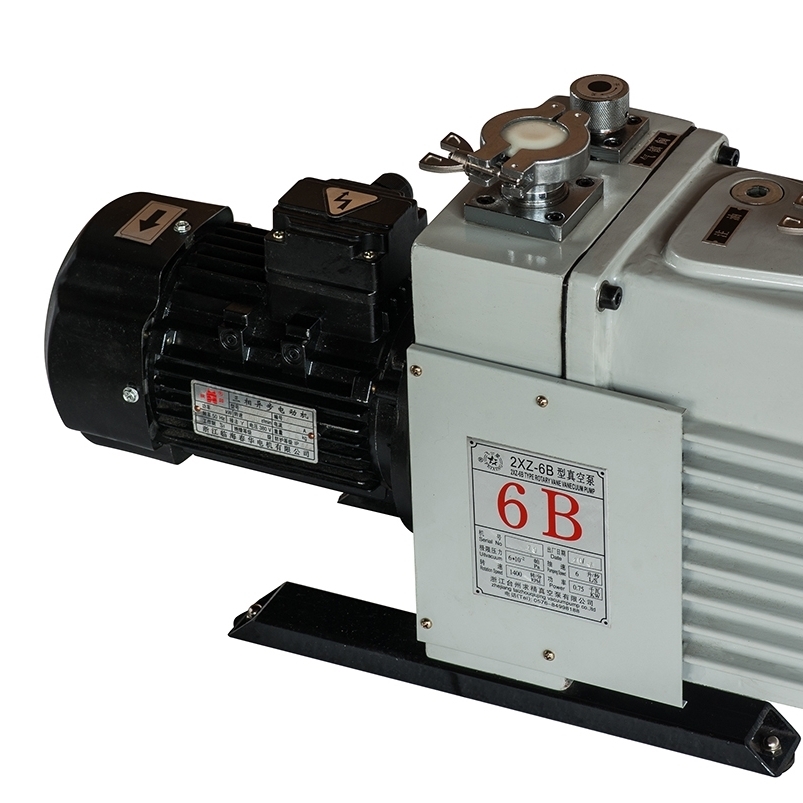
The 2XZ-6B page describes direct-coupled two-stage pumping, forced oil supply and a gas-ballast valve. It lists use as a standalone pump or as a backing pump for booster, diffusion or molecular pumps. Match the complete pump train and shutdown isolation; a stated anti-return feature is not a substitute for confirming the valve arrangement on the supplied unit.
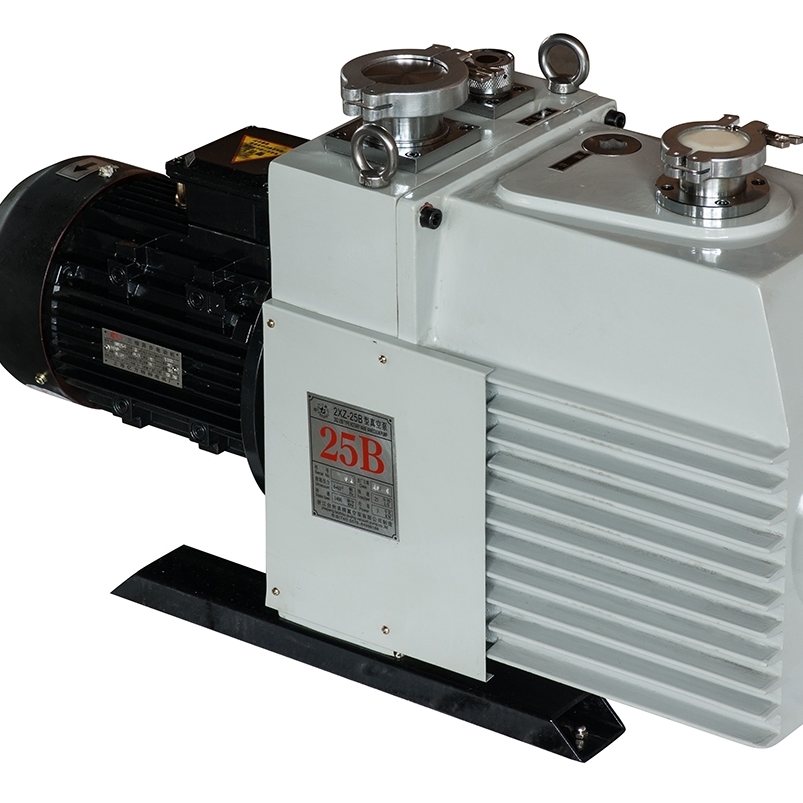
The published 6B row gives 6 L/s, 0.06 Pa and 0.75 kW. The 25B row gives 25 L/s, 0.06 Pa and 3 kW. Their listed dimensions are 542 × 196 × 332 mm and 786 × 276 × 470 mm. Convert nominal speed only for unit comparison: 6 L/s is 21.6 m³/h; 25 L/s is 90 m³/h.
For 6B, the overview states 50 kg while the detailed table states 40 kg. For 25B, the overview states KF40 and 90 kg, while the table states a 50 mm inlet and 94 kg. Request a port drawing, mounting dimensions and confirmed shipping mass. A clamp designation and a diameter field do not establish an interchangeable mating connection.
Make oil condition and exhaust handling part of the equipment specification
Qiujing’s operating notes place the stopped-pump oil level around the sight-glass centre: low oil can impair sealing, while overfilling can lead to oil discharge during atmospheric startup. They describe gas-ballast operation when humidity or condensable vapour is present. Obtain the specific oil grade, fill quantity and ballast procedure for the ordered model; the inconsistent 2XZ-2 paragraph’s oil-quantity notation is unsuitable for an order.
For routine service, the company’s maintenance guidance calls for oil-condition checks, clean inlet filtering, seal inspection and attention to unusual motor or bearing noise and heat. Translate this into a spare-parts and service request: oil specification, filter elements, seal kit, replacement vanes and an accessible maintenance drawing. Specify whether an exhaust mist separator is included and where its outlet is routed.
Agree how pressure and pump-down performance will be measured
Separate the pump’s blank-off ultimate pressure from the required pressure at the instrument or chamber. The company’s notes distinguish gauge readings and oil-related effects; the catalogue number should therefore come with the measuring method, pump condition and gas-ballast setting.
A useful acceptance brief has two tests: the offered pump at an agreed blank-off condition, and the connected system reaching its required pressure in the allowed time. Record the gauge type and position, chamber volume, hose diameter and length, leak condition, oil grade and ballast setting. For backing service, add the main pump’s permitted foreline pressure and start/stop interlocks. These are proposed purchasing checks, not a claim that Qiujing has already tested your installation.
What the resin-infusion paper actually demonstrates
A February 2026 paper in Acta Materiae Compositae Sinica, volume 43(2), pages 795–807, studies pultruded spar-cap features and vacuum-assisted resin infusion. In its materials/permeability-test section, the authors identify a vacuum pump made by this exact company. They do not specify its model or establish production-scale pump performance.
For a composite-material buyer, that is a concrete laboratory-use reference, not proof of a complete wind-turbine production-line supply. Ask how resin and condensate are prevented from reaching the pump, specify the catch-pot capacity and isolation, and agree the required pressure with the actual bag leakage and cycle duration.
The company introduction also names SHZ water-ring pumps, but the reviewed product pages do not provide a model-specific SHZ curve or complete configuration. Treat a water-based alternative as a separate technical enquiry requiring the model, water temperature, water consumption and materials—not as an oil-free substitute selected from a generic application article.
Give Qiujing a vacuum-system brief that can be checked
Process and pressure
- Chamber or instrument, volume, target absolute pressure and pump-down time.
- Gas composition, humidity, vapour quantity, continuous gas load and expected leakage.
- Standalone operation or backing duty, main-pump limits and switching sequence.
Installation and protection
- Required inlet connection and drawing; hose length, diameter and available installation space.
- Liquid/resin traps, inlet filtering, exhaust mist separator and isolation requirements.
- Voltage, phase, frequency, motor protection and ambient conditions.
Quote and acceptance
- Exact XZ, 2XZ or B variant with reconciled pressure, mass and connection details.
- Oil grade/fill quantity, maintenance instructions and agreed service parts.
- Blank-off and connected-system test conditions, quantity, destination and delivery requirement.
Submit through KanBeng’s enquiry form with this factory named in your request.