
Process-liquid transfer · seals, magnetic drive and compressed air · Jingjiang
Jiangsu Hanna Pump Industry Co., Ltd.
Jiangsu Hanna’s catalogue includes mechanically sealed process pumps, magnetic-drive centrifugal pumps and air-operated diaphragm pumps. Their selection questions differ: liquid chemistry and temperature, containment requirements, suction conditions and available utilities should decide the direction before a model is quoted.
- Company identity
- 江苏翰纳泵业有限公司
- Published location
- Xinqiao, Jingjiang, Jiangsu, China
- Reviewed product directions
- HNA/HNE · stainless CQB · QBY diaphragm
- Selection inputs
- Chemistry, duty, temperature, suction and utilities
Choose the pumping arrangement around the liquid and utilities
| Process requirement | Direction to evaluate | Decisive enquiry information |
|---|---|---|
| Defined centrifugal duty with a selected shaft-seal system | HNA / HNE process pump | Normal and upset temperature/pressure, materials, seal arrangement and available cooling/flushing. |
| Clean compatible liquid; magnetic transmission through containment | CQB stainless magnetic-drive pump | Chemistry, density/viscosity, suction pressure, absence of hard solids/fibres and protection against dry running. |
| Intermittent or variable transfer using compressed air | QBY air-operated diaphragm pump | Viscosity, particles, discharge backpressure and available clean compressed-air pressure/capacity. |
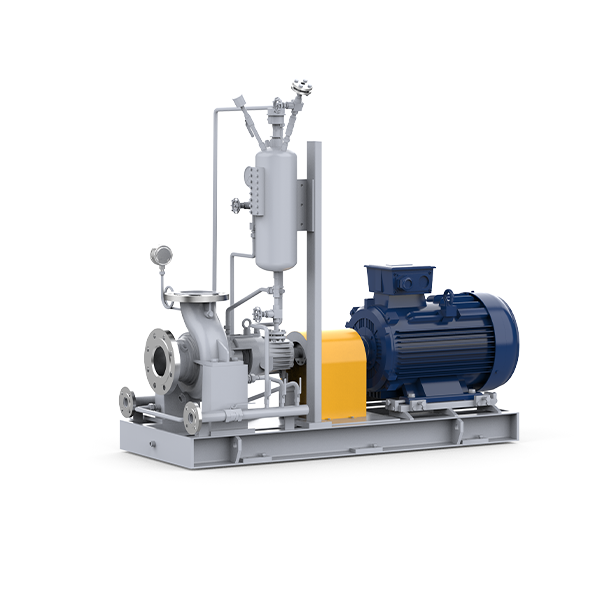
HNA and HNE: support arrangement changes the selection envelope
Hanna describes these as horizontal, single-stage, single-suction, radially split centrifugal process pumps. The detailed catalogue separates the two constructions rather than giving every unit the widest combined range.
These directions are not a promise that every material, flange and seal can operate at the highest pressure and temperature together. Specify normal, start-up and upset conditions and request the allowable pressure–temperature curve for the actual construction. The catalogue offers different materials and bearing-cooling arrangements; identify which are included in the selection.
The product description refers to API 610 design requirements and discusses interfaces for temperature, vibration and pressure monitoring. For a project specification, state the required standard edition and obtain the supplier’s compliance/deviation schedule. A reference to a standard is not a third-party certification or evidence that every catalogue option meets your purchase specification.
Ask for the selected performance curve, data sheet, installation dimensions and seal arrangement before freezing piping. For a replacement, check nozzle sizes and locations, foundation, alignment, permitted pipe loads and rotating-assembly removal space. Cooling, flushing and seal-liquid systems need their own utility and supply boundaries.
| Catalogue distinction | HNA | HNE |
|---|---|---|
| Casing support | Foot supported | Centreline supported |
| Published temperature direction | −80 to +180 °C | −80 to +450 °C |
| Published pressure direction | Up to 2.5 MPa | Up to 5.0 MPa |
| Thermal arrangement | Confirm selected bearing/seal cooling | Catalogue describes cooling provision for the centreline support; confirm supply scope. |
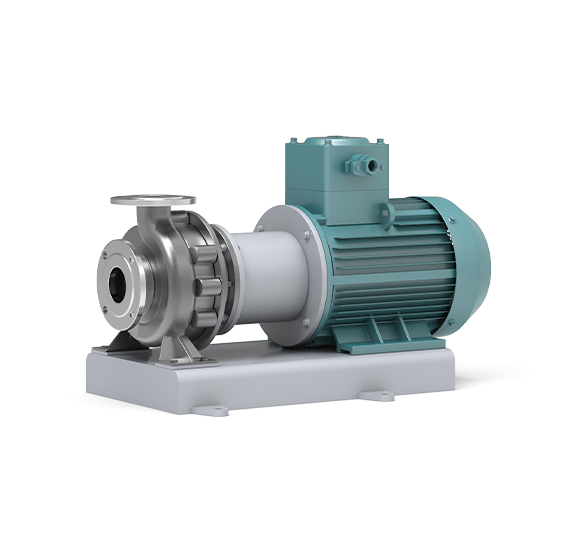
CQB: containment starts with a suitable liquid and operating conditions
CQB transfers torque magnetically through a stationary containment shell rather than a rotating shaft seal. This construction is useful to evaluate where shaft-seal leakage is a concern, but it does not remove static joints, containment integrity, liquid compatibility or the need for operating protection.
The stainless CQB working-condition description is for liquids without hard particles or fibres, with suction pressure no greater than 0.2 MPa, density no greater than 1,600 kg/m³ and kinematic viscosity no greater than 30 × 10⁻⁶ m²/s (30 mm²/s). It gives a temperature direction up to 100 °C. Confirm the precise metallurgy, bearings, containment-shell material, temperature and allowable pressure for the offered model; the fluoroplastic and high-temperature variants are separate selections.
The manufacturer explicitly warns against dry running because the pumped liquid provides bearing cooling and lubrication. Explain low-tank-level events, emptying cycles, gas entrainment and restart conditions in the enquiry, then agree the protective logic and instruments. For liquids that crystallise or settle, request the cleaning, draining and restart procedure for that liquid.
Ask for a parts-specific material schedule
Identify casing, impeller, containment shell, shaft, bearings and static seals separately. A corrosion-resistant casing does not establish compatibility of every internal part with the same liquid. Include concentration and temperature with the chemical name.
Define the containment and inspection scope
For hazardous process liquids, specify the project’s containment, leak detection, inspection and electrical/hazardous-area requirements. Obtain the actual offered configuration and applicable documents; do not treat a broad application list as an approval for the installation.
QBY: compressed-air demand belongs in the quotation
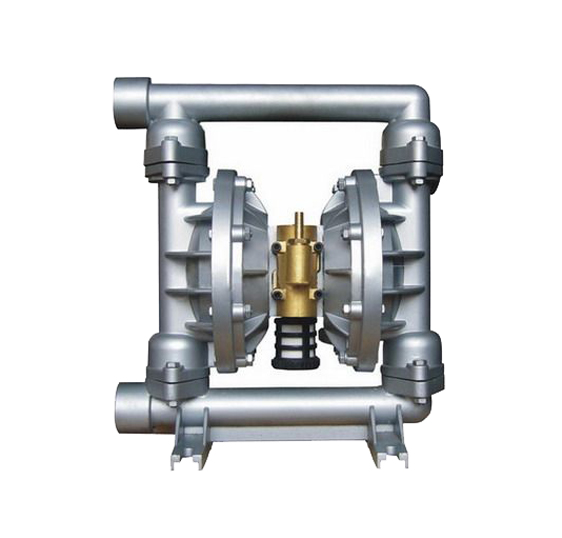
Hanna’s QBY direction uses clean compressed air to drive reciprocating diaphragms. The catalogue discusses viscous liquids and liquids containing particles, with different body-material options. Specify the diaphragm, balls/valves, seats and body materials against the actual liquid, including solvents, concentration and temperature.
The stated air-supply limit is 7 bar and the general temperature direction is up to 100 °C. Ask for the selected size’s performance curve at the available air pressure and required discharge backpressure, with air consumption at that operating point. A maximum catalogue delivery cannot be assumed at the same time as maximum discharge pressure or suction lift, and water-test delivery is not a viscosity-corrected process guarantee.
State particle size and shape, viscosity at the pumping temperature, suction-pipe diameter/length and whether the transfer is continuous or intermittent. Agree the air treatment, supply connection, exhaust routing, noise control and any pulsation-sensitive downstream equipment. If the liquid or installation requires hygienic or hazardous-area documentation, request evidence for the actual configuration; the absence of an electric motor alone does not establish system suitability.
Company identity and a specific public manufacturing-project record
The official company profile identifies 江苏翰纳泵业有限公司 in the Xinqiao industrial area of Jingjiang. Its broader catalogue includes process, magnetic-drive, self-priming, submerged and other industrial pump directions. This profile focuses on three constructions for which the supplier publishes selection and operating information; a broad catalogue list should not be read as an order-specific capability guarantee.
A Jingjiang government announcement dated 28 April 2026 lists environmental approval 泰环审(靖江)〔2026〕27号 for the company’s magnetic gear-driven pump production-line project. The original approval identifies the site at No. 8 Zhenxin Road, Xinqiao, matching the company’s published address. It describes planned construction and equipment including machining and welding facilities. This establishes a named project approval, not proof of commissioned capacity or performance of a CQB, HNA/HNE or QBY order.
Make the selected configuration traceable through the order
Freeze liquid and service conditions
Record normal/upset temperature and pressure, chemical concentrations, density, viscosity, solids and required operating range. Include suction conditions and the site utility limits.
Approve the offered construction
Identify the exact series/size, selected curve, materials and seal/containment/diaphragm configuration. Obtain installation drawings and an explicit list of accessories and external services.
Agree documentation and acceptance
Define project-standard compliance/deviations, material and test records, inspection/witness points and the offered spare-parts list. Put any cooling, flushing, compressed-air or monitoring package in the supply schedule.
Prepare a process enquiry the supplier can select against
Liquid and duty
- Chemical composition/concentration and normal/upset temperature.
- Flow, differential head/pressure, density/viscosity and any solids/fibres.
- Suction pressure or vessel levels, pipe route and intermittent/continuous operation.
Construction and utilities
- Required materials and HNA/HNE, CQB or QBY direction.
- Seal, cooling/flushing, containment or diaphragm requirements.
- Electrical supply or compressed-air pressure and available capacity.
Order and inspection
- Quantity, destination, replacement drawings and delivery programme.
- Applicable standards/editions, approvals, deviations and test/witness requirements.
- Pump-only or complete skid boundary, service information and spare parts.
Submit through KanBeng’s enquiry form with this factory named in your request.
Research scope and review date
Reviewed on 8 October 2026 from Hanna’s company profile and dedicated HNA/HNE, stainless CQB and QBY documentation, with company/site identity cross-checked against the official environmental project approval. KanBeng’s questions help prepare the enquiry; final selection and acceptance follow the actual offered configuration and project documents.
Report an outdated detail · Return to the enquiry checklist ↑