
Viscous transfer · abrasive process liquids · submerged acid circulation
Jiangsu Yunhui Pump & Valve Group Co., Ltd.
Jiangsu Yunhui’s catalogue spans different pumping principles for different plant duties. A G single-screw pump moves enclosed cavities through a rotor and stator; LCF is a centrifugal option for corrosive or abrasive liquids; JHB serves submerged concentrated-acid circulation. The useful choice depends on rheology, wear, chemistry and installation geometry. Define those conditions before comparing motor size or a nominal model number.
- Company identity
- 江苏云辉泵阀集团有限公司
- Published location
- Xinqiao, Jingjiang, Jiangsu, China
- Reviewed directions
- G single-screw · LCF alloy centrifugal · JHB submerged acid
- Order priorities
- Fluid behaviour, wear parts, protection and installation dimensions
Choose the principle before comparing the motor rating
These are selection directions, not interchangeable approvals. The company’s broader company page also lists chemical-process, self-priming and submerged series. For a multi-pump plant package, assign each duty to its own construction and material schedule; one suitable pump does not establish suitability for every liquid in the plant.
| Buyer’s task | Catalogue direction | Decision-driving information |
|---|---|---|
| Transfer viscous material, sludge or a shear-sensitive liquid | G single-screw | Startup viscosity/rheology, rotor/stator compatibility, speed, pressure and supply-loss protection. |
| Circulate a corrosive or abrasive process liquid | LCF alloy centrifugal | Solids loading/hardness, corrosion conditions, operating curve, seal arrangement and wear adjustment. |
| Circulate concentrated acid from a tank or tower | JHB submerged centrifugal | Acid composition/concentration basis, temperature, immersion geometry and liquid-lubricated bearing conditions. |
G35-2 is a speed-and-pressure selection, not a whole-family rating
Yunhui describes a single-helix rotor moving inside a double-helix stator to carry enclosed cavities axially through the pump. The G designation separates nominal rotor diameter and stage count; a leading F denotes the manufacturer’s stainless construction option. State the full code and material schedule rather than treating every G pump as all-stainless.
The existing G35-2 listing corresponds to the 960 r/min row: 8 m³/h, 1.2 MPa, 4 kW motor, 65 mm inlet and 50 mm outlet. The neighbouring G35-1 row has the same listed speed and flow but 0.6 MPa and 3 kW; G35-3 changes to 510 r/min, 5 m³/h and 1.8 MPa. More stages do not imply the same flow, speed and drive across every catalogue row.
| Row | Speed / flow | Pressure | Listed motor |
|---|---|---|---|
| G35-1 | 960 r/min / 8 m³/h | 0.6 MPa | 3 kW |
| G35-2 | 960 r/min / 8 m³/h | 1.2 MPa | 4 kW |
| G35-3 | 510 r/min / 5 m³/h | 1.8 MPa | 4 kW |
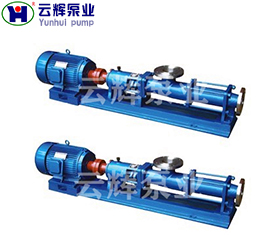
View the reviewed product family →
Specify startup and cleaning conditions alongside the normal flow
The G page explicitly prohibits running without liquid and requires the correct rotation direction. It also describes cleaning after viscous, corrosive or particle-bearing service. Agree an approved wetting/priming and restart procedure for the supplied stator and process liquid; a generic recommendation to introduce oil is not an appropriate universal procedure for food or chemical service.
Provide viscosity at the coldest startup condition as well as normal operation, whether the liquid is shear-dependent, and any tendency to settle, crystallise or harden during a stop. Ask for the stator compound, rotor material/coating, allowable temperature, startup torque and permitted speed range. The page’s broad solids and temperature claims are not model-specific acceptance limits for every elastomer and liquid.
Pennsylvania’s wastewater operator training describes progressive-cavity transfer of thick sludge, while warning that grit accelerates rotor/stator wear and that these pumps must not operate dry or against a closed discharge. Hydraulic Institute guidance separately identifies starting torque and pressure relief as positive-displacement selection concerns. These are operating principles, not an independent test of Yunhui’s G35-2.
Specify protection in the offer
- Method for detecting loss of liquid supply and the shutdown/reset sequence.
- Overpressure protection, relief routing and settings appropriate to the offered pump and system.
- Motor/drive starting torque and control range for the actual liquid.
Plan the wear-part cycle
- Stator compound and rotor identification, with spare-part interchangeability.
- Cleaning fluid, concentration, temperature and compatibility; drain/storage instructions.
- Inspection and reassembly procedure, including rotation and wet restart checks.
Submit through KanBeng’s enquiry form with this factory named in your request.
LCF selection needs a wear strategy as well as a hydraulic curve
The LCF page describes a horizontal, single-stage, single-suction bracket-mounted centrifugal pump for suspended particles, corrosive/abrasive liquids and other demanding media. It offers different impeller and seal arrangements and describes an axial adjustment device for restoring the impeller-to-casing clearance after wear. These features support a maintenance discussion; they do not establish an unlimited solids tolerance or guaranteed service life.
For LCF50-210 the page lists ranges of 15–55 m³/h, 10–55 m head, 26–51% efficiency and 960–2,950 r/min. These are selection ranges spanning operating configurations, not one point delivering 55 m³/h at 55 m. Request the proposed speed, impeller and full curve, plus absorbed power and material/seal selection at the actual liquid conditions.
For abrasive duty, give particle size distribution, concentration, hardness and settling behaviour. For corrosion, give composition, concentration and temperature together. Ask which alloy, impeller passages and seal/flush arrangement are offered, how clearance is checked and adjusted, and which wear parts are replaceable. The company’s general alloy list does not identify the material of every LCF pump.
Document the supplied baseline
Record the offered curve, impeller size, material schedule, shaft-seal arrangement and initial clearance/adjustment instructions.
Define a maintenance response
Agree inspection indicators, adjustment limits and replacement parts. Investigate suction conditions, blockage and wear before assuming a falling flow can be solved by increasing speed.
JHB’s submerged bearings make liquid composition and immersion geometry essential
The JHB page describes a VS4, single-stage, single-suction submerged centrifugal construction for drying/absorption circulation and concentrated-acid transfer. It names 93–98% concentrated sulfuric acid and separately describes fuming-acid service using a concentration convention above 100%. Supply the actual composition and concentration basis, including free SO₃ where relevant, rather than reading that notation as an ordinary mass fraction.
Above-liquid angular-contact bearings carry axial loads; one or two pairs of submerged sliding bearings carry radial loads. The manufacturer describes the submerged bearing materials and lubrication by the pumped acid. Request the required liquid levels and lubrication conditions, compatible materials and the approved startup/shutdown procedure for your tank arrangement.
The webpage’s parameter table contains inconsistent entries and headings. Select from a current approved datasheet and curve instead of correcting ambiguous numbers by inference. “High-temperature acid” in the title does not supply a numerical temperature approval for every concentration and material.
Send a tank or tower drawing
- Mounting opening/flange, support loads, immersion length and available lifting/removal height.
- Minimum, normal and maximum liquid levels and intake clearance.
- Discharge route, thermal movement, access and any required containment.
Specify the liquid envelope
- Acid composition, concentration basis, impurities and normal/maximum temperature.
- Required flow and differential head, operating hours and stop/restart pattern.
- Bearing/material/shaft-seal schedule and required test/inspection documents.
Submit through KanBeng’s enquiry form with this factory named in your request.
Turn the published manufacturing capabilities into order documents
The official company profile places the group in Xinqiao, Jingjiang and describes design, production and maintenance services. It lists alloy analysis, metallographic and non-destructive inspection capabilities, and pump performance testing. Use those descriptions to request the inspection plan and records for the material and pump actually being purchased.
For an alloy process pump, agree material identification and traceability, any casting/NDT requirements, the hydraulic test duty and tolerances, and the delivered seal/drive configuration. For a screw pump, add elastomer identification, startup/control verification and the wear-parts list. For JHB, add the installation drawing and submerged-bearing operating requirements.
The website reproduces an old 2012 sampling certificate for a named pump under 江苏云辉泵业有限公司 and a low-resolution test-report cover. Neither is a current test report for a new Group order. If certification or third-party testing is part of your specification, request a readable document identifying the holder, product, issuer, scope and validity, or the test conditions and results for the supplied unit.
Send a duty-specific package with the factory named
Reviewed on 8 October 2026 from the official company, G, LCF, JHB and testing pages. General operating context uses Hydraulic Institute guidance and Pennsylvania wastewater operator training. Catalogue claims remain scoped to the named construction and liquid conditions; the enquiry checklist is procurement analysis rather than a witnessed factory test.
Fluid and operation
- Composition, concentration/basis, temperature, density and viscosity/rheology at startup and normal duty.
- Particles, fibres, hardness, settling and crystallisation behaviour.
- Required flow, pressure/head, suction conditions and the operating/start-stop cycle.
Equipment and supply scope
- Existing full nameplate/model and photos for replacement; proposed principle and complete code for a new duty.
- Rotor/stator or alloy/seal specification, drive and protection devices, or submerged installation drawing.
- Inspection/test records, cleaning and maintenance instructions, wear parts, quantity and delivery destination.
Submit through KanBeng’s enquiry form with this factory named in your request.
Report an outdated detail · Return to the enquiry checklist ↑