
Polymer-alloy wet ends · sewage and cutting directions · Q water transfer
Nanyin Corrosion-resistant Pump (Zhejiang) Co., Ltd.
Nanyin Corrosion-resistant Pump (Zhejiang) Co., Ltd., legally 南音耐腐泵(浙江)有限公司, is based in Daxi, Wenling. Its product direction centres on polymer-alloy pump components, with separate sewage, cutting and Q-type submersible constructions. A buyer needs to resolve two questions together: whether the liquid is compatible with the selected components, and whether the pump, electrical supply and installation fit the duty. The official product pages and illustrated manuals provide the distinctions below.
- Chinese legal name
- 南音耐腐泵(浙江)有限公司
- Published location
- Daxi, Wenling, Zhejiang
- Brand shown
- NANYIN / 南音
- Product directions
- WQD/WQ · WQ cutting · Q
“Polymer alloy” is a material direction; the liquid still decides suitability
Nanyin describes development across polymer-alloy materials, pump design and motor design. Its current site lists WQD/WQ sewage pumps, a corrosion-resistant cutting direction and Q submersibles. Begin with the liquid composition, concentration, temperature and solids rather than a general request for a corrosion-resistant pump.
The WQD/WQ manual identifies sulfuric, hydrochloric and nitric acid at concentrations up to 20%, alkalis, salts, seawater and general chemical/wastewater applications excluding benzene-related substances. It explicitly excludes benzene-related substances and those three acids above 20%. Treat this as a screening boundary in that manual, then request written compatibility for the actual mixture, temperature and selected wet end, seals and cable.
Mixtures, cleaning chemicals and concentration changes matter as well as the normal liquid. Identify the nylon/polymer grade, impeller and casing materials, exposed metal and elastomer grades in the offer. A broad comparison with stainless steel or cast iron is not a substitute for those component-specific checks.
| Liquid or task | Direction to investigate | What must be established |
|---|---|---|
| Wastewater with short fibres, paper and sediment | WQD / WQ sewage | Selected solids passage, material compatibility, hydraulic point and installation. |
| A sewage duty requiring cutting | WQ corrosion-resistant cutting | Cutter arrangement, permitted solids and actual curve for the quoted construction. |
| Water transfer, irrigation or drainage within the Q manual limits | Q submersible | Water quality, temperature, immersion, head range and three-phase supply. |
WQ/F: compare real hydraulic points, not motor power alone
The WQ description places a three-phase asynchronous motor above the pump, with a double mechanical seal between pump and motor and static O-ring seals. The published application includes domestic wastewater and liquids with short fibres, paper scraps and sediment. Confirm particle dimensions, concentration and fibre character; the application list does not provide a universal solids-passage diameter.
The illustrated code 65WQ/F30-18-3 identifies a 65 mm outlet, WQ sewage direction, F corrosion-resistant version, rated flow 30 m³/h, head 18 m and matching power 3 kW. Keep the complete designation in the quotation and nameplate request.
The manual shows different duties at the same 3 kW rating: 50WQ/F12-30-3 gives 12 m³/h at 30 m, 65WQ/F30-18-3 gives 30 m³/h at 18 m, and 100WQ/F70-9-3 gives 70 m³/h at 9 m. These are separate listed selections. Agree the simultaneous flow/head for the real pipe route and request its curve instead of choosing only “3 kW sewage pump”.
| Full designation | Rated flow / head | Power | Listed matching flange size |
|---|---|---|---|
| 50WQ/F12-30-3 | 12 m³/h · 30 m | 3 kW | 50 mm / 2 in |
| 65WQ/F30-18-3 | 30 m³/h · 18 m | 3 kW | 65 mm / 2.5 in |
| 100WQ/F70-9-3 | 70 m³/h · 9 m | 3 kW | 100 mm / 4 in |
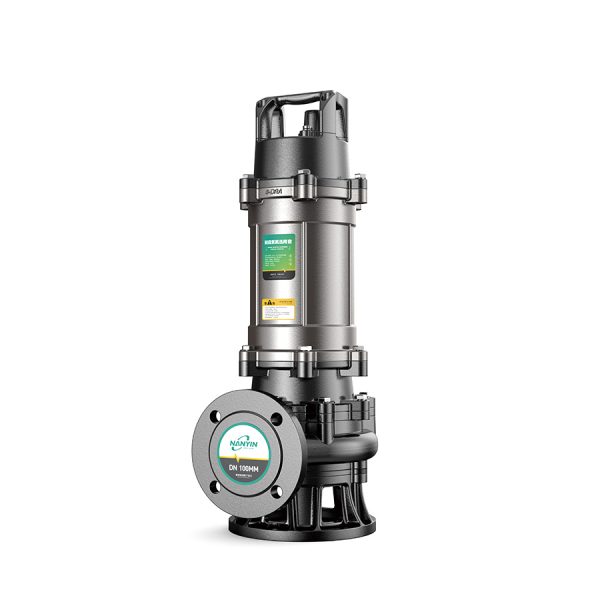
Check the coupling family before reusing the wet-well hardware
The WQD/WQ manual describes automatic coupling, rigid-pipe mobile and hose mobile installation routes. Its guide-rail arrangement lowers the pump to a discharge base; the support, rails, discharge connection and lift path therefore belong to the purchase scope.
A specific manual note says the WQ/S and WQB automatic coupling devices are not interchangeable with the WQ/F series coupling device. For a replacement, send the installed base and rail measurements, discharge connection, bolt pattern and pump interface. A matching nominal outlet alone does not establish that the new pump will seat correctly.
Agree the selected coupling frame, discharge base, guide rails and top support, lift chain/rope and civil fixing responsibilities. The manual specifies attaching lifting equipment to the pump handle and securing its other end on shore; establish the rated handling equipment and retrieval route for the supplied unit.
For hose or rigid-pipe use, confirm support feet, connection dimensions, hose internal diameter and the real discharge route. Include minimum operating level, controls and access to clear the intake or remove the pump. Moving between portable and fixed installation requires a scope/drawing check, not merely a different discharge hose.
Replacement information worth sending first
Provide photographs and dimensions of the existing base and rails, full nameplate and outlet connection, lowest water level, pipe route and lifting clearance. Request a dimensioned assembly drawing before approving the replacement.
A cutting construction needs its own solids and wear-part agreement
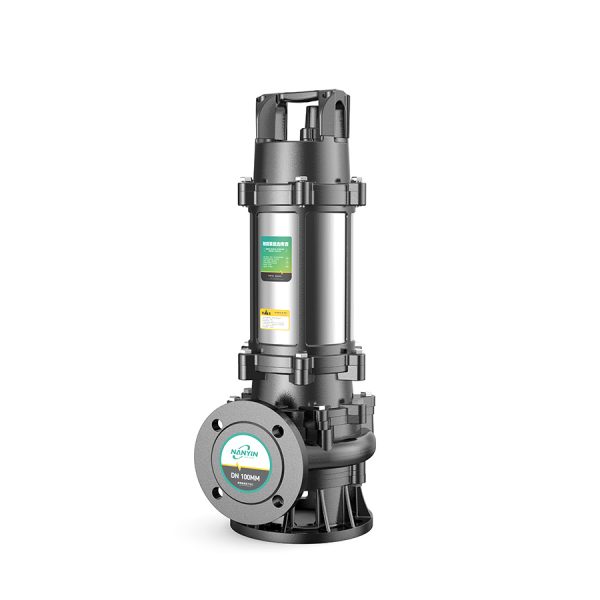
Nanyin lists a distinct WQ corrosion-resistant sewage cutting pump and publishes its own product photograph. Establish why cutting is required: fibres and soft waste create a different challenge from grit, stones or hard foreign objects.
Put the actual solids and fibre description, quantity, flow/head and pipe route into the enquiry. Request the selected cutting mechanism, permitted particle/fibre limits, cutter material, adjustment/service procedure and wear-part references. Do not carry the WQ/F non-cutting table into the cutting offer without a matching manufacturer selection.
Ask how the cutter and seal assembly are accessed after removal and what clearance or adjustment is required. For intermittent wet-well service, agree the level controls, permitted start frequency and minimum submergence for the exact unit.
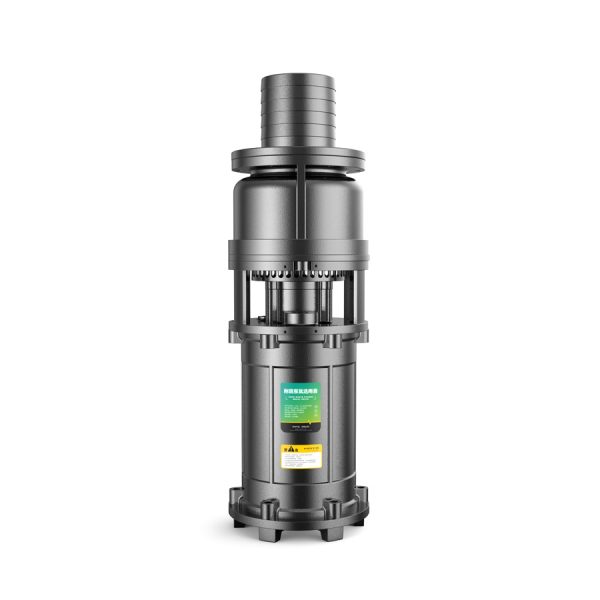
Q water-transfer pumps have explicit water-quality and immersion limits
The Q manual describes water transfer for irrigation, wells, water towers and drainage. Its operating conditions specify water temperature no higher than 40°C, pH 6.5–8.5, sand/insoluble solids no more than 0.1% by volume and particle size no greater than 0.2 mm. These Q conditions should not be substituted for the sewage or cutting constructions.
Immersion is linked to rated head in this manual: a pump with rated head below 10 m is limited to 10 m immersion, while a rated head above 10 m allows up to 40 m. Obtain the limit for the actual designation, including a unit rated exactly 10 m. Head developed by the pump and depth below the water surface are different requirements.
Q15-26-2.2F is a listed 15 m³/h, 26 m selection with a 2.2 kW, 380 V motor, rated current 5.4 A, 51 mm matching pipe internal diameter and 3,000 r/min synchronous speed. Use the selected nameplate and curve; synchronous speed is not a measured loaded shaft speed.
Q100-4.5-2.2F is a very different 2.2 kW option: 100 m³/h at 4.5 m with a listed usable head range of 0–7 m and 152 mm pipe internal diameter. Another row, Q10-51/3-3F, lists 10 m³/h at 51 m and a 45–60 m usable head range. Match the real head and pipe losses to the selected range rather than grouping all Q pumps by power.
Ask for the exact seal assembly and a service plan for the operating liquid
A Chinese invention grant publication, CN116357610B dated 15 April 2025, names 南音耐腐泵(浙江)有限公司 as proprietor and describes a mechanical-seal structure for a submersible electric pump. Its abstract focuses on a rubber arrangement around the rotating/stationary ring interface intended to limit sand entry. The publication supports a specific design record; request the drawing and part number used in the pump being supplied.
The Q manual distinguishes an oil-free three-phase motor construction from a lubricated seal chamber containing a complete double mechanical-seal box. “Oil-free motor” should therefore not be read as an assembly with no lubricants anywhere. Ask for the selected seal-chamber contents, isolation and maintenance instructions.
For Q maintenance, the manual calls for seal-chamber oil inspection after 500 operating hours and a strip inspection after one year, including seal-box, O-ring, diffuser, shaft-sleeve and nylon-bearing wear parts. Agree the appropriate service interval for the actual liquid, duty and supplied revision, plus the spare-part schedule and qualified service arrangements.
The operating instructions prohibit normal running out of water, lifting by the cable and allowing the unit to sink into mud. Include level protection, intake placement and a proper retrieval arrangement. Cable, earthing and electrical protection should be specified and commissioned for the site supply under the applicable electrical requirements.
For a seal or motor problem
Retain the full nameplate, observed flow/head, temperature and liquid analysis, current/protection history and maintenance records. Ask for an order-specific inspection and repair procedure rather than treating a seal part as universally interchangeable.
Give the supplier a liquid brief, a hydraulic brief and an installation brief
Liquid and construction
- Composition, acid/alkali concentration, temperature range and cleaning or upset conditions.
- Particles, sand concentration, fibres and need for cutting; exact wetted/elastomer grades.
- Selected full designation, component schedule and written compatibility basis.
Hydraulics and supply
- Required simultaneous flow/head, static lift, pipe/hose route, fittings and operating range.
- Curve, motor voltage/frequency, rated current, protection and controls for the selected pump.
- Water levels, immersion limit, intake placement and expected operating pattern.
Installation and service
- Coupling family and dimensions or portable connection, rails/base/support and lifting scope.
- Selected seal assembly, wear parts, current operating instructions and inspection requirements.
- Quantity, destination and requested date, with delivery, warranty and service terms in the offer.
Submit through KanBeng’s enquiry form with this factory named in your request.