
Oil-sealed backing pumps · Roots boosters · wet-gas vacuum systems
Sichuan Nanguang Pump Co., Ltd.
Sichuan Nanguang lists individual vacuum pumps and combined pumping units. Start with the gas load and pressure cycle, then select the backing pump, booster stages, oil or sealing-liquid services and controls as one operating system.
- Chinese company name
- 四川南光泵业有限公司
- Published locality
- Chengdu, Sichuan
- Oil-sealed equipment
- 2X rotary vane · H sliding valve
- System directions
- ZJP Roots · Roots–liquid-ring units
Begin with the chamber and gas, not the largest pumping-speed number
Sichuan Nanguang Pump Co., Ltd. presents its Chinese name as 四川南光泵业有限公司 and lists its location in Chengdu, Sichuan. Its product catalogue spans oil-sealed rotary-vane and sliding-valve pumps, ZJP Roots boosters, liquid-ring pumps and combined vacuum units. These are different pieces of a vacuum system: a booster nameplate cannot substitute for a complete pump-down specification.
Describe the chamber volume, starting pressure, target absolute pressure and permitted pump-down time. Add the continuous gas load and its composition, moisture, condensable vapours and particles. State whether the equipment pumps down intermittently, holds a steady process pressure or experiences repeated venting. The required speed at the chamber also depends on the connecting line, valves and traps; a catalogue speed at the pump inlet is not the delivered chamber speed.
| Route | Documented equipment | Resolve before ordering |
|---|---|---|
| Oil-sealed backing or standalone vacuum | 2X rotary vane; H sliding valve | Gas compatibility, pressure cycle, oil and cooling services |
| Higher speed in a lower-pressure range | ZJP Roots booster with backing pump | Backing pressure, differential-pressure protection and cut-in control |
| Vapour-bearing gas and liquid-sealed operation | Liquid-ring pump or Roots–liquid-ring unit | Sealing-liquid temperature, gas chemistry and recirculation arrangement |
Read the 2X-100 values with their pressure definitions
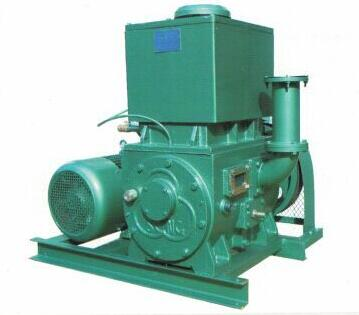
The 2X-100 page describes a two-stage rotary-vane pump for basic vacuum duty and as a forepump for other vacuum equipment. Its specification sheet gives a geometric pumping speed of 98.5 L/s, a 7.5 kW motor and a 100 mm inlet. Treat the model name “100” as a designation, rather than replacing the published 98.5 L/s value with a rounded operating guarantee.
The sheet distinguishes ultimate pressure at or below 0.06 Pa from total pressure at or below 0.6 Pa. Ask which gauge, test procedure, gas-ballast setting and oil condition apply to the proposed acceptance test. Do not promise either value in a wet, leaking or continuously loaded process solely because the bare-pump table contains it.
For installation, the same sheet lists 10 L/min cooling-water consumption, 20 L oil charge and 450 kg mass. Request the oil specification, water quality and temperature limits, drain/refill access, exhaust treatment and service instructions. Use an approved installation drawing for foundation and belt/guard clearances rather than scaling the catalogue photograph.
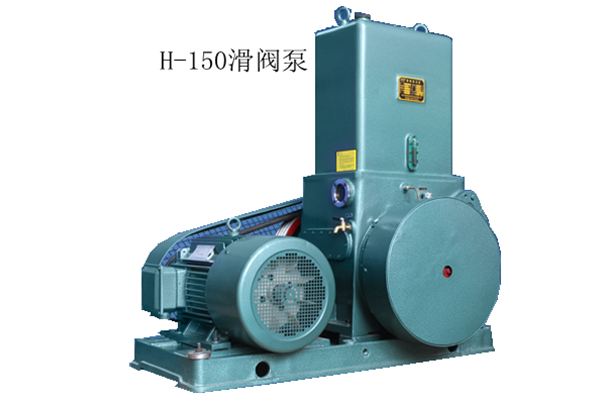
Keep H-150, H-150A and HG-150 construction separate
The H-150 listing contains both an HG-150 table and a separate H-150/H-150A table. Similar nominal speed does not make their motor, weight or installation dimensions interchangeable. For an existing pump replacement, send the complete nameplate and request the matching assembly and connection drawing.
The H-150 and H-150A rows each state 150 L/s pumping speed and 1 Pa ultimate pressure, but list 15 kW and 11 kW motors respectively. Both rows give 100 mm inlet and 80 mm outlet connections. The same table sets the maximum inlet pressure for long continuous operation at 1.3 × 10⁴ Pa. Discuss prolonged operation above that range, startup and repeated venting explicitly rather than assuming ultimate-pressure duty describes the whole cycle.
The table specifies a 30 kg oil charge and references SH0528-92 No. 100 vacuum oil for these variants. Confirm the currently supplied oil, cooling connections and maintenance procedure. Several H-150F cells are blank in the original table; obtain its own specification if offered instead of carrying H-150 or H-150A values into that version.
| Variant | Pumping speed / ultimate pressure | Motor / connections |
|---|---|---|
| H-150 | 150 L/s / 1 Pa | 15 kW / inlet 100 mm, outlet 80 mm |
| H-150A | 150 L/s / 1 Pa | 11 kW / inlet 100 mm, outlet 80 mm |
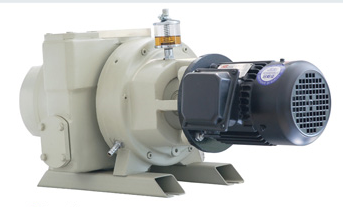
A Roots booster needs its backing pump and protection logic
The ZJP sheet covers nominal speeds from 30 to 1,200 L/s and provides recommended backing-pump combinations. For example, the ZJP-150 row lists 150 L/s nominal speed, a 2.2 kW motor, a maximum continuous pressure difference of 8,000 Pa and a recommended 2X-30 backing pump. These values describe a particular catalogue row, not an instruction to connect a booster directly to any chamber at atmospheric pressure.
The same sheet lists a 0.03 Pa ultimate pressure across its ZJP range. Treat this as a combination-dependent catalogue value and request the complete booster/backing-pump curve and test conditions. Leybold’s technical explanation shows why Roots operation depends on backing pressure and a permitted pressure difference. Agree the cut-in pressure, bypass or overflow protection, interlocks and shutdown sequence for the supplied configuration.
For an upgrade to an existing forepump, provide its actual speed-versus-pressure curve, inlet/outlet connections, gas compatibility and maximum continuous inlet pressure. Include foreline losses and exhaust backpressure. The ZJP sheet mentions overflow and optional gas-protection arrangements; it does not establish that every quoted unit includes these features, nor that dust or condensate can be admitted without process-specific protection.
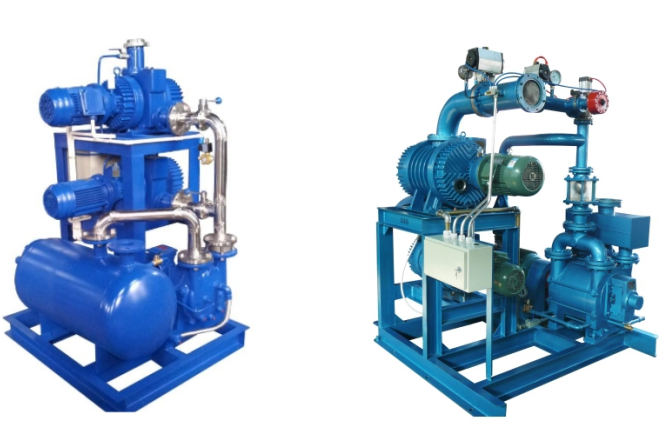
Compare complete staged units, including the sealing-liquid circuit
Nanguang’s Roots–liquid-ring page publishes two-stage units with a main Roots pump, another Roots stage and a liquid-ring backing pump. The JZS150-2.1 row combines ZJP-150, ZJP-70 and 2BV5111 and lists 10 kW total power; JZS150-2.2 uses ZJP-150, ZJP-70 and 2BV5110 and lists 8.5 kW. The unit table gives 25–67 Pa in a shared ultimate-vacuum column. Ask for the pressure and pumping-speed curve of the exact proposed assembly, not a universal target inferred from that shared range.
The unit table lists the main ZJP-150 motor as 3 kW, while the standalone ZJP sheet lists 2.2 kW. Keep the unit’s own configuration intact and resolve the selected motor and test duty in the quotation. Do not silently combine the smaller standalone motor with the unit’s total-power or vacuum figures.
Liquid-ring pumping uses an operating liquid for sealing and heat removal. Leybold’s explanation identifies that liquid’s vapour pressure as a limit on attainable intake pressure. For a real wet-gas process, specify sealing-liquid inlet temperature, chemistry, contamination and allowable discharge. Ask whether the offered scope includes a separator, replenishment, heat exchanger, recirculation tank, drains and instruments. A pump photograph does not confirm these accessories or establish corrosion resistance.
Define useful vacuum at the process connection
Write the acceptance around the process: starting and final absolute pressures, chamber volume, gas load, pump-down time, hold period and repeat-cycle duty. Mark the gauge location and specify pressure units consistently. Test the installed connecting line and agreed valves/traps when the purchase is a system package; a blanked-inlet ultimate-pressure test answers a different question.
For oil-sealed equipment, document how condensate and particles are intercepted, how exhaust is handled and how oil quality is monitored. For liquid-ring equipment, define the sealing-liquid circuit and wastewater boundary. For a Roots system, include safe startup, protection against excessive differential pressure and response to a backing-pump failure. Allocate responsibility for pumps, motors, baseframes, guards, controls, instruments, piping and commissioning in the offer.
For spares, identify the full model, serial or nameplate details and the affected assembly before requesting a seal, rotor, bearing or valve. Confirm the required service parts and maintenance access with the supplied drawing; family resemblance and nominal pumping speed do not establish interchangeability.
Give Nanguang a pressure cycle and configuration brief
Use KanBeng’s enquiry form with Sichuan Nanguang identified. Choose the relevant brief below and attach the chamber, foreline and existing-equipment information needed to compare an actual configuration.
2X or H backing-pump replacement
- Full existing model/nameplate and connection drawing; chamber volume, starting/target absolute pressure and pump-down time.
- Gas composition, vapours, particles, continuous load and operating cycle; available cooling water, oil and exhaust arrangements.
- Motor supply, foundation and service access, included guards/baseframe, spare parts and agreed pressure test.
ZJP booster or staged vacuum upgrade
- Proposed booster and existing backing-pump curves; foreline dimensions, valves, gas load and required process pressure.
- Permitted differential pressure, cut-in condition, bypass/overflow scope, backing-pump interlocks and shutdown sequence.
- Configuration-specific curve and motor rating, instrumentation, control panel and commissioning boundary.
Liquid-ring or Roots–liquid-ring package
- Wet-gas composition, normal/peak throughput and required absolute pressure; selected unit code and pressure curve.
- Sealing-liquid type, inlet temperature, chemistry and utilities; separator, recirculation, heat exchanger and waste-discharge requirements.
- Complete staged pump/motor list, accessories, materials, test conditions, destination and quantity.
Submit through KanBeng’s enquiry form with this factory named in your request.