
Polymer-lined slurry pumps · seal services · low-level tank transfer
Yixing Zeus Pump Industry Co., Ltd.
Yixing Zeus specialises in corrosion- and abrasion-resistant polymer pump construction. Its catalogue offers several ways to move the same process liquid: a horizontal lined pump, a self-priming set, a rear-suction filter-press feed pump or a floating immersed assembly. The useful buying decision connects the liquid and solids with the inlet arrangement, seal service and replacement parts. A broad chemical application list alone cannot establish that a particular liner or seal fits the process.
- Chinese legal name
- 宜兴市宙斯泵业有限公司
- Published location
- Dingshu, Yixing, Jiangsu
- Reviewed directions
- UHB-ZK · FSZ · HFM · YUF
- Existing model
- UHB-ZK
Start with the inlet and process, before comparing pump sizes
Zeus also lists clear-liquid chemical pumps and fixed immersed YU designs. Keep their materials and operating instructions separate. None of the alternative directions below changes the identity or specification of the existing UHB-ZK product page.
| Process problem | Documented direction | Decisive information |
|---|---|---|
| Corrosive slurry or clear liquid in a horizontal transfer loop | UHB-ZK lined centrifugal | Chemistry, solids, selected curve, inlet pressure and K/G3/G4 seal arrangement. |
| Liquid below a horizontal pump with priming required | FSZ-Z clear-liquid / FSZ-K slurry self-priming | Actual lift, air-tight inlet, retained priming liquid, density and seal-water availability. |
| Filter-press feed as resistance changes | HFM-I single-stage / HFM-II two-stage rear suction | Feed cycle, pressure/flow trajectory, inlet conditions and selected expeller/cooling configuration. |
| A large tank with changing levels or settling solids | YUF floating / YUF-J with agitation | Level range, floating platform, discharge connection, low-level protection and retrieval. |
UHB-ZK: specify the lining and the complete liquid-contact assembly
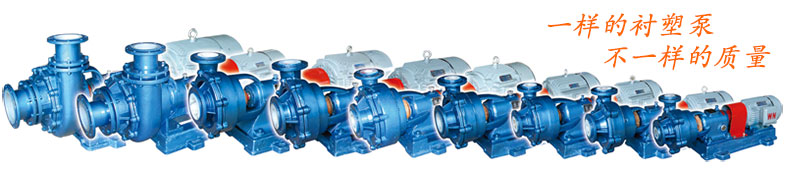
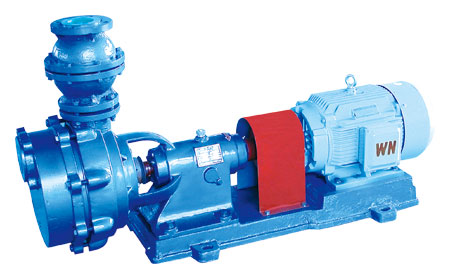
The UHB-ZK documentation describes metal-supported ultra-high-molecular-weight polyethylene lining, 8–20 mm thick, with an anchoring mesh. It offers open and closed impellers and K dynamic or G3/G4 mechanical seals. The catalogue overview gives −20 to +90°C; chemical compatibility still depends on concentration, temperature, contaminants and the selected elastomers and seal components.
Send a complete liquid composition and solids description, including particle size, hardness, loading and tendency to crystallise. Agree the casing/cover lining, impeller, sleeves, gaskets and seal faces as a component schedule. A liner material name does not identify every wetted part.
The family overview spans 5–2,600 m³/h and head up to 80 m. Select from an identifiable curve and speed rather than pairing family maxima. Some individual rows extend below that overview, and at least one printed model/head pair is inconsistent; ask for the selected current curve and drawing.
View the reviewed product family →
A dynamic seal needs a shutdown seal and the right service connections
The K arrangement uses an expeller or rear blades to reduce pressure at the seal while running, with a rubber lip seal taking the shutdown role. Ask whether the selected construction has an expeller, which sleeve and lip materials it uses, and whether service-water ingress is acceptable in the process.
The linked configuration manuals for water-cooled UHB-ZK K and G4 assemblies specify separate clean-water inlet and outlet connections: 0.02–0.05 MPa and 30–50 kg/h. They warn against reversing connections or putting several pumps’ cooling circuits in series. Include the supply, drain route and response to service loss in the installation brief.
The overview recommends G3/G4 for suction lifts over 2 m, while the linked configuration manuals limit their illustrated suction arrangement to 2 m and recommend 1 m or less. Treat this as a selection-document issue: provide the actual inlet pressure, levels and pipe losses and obtain the applicable configuration drawing. A seal change alone does not prove a higher suction lift.
Dry running is not a normal operating mode. The configuration manuals contain more restrictive dry-run and closed-discharge cautions than the general overview. Agree the current operating instructions and protection for the supplied assembly; do not use a maximum warning interval as a planned duty cycle.
Plan access to the wear parts
The illustrated parts schedules identify liners/covers, impellers, sleeves, seals and gaskets separately. Order replacements against the actual configuration and assembly drawing; include the access and tools needed to replace them.
FSZ-Z and FSZ-K solve different feed and seal problems
The catalogue uses PP or UHMWPE wetted construction. Its maximum self-priming-height entries vary with size, and it explicitly notes liquid density and viscosity effects. The linked FSZ manuals describe a lower installation lift than the catalogue maxima. Obtain the current model-specific selection instead of assuming a catalogue 4 m entry applies to the offered set.
Both manuals require the pump cavity to be filled before use and an inlet non-return arrangement to prevent loss of retained liquid. They warn that an S-shaped outlet can prevent air discharge. If priming does not produce delivery within the documented interval, the instruction is to stop and investigate, rather than continue heating the retained liquid.
Specify the actual liquid levels, inlet length/diameter, fittings, filter and discharge route. The table motor selections assume density near water; confirm loading for the process liquid. For FSZ-K, include the cooling-water circuit. FSZ-Z has a different mechanical-seal service and shutdown sequence.
| Direction | Published scope | Installation questions |
|---|---|---|
| FSZ-Z | Mechanical seal; corrosive clear liquid within the stated 80°C direction | Initial fill, retained liquid, inlet air leaks, actual lift and compatible seal parts. |
| FSZ-K | K dynamic seal; slurry up to the stated 15% solids by volume | Particle properties, service water, priming sequence and wear-part access. |
HFM: select for the feed cycle and inlet conditions
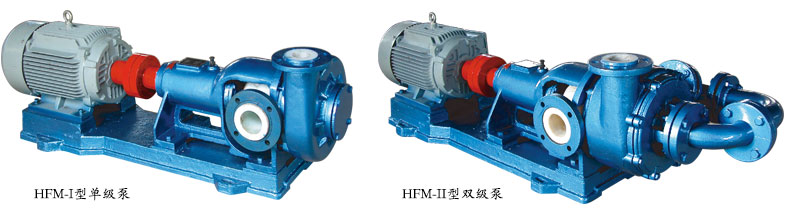
HFM places the inlet on the shaft-seal side. The catalogue distinguishes HFM-I single-stage and HFM-II two-stage construction for pressure-feed duties, including filter presses. Describe how flow falls and required pressure rises during the filtration cycle, together with the solids and liquid temperature.
The source excludes locations with liquid level more than 0.5 m below the pump or excessive inlet vacuum. Provide the minimum level and suction-pipe losses; do not treat HFM as an alternative self-priming pump.
The overview and illustrated component schedules describe different expeller configurations. The table documentation identifies its default as a set with pressure-reducing expeller and cooling water, while alternatives require separate specification. Agree the exact drawing, services and operating range. Claims of no leakage, savings or longer wear life are not substituted for an order-specific selection and test.
Separate removable liner/wear components appear in the parts schedules. Ask for the identified covers, sleeves, impellers, seals and gaskets and their replacement references. The selected liquid-contact materials, including modified UHMWPE where offered, must be checked against the actual chemistry and temperature.
YUF: design the floating assembly around movement and access
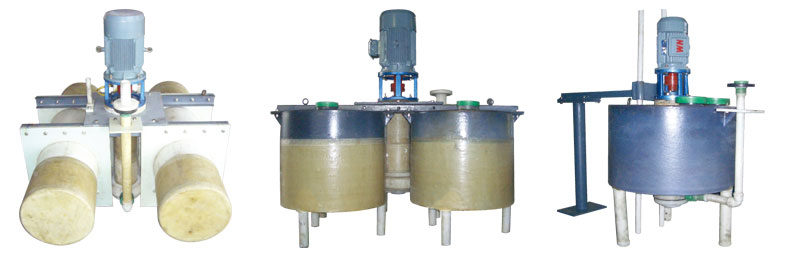
YUF combines a floating platform, immersed pump and automatic level switch. YUF-J adds agitation below the assembly for liquid with rapidly settling material. This differs from selecting a fixed immersed length for a YU installation.
The source identifies PP/UHMWPE liquid-contact construction and a semi-open impeller. Its standard direction is −5 to +80°C; modified material for higher temperature is a separate option. Concentrated sulphuric and nitric acid are excluded from its broad application statement. Specify the complete mixture rather than using an acid-family label as approval.
Provide the tank footprint and minimum/normal/maximum levels, platform movement limits, bottom deposits and retrieval route. Agree the discharge connection and supports as the platform moves, the selected agitation arrangement and the level-switch setting/interlock. Confirm how the assembly is inspected and lifted out without loading the discharge pipe.
Tie the supplied configuration to the documents and spare parts
The company profile describes machining, polymer moulding, assembly and pump testing, and records company registration in 2001 and main-plant relocation in 2009. Undated output, staffing and test-capacity claims are not used to establish the facilities assigned to an order.
A Yixing government approval summary published on 6 June 2023 identifies the legal company and a pump-and-accessories manufacturing project in Zhangze village, under approval 2034 for that year. This is a historical project approval, not evidence that a new capacity is operational or that the pump meets the buyer’s performance test.
Specify the selected duty, curve and test-liquid basis, dimensional checks, component materials and seal-service drawing. Obtain the current instructions for the actual configuration and reconcile them with the catalogue before accepting the offer. Match delivered identification, spare-part references and documentation to that selection.
Liquid and hydraulics
- Chemistry/concentration, temperature, density, viscosity, particles and crystallisation.
- Simultaneous flow/head or filter-press pressure/flow cycle, inlet pressure and liquid levels.
- Selected model, speed, motor supply and complete wetted-part/seal schedule.
Installation and operation
- Inlet/discharge layout, prime-retention arrangement and service-water supply/drain.
- Tank/platform movement, agitation, level protection and lifting/maintenance access.
- Startup, flushing, shutdown and service-loss requirements for the selected configuration.
Acceptance and maintenance
- Selected test basis, curve, tolerances, drawings and identification records.
- Current applicable conformity documents if required, with model/scope and issuer details.
- Wear-part list and replacement references, quantity, destination and requested date.
Submit through KanBeng’s enquiry form with this factory named in your request.