
Sewage lifting · cutting arrangements · high-head drainage · self-priming transfer · screw pumps
Taizhou Youxin Pump Co., Ltd.
Taizhou Youxin Pump Co., Ltd. presents a wastewater-oriented range from Zeguo, Wenling: WQ submersible sewage pumps, JYWQ agitation pumps, WQK cutting pumps, WQX high-head units, BZW/ZW surface pumps and G/FG screw pumps. Start with the liquid and installation, then compare the actual duty row. A cutter, a sludge agitator and a progressive-cavity pump solve different problems; their names do not make them interchangeable.
- Chinese company name used in contact records
- 友鑫泵业有限公司
- Published manufacturing location
- Shankeng, Zeguo, Wenling, Zhejiang
- Company-stated history
- Established in 2013
- Reviewed product directions
- WQ · JYWQ · WQK · WQX · BZW/ZW · G/FG
Choose by what enters the pump and where it will operate
A sewage pit with suspended solids needs a passage and impeller arrangement matched to the incoming material. Fibrous waste may call for a cutting arrangement, while settled sludge may need agitation. A higher lift requires a verified pressure capability and duty curve; it cannot be solved by choosing a larger sewage-pump outlet alone.
A pump installed above the liquid faces suction and priming questions that a submerged unit does not. For viscous or shear-sensitive transfer, Youxin’s screw-pump direction should be evaluated with viscosity, temperature and stator compatibility. Treat these as separate enquiries rather than selecting everything from one headline power range.
Wet-well sewage lifting
WQ: define flow, total head, free passage, rag content, minimum cooling level and retrieval arrangement.
Fibres or settled material
WQK cutting and JYWQ agitation: specify the problem separately and ask for the actual cutter or mixer construction.
Lift, suction or viscous transfer
WQX, BZW/ZW and G: compare pressure duty, suction startup or rotor/stator requirements respectively.
WQ: identical motor power can serve very different duties
The WQ page describes single- or double-channel impellers, an oil-chamber sensor and winding temperature monitoring. It offers float control, a control cabinet and double-guide automatic coupling as configurations to discuss. Agree which protections and accessories are included in the quote, the sensor outputs and the cabinet’s response to each alarm.
The published charts distinguish small A-type pumps at 2,900 r/min from four-pole rows at 1,450 r/min and other larger two-pole rows. The examples below deliberately retain their different speeds. They are published rated points, not a complete curve or a guaranteed operating point for your system.
For a retrofit, provide the existing guide rails, discharge elbow, flange drawing, cable length and pit depth. Obtain a free-passage dimension and material specification for the offered impeller; a broad fibre-passing or non-clogging statement is insufficient for wipes, grit and mixed waste.
| Published model row | Rated flow | Rated head | Power / speed | Listed voltage |
|---|---|---|---|---|
| 50WQ15-15-1.5 | 15 m³/h | 15 m | 1.5 kW / 2,900 r/min | 220 or 380 V |
| 100WQ100-25-11 | 100 m³/h | 25 m | 11 kW / 1,450 r/min | 380 V |
| 150WQ100-20-11 | 100 m³/h | 20 m | 11 kW / 2,900 r/min | 380 V |
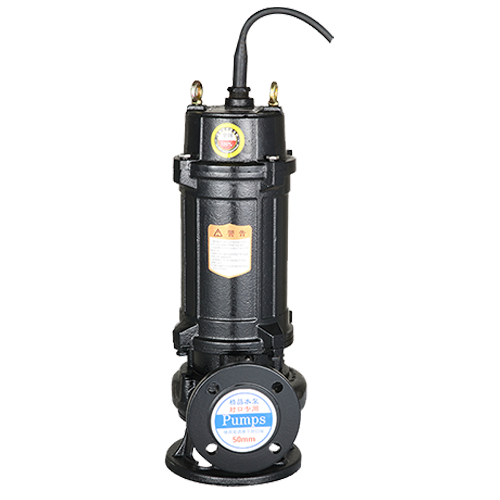
JYWQ: resolve the agitation mechanism before specifying a sludge duty
The JYWQ introduction describes shaft-driven agitation, but a later feature paragraph describes agitation using the pump’s own water pressure. These are materially different arrangements. Ask for an assembly drawing identifying the agitator, jet outlet or other mixing device on the exact offered pump.
The reviewed detail page does not supply a JYWQ-specific performance table that can safely be applied to an order. Do not borrow WQ rows simply because a shared image appears on both pages. Specify sludge concentration, settling tendency, fibre content, required mixing coverage and the duty after agitation.
The page also describes an optional external cooling jacket for operation outside a wet well. Confirm that option, its cooling supply and the permitted operating sequence. It does not establish that every JYWQ pump can run dry or operate indefinitely with the motor exposed.
WQK: cutting fibres is different from accepting hard debris
The WQK description gives a fixed cutting disc and rotating inlet assembly. Its stated liquid conditions are no more than 40°C, density no more than 1,200 kg/m³ and pH 5–9. These limits belong to this published WQK description; they are not blanket limits for every Youxin family.
Although the introduction describes a two-pole arrangement, the charts also include four-pole units at 1,450 r/min. For example, 50WQK15-15-1.5 is listed at 15 m³/h, 15 m and 1.5 kW at 2,900 r/min, whereas 100WQK100-25-11 is listed at 100 m³/h, 25 m and 11 kW at 1,450 r/min. Confirm speed, curve and cutter assembly together.
Describe the actual fibres and rag sizes, and identify stones, metal or other hard debris upstream. Request cutter material, clearance-setting instructions and replacement cutter parts. The cutting claim does not establish tolerance of arbitrary hard solids or a maintenance-free installation.
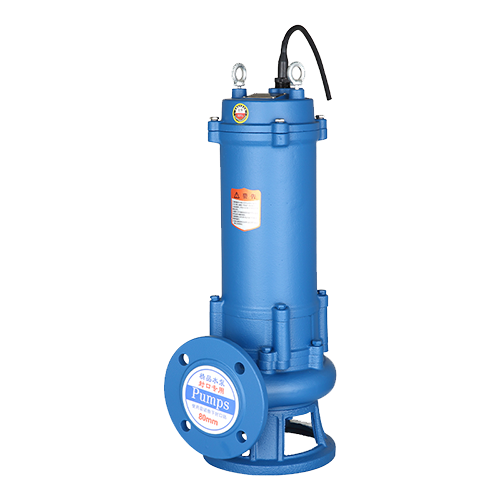
WQX: size the lift from the published duty row, not a category headline
The reviewed WQX chart provides the following examples at 2,900 r/min. A general high-head category description must not be interpreted as a 300 m rating for these pumps: the displayed WQX rows reach 70 m rated head.
Total dynamic head includes the level difference, pipe or hose friction and required outlet pressure. Give the discharge route, length, diameter and fittings, then request the curve, shut-off head, allowable operating range and pipe pressure rating. Confirm intake-strainer opening and the permitted solids load separately; high head does not imply sewage free-passage capability.
| Model | Rated flow | Rated head | Power | Listed voltage |
|---|---|---|---|---|
| WQX10-24-1.5 | 10 m³/h | 24 m | 1.5 kW | 220 or 380 V |
| WQX15-45-4 | 15 m³/h | 45 m | 4 kW | 380 V |
| WQX15-70-7.5 | 15 m³/h | 70 m | 7.5 kW | 380 V |
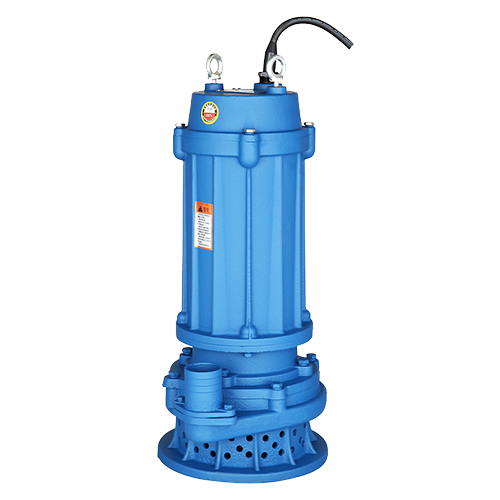
BZW and ZW: keep the two self-priming tables separate
The BZW page supplies separate tables for BZW and ZW directly coupled surface pumps. At 2,900 r/min, its 50BZW-25-2.2 row lists 10 m³/h at 25 m with 2.2 kW, while 50ZW-10-20-2.2 lists 10 m³/h at 20 m with 2.2 kW. Specify the full designation rather than accepting a substitute based on outlet size and power alone.
Self-priming needs an agreed startup procedure, retained liquid and an airtight suction line. Ask for initial filling instructions, permitted suction lift at your site, priming time, liquid temperature and restart behaviour after the suction line drains. A claim that no foot valve is required does not establish safe starting with an empty pump.
Some application paragraphs on this page switch to ISWR/ISWB designations. They do not establish a BZW hot-water or flammable-liquid configuration. For industrial effluent, obtain model-specific wetted materials, seal details, solids passage and temperature limits rather than carrying those other-family paragraphs into the specification.
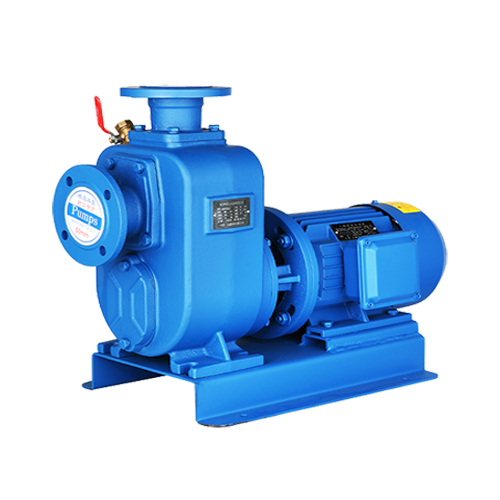
G/FG: confirm the stator and construction behind the model letters
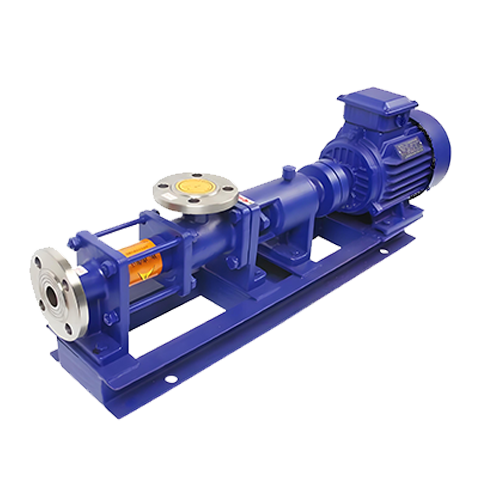
The G/FG page describes progressive-cavity pumping with a rotor and stator, and states 0.6 MPa per stage. Its model key uses F for a stainless-steel body and internal parts, while its heading refers to a fluorine-lined configuration. Those statements do not prove that every F model has a fluoroplastic lining. Obtain the actual bill of wetted materials, lining if specified, stator compound and seal configuration.
The two published G35 examples illustrate staging: both rows list 8 m³/h at 960 r/min, but G35-1 is listed at 0.6 MPa and 3 kW, while G35-2 is listed at 1.2 MPa and 4 kW. These are G-table values, not an independently verified rating for every FG build or for every viscous liquid.
Supply viscosity at operating temperature, solids size, abrasiveness and chemical composition. Request the selected speed, pressure limit, compatible elastomer and rotor/stator service parts. Agree overpressure protection and a startup procedure that keeps the pumping element appropriately wetted. The page’s special-temperature statements require a specific material configuration; they should not be treated as a universal 150°C capability.
| Model row | Published flow | Published pressure | Motor power |
|---|---|---|---|
| G35-1 | 8 m³/h | 0.6 MPa | 3 kW |
| G35-2 | 8 m³/h | 1.2 MPa | 4 kW |
Use the manufacturing record to ask for the right acceptance evidence
A December 2020 environmental-impact report hosted on a Zhejiang government service identifies 友鑫泵业有限公司 and a proposed sewage-pump project in Shankeng, Zeguo, matching the manufacturing locality in the company’s contact information. It describes proposed winding, vacuum varnishing, assembly and water-pressure testing. This is dated project documentation, not proof of current capacity, installed equipment or environmental approval.
The company’s introduction uses a Taizhou-prefixed name, while its contact page and the historical report use the shorter Chinese name above. Obtain the current business licence and contract-party details for the supplier on an order. Neither the website name nor a historical project report substitutes for that document.
For a sewage-pump purchase, ask for the offered model’s hydraulic test record and curve, motor insulation and electrical checks, seal/leak test, protection-sensor verification and a nameplate photograph. Identify whether any witnessed test is included and the agreed acceptance conditions. A water-pressure test in a historical process description is not the same as a certified flow/head or efficiency result.
Send a wastewater specification that distinguishes the actual configuration
Liquid and duty
- Source of wastewater, fibres, largest solids, grit, sludge concentration and chemical composition.
- Required flow and total dynamic head; for screw pumps, viscosity and discharge pressure at operating temperature.
- Liquid temperature, density, operating cycle and any settling or mixing requirement.
Installation and controls
- Submerged, surface-mounted or cooling-jacket arrangement; pit depth, minimum liquid level and access for retrieval.
- Guide coupling or portable discharge, dimensioned connections, hose/pipe length and suction conditions.
- Voltage, phase and frequency; float controls, alarm sensors, cable length and cabinet scope.
Supply and acceptance
- Complete WQ, JYWQ, WQK, WQX, BZW/ZW or G/FG designation with a current curve and material list.
- Cutter, rotor/stator, seals and spare-parts drawings; startup, cleaning and maintenance instructions.
- Current contracting entity, quantity and destination; test conditions and inclusions confirmed through the platform enquiry.
Submit through KanBeng’s enquiry form with this factory named in your request.