
Residential sewage hydraulics · lifting stations · maintenance access
Zenit Pumps (China) Co., Ltd.
Zenit’s China profile is most useful when buying a wastewater arrangement rather than an isolated pump. The group describes a Suzhou production and sales operation, while its catalogue distinguishes vortex sewage hydraulics, drainage hydraulics and packaged collection tanks. The important choices are the actual waste stream, sewer elevation, tank layout, control sequence and how a technician will remove the pump. Keep the offered manufacturing and contractual entity separate from the group’s wider product portfolio.
- Chinese legal name
- 泽尼特泵业(中国)有限公司
- Reviewed China operation
- Suzhou Industrial Park, Jiangsu
- Existing catalogue profile
- DG blue · 50 Hz
- Other reviewed direction
- blueBOX collection and lifting stations
Drainage, sewage and a lifting station are three different purchase briefs
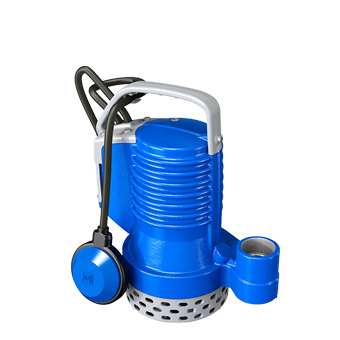
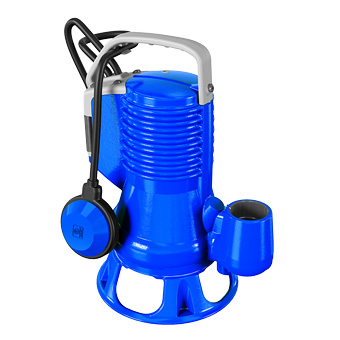
The blue family is intended mainly for domestic/residential installations. The DR and DG photographs look similar above the hydraulic end, but their impeller directions serve different waste streams. Describe solids and fibres from the actual process. A solids-passage figure is not a statement that every fibrous or abrasive stream is suitable.
For a room below sewer level, the enquiry should describe the complete collection and discharge system. Buying a pump alone leaves the inlet height, tank connections, overflow alarm and access arrangements unresolved.
| What needs to be moved | Reviewed direction | Selection boundary |
|---|---|---|
| Clear or slightly soiled wastewater | DR blue: multichannel open impeller | Define debris and the required curve; do not substitute DG ratings. |
| Sewage or heavily soiled wastewater with solids | DG blue: techno-polymer vortex impeller | Select the exact size, solids passage, levels and installation accessories. |
| Wastewater that cannot reach the sewer by gravity | blueBOX collection tank with a selected pump arrangement | Resolve inflow/storage, pumping duty, pipe entries, venting, controls and service access. |
Use the DG curve, not two catalogue maxima combined
The existing DG blue profile is a family-level 50 Hz reference. Its maximum flow and maximum head are separate limits, not an operating point that delivers both at once.
The product documentation describes an oil chamber, mechanical seals and a protective V-ring, with wear-part replacement and pressurised assembly testing among its construction details. Ask for the supplied model’s materials, seal service instructions and replacement part references. General family photographs do not identify every seal or electrical variant.
The page also lists versions with hazardous-area certification. This does not make a standard DG blue order an explosion-protected unit. If the project requires such a version, put the atmosphere/zone requirement in the enquiry and obtain the exact marked configuration and matching documentation.
| DG blue 50 Hz field | Published family value | What to confirm |
|---|---|---|
| Maximum flow / maximum head | 468 L/min / 12 m | Select the exact DG size and duty on its curve. |
| Free passage | Up to 40 mm | Compare the offered hydraulic version with actual solids and debris. |
| Motor range / supply | 0.3–0.74 kW / 220–240 V single phase | Confirm the motor/nameplate and required local electrical supply. |
View the reviewed product family →
blueBOX: nominal tank volume is only the start of the layout
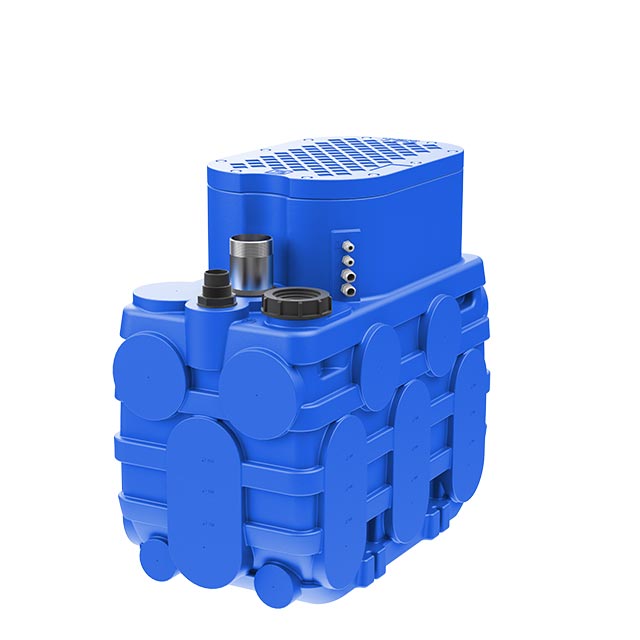
The reviewed blueBOX range uses polyethylene tanks with rated volumes from 60 to 500 litres. The documentation separates smaller domestic/residential directions from larger civil-installation directions, and lists fixed and coupling-device configurations. A nominal tank volume alone does not determine usable operating storage or the number of starts.
Provide the incoming fixtures/streams, estimated inflow pattern, sewer/discharge elevation and discharge pipe route. Agree the selected pump curve, start/stop levels and the volume between those levels. For intermittent peaks, describe the peak duration rather than only an average daily volume.
The catalogue describes intake connections up to DN110 and DN40/DN50 delivery connections, with extensions for the 250 and 500 litre versions. Identify actual connection sizes and elevations on the selected drawing. Include a vent route, floor or underground arrangement, emergency emptying and backflow provisions appropriate to the project.
Write the control and alarm scope
The documentation distinguishes a pump float from an optional continuous level-sensing arrangement. Agree start/stop thresholds, the maximum-level alarm, panel scope and response to pump failure. For a multi-pump offer, define the duty/alternation sequence and whether either pump can meet the required service.
Choose the coupling around the removal route
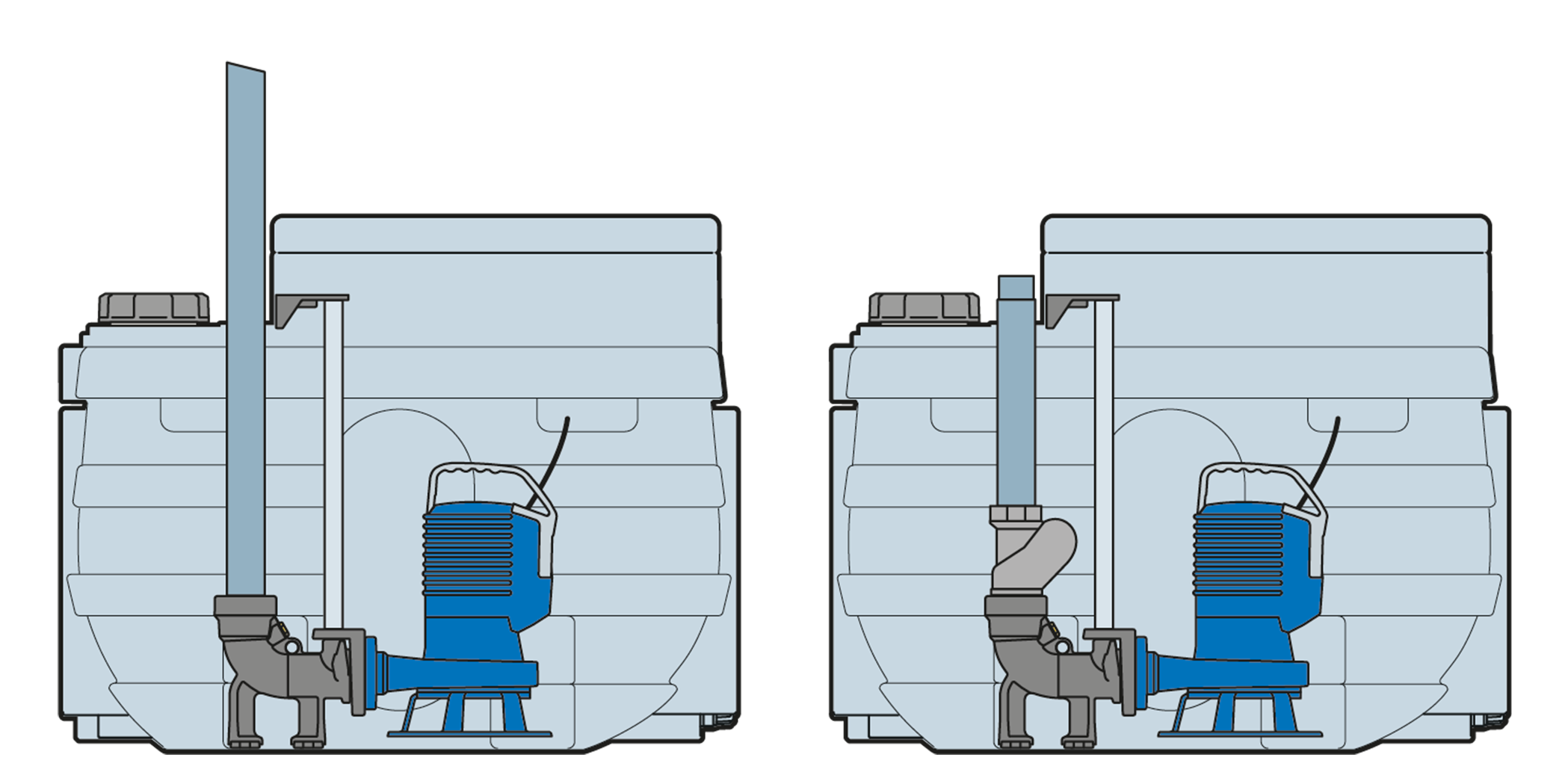
The blueBOX construction guide describes direct quick-coupling installation and a bottom coupling device, allowing separation of the pump for maintenance without dismantling the station’s connected pipework. These are access features, not permission to omit cleaning and inspection.
Show the cover opening, lifting space, guide/coupler arrangement and technician access in the installation drawing. Specify how the pump, float or level sensor can be removed, and which valves and emergency-emptying parts are included. A tank that fits under a floor can still be difficult to maintain if the lifting route is blocked.
For existing installations, send photographs and a dimensioned sketch of the pipe entries and removal path. Ask for a compatible pump/coupling assembly and spare-part references rather than assuming a new pump will fit an older station connection.
A metro example shows why tank, pumps and controls must be specified together
Zenit’s June 2019 Hangzhou Metro Line 5 case history describes wastewater collection/lifting with blueBOX tanks and UNIQA pumps. It discusses a two-external-pump horizontal arrangement and alternating operation through an electronic control panel. This is a manufacturer-published historical example, not independent site acceptance or a DG blue installation.
The procurement lesson is the boundary between the hydraulic package and the building: identify the incoming wastewater, selected collection arrangement, pump access and control sequence together. The case sheet uses different historical station designations; it does not establish that its particular assembly is the currently offered blueBOX 250 or that the Suzhou entity manufactured every component. Request the present configuration and origin in the offer.
Separate the Suzhou order from the wider group portfolio
The group identifies Suzhou production of submersible electric pumps, lifting stations and water-treatment equipment, and describes machining, assembly checks, hydraulic tests and electrical analysis. It separately identifies a Chengdu operation with its own production directions. Agree the legal contracting entity, manufacturing location and supplied components on the order instead of assigning every group product to Suzhou.
The original CQC-issued environmental-management document names Zenit Pumps (China) Co., Ltd. at the same Suzhou address. Its stated period is 18 February 2025 to 17 February 2028, with surveillance conditions; the submersible-pump scope includes a 7.5 kW limit. This is a management-system document, not a hydraulic acceptance report or product approval for every group range.
For procurement requiring current quality-system evidence, obtain the current issuer record and applicable scope: the reviewed company-hosted ISO 9001 document carries an expiry of 26 January 2026. A Suzhou government inspection list separately records the named China entity’s 24 February 2025 inspection with no obvious unlawful conduct found at that inspection. Neither historical record replaces the selected order’s conformity and test documents.
Freeze the supplied configuration
List the pump model, impeller/materials, station volume/layout, coupling, valves, level devices and control panel.
Match documents to the entity and unit
Request the current applicable declarations/certificates, nameplate/origin, selected curves and agreed hydraulic/electrical test records.
Define the handover
Agree installation/commissioning responsibility, operating instructions, cleaning and inspection access, part references and the spare-parts package.
Prepare a wastewater-system brief that can be priced
Waste stream and duty
- Drainage or sewage; solids, fibres, abrasives, temperature and chemical/cleaning exposure.
- Required flow and discharge head, pipe length/diameter and discharge/sewer elevations.
- Average and peak inflow patterns, intended operating levels and required failure response.
Station and service access
- Standalone submerged pump or complete collection station; floor/underground layout.
- Tank footprint, entry elevations, pipe connections, venting and backflow requirements.
- Cover/removal clearance, coupling and guide arrangement, valves and emergency emptying.
Electrical and supply boundary
- Exact voltage/frequency, float or sensor, controls/alarms and multi-pump sequence if required.
- Legal supplier, manufacturing origin, selected drawings and applicable current documentation.
- Quantity, delivery destination, requested date, installation responsibilities and spares.
Submit through KanBeng’s enquiry form with this factory named in your request.