
Wastewater lifting · low-head pumping stations · emergency drainage
AsiaSun Pump & Valve Co., Ltd.
AsiaSun Pump & Valve, legally 亚太泵阀有限公司, is based in Taixing, Jiangsu. Its pumping directions include sewage lifting, large-flow low-head stations and portable flood response, alongside water-treatment equipment. A wet-well sewage installation, a reversible irrigation channel and a temporary hose route have different hydraulic and civil requirements. This guide separates those purchasing decisions and identifies the interfaces that need to be settled before ordering.
- Chinese legal name
- 亚太泵阀有限公司
- Published location
- Taixing, Jiangsu
- Main buying routes
- Wastewater, low-head stations and flood response
- Existing model
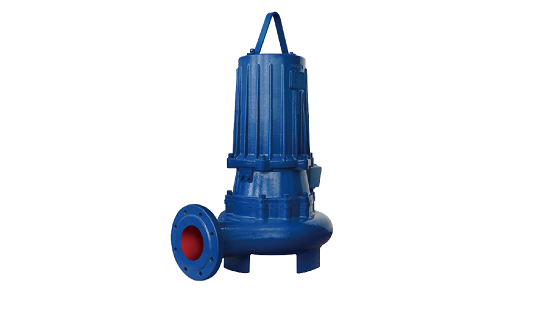
- QW submersible sewage
Start with the water route and the installation, not just a flow target
The company’s catalogue distinguishes QW sewage pumps, QZ/QH submersible axial- and mixed-flow pumps, QGL/QGLS tubular units and portable permanent-magnet equipment. QW sewage pumps, low-head station units and temporary hose-connected equipment are selected for different installations. Compare the required flow at the actual head, then establish how water reaches the pump and how the unit will be removed for service.
| Project | Relevant catalogue direction | Resolve before comparing offers |
|---|---|---|
| Wastewater lifted from a wet well | QW sewage | Solids and fibres, temperature, liquid levels, coupling, cooling and retrieval. |
| Clean or lightly contaminated water at low head | QZ axial / QH mixed flow | Station head variation, minimum submergence, electrical voltage and installation drawing. |
| Fixed channel or station requiring flow in both directions | QGL / QGLS tubular | Separate forward/reverse curves, embedded supports, expansion joints and isolation. |
| Temporary flood drainage or irrigation | Portable permanent-magnet set | Hose route and friction, power source, control cabinet, lifting and transport. |
QW: separate normal sewage service from special-temperature or hazardous versions
The standard QW page specifies liquid temperature up to 40°C, pH 4–10 and solids below 2% by volume. The stated solids-passage range of 5–125 mm spans different constructions; it is not a 125 mm passage guarantee for every model. Describe the actual debris, fibres, particle dimensions and abrasive content, and obtain the selected impeller and passage details.
The catalogue describes an external self-circulating water-jacket cooling arrangement, but explicitly excludes that system on units below 15 kW. Do not extend a dry-installation or exposed-motor statement to every small QW pump. Request the minimum operating level, permitted exposure, cooling arrangement and protective response for the selected construction.
The technical page also describes high-temperature abrasion-resistant and flameproof variants. These are distinct ordering routes. They cannot be inferred from a normal QW model name or from the presence of an overload relay.
| Construction described | Published liquid conditions | Order-specific confirmation |
|---|---|---|
| Standard sewage QW | Up to 40°C; pH 4–10; solids below 2% by volume | Selected passage, wetted/seal materials, cooling and installation limits. |
| High-temperature abrasion-resistant variant | Up to 80°C in the separate variant description | Exact designation, wear materials, seals, any external flushing or agitation. |
| Flameproof variant | Up to 40°C; pH 5–9; altitude up to 2,000 m in its separate description | Applicable area classification, marking and valid documents for the exact assembly. |
Make QW removal, sensing and cable scope part of the station specification
For a fixed wet-well arrangement, the guide-rail automatic coupling allows the pump to be lifted without entering the pit to disconnect it. Supply the well depth, pipe connections, hatch dimensions and lifting route. Confirm the coupling base, guide rails, chain, fasteners and the assembled drawing, including who supplies and installs each part.
The catalogue also shows dry installation outside the wet well and portable hose-connected installation. A dry arrangement still needs the selected cooling and inlet conditions to be checked. For a portable unit, establish the stable placement, hose connection and retrieval method; neither the discharge hose nor an electrical cable should be treated as a lifting attachment.
Published construction includes two independent mechanical seals and water/temperature monitoring arrangements. The page discusses winding-temperature protection and options for leakage, humidity, immersion and level signals. Agree which sensors are actually fitted, how they connect to the cabinet and whether each condition gives an alarm, shutdown or lockout.
The source describes standard cable lengths of 6 m or 10 m across different power groups and a normal 3 m guide-rail provision. Specify the real distance and routing rather than assuming either length will reach the cabinet. The ordering notes distinguish a control terminal box from a connection terminal box and ask for the starting method, level-control method and indoor/outdoor cabinet arrangement.
View the reviewed product family →
Curve and power
Request the exact curve and absorbed-power information at the selected speed; a series envelope is not a duty-point guarantee.
Levels and protection
Agree minimum/start/stop liquid levels, standby rotation and the response to sensor failures.
Service access
Plan seal inspection and replacement access, with wear-part references tied to the delivered model.
QZ and QH: station hydraulics and electrical supply must be selected together
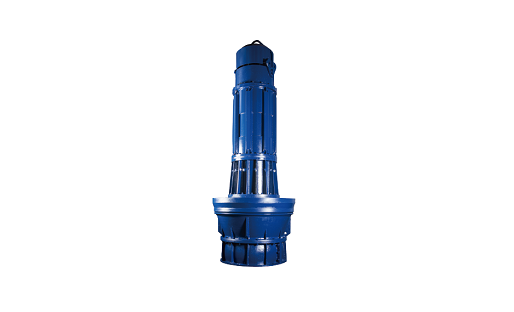
The QZ axial-flow direction is described for generally below 10 m head, while QH mixed flow is described for head up to about 20 m. These are broad catalogue directions for low-head clean or lightly contaminated water, including irrigation, drainage and water transfer. They do not define one unit’s maximum flow/head combination.
The submersible motor and pump form one assembly. The catalogue describes a short common shaft, two seals and an oil chamber, with an anti-rotation arrangement to resist reaction torque. Give the station drawing, water-level range, inlet approach, required operating combinations and removal route so that the actual mounting and submergence can be checked.
The electrical options listed across power sizes include 380 V, 660 V, 3 kV, 6 kV and 10 kV. A voltage appearing in the family catalogue does not make it available on every size. State the site voltage and frequency, starting equipment, cable route and protection scheme. The motor insulation discussion must not be used as a pumped-liquid temperature rating.
Cooling descriptions vary with power and construction. Request the permissible water-level envelope and the selected temperature/leak monitoring functions, together with the matching cabinet and interlocks. Confirm cable length, motor handling mass and lifting provisions before finalising the civil or electrical design.
QGL/QGLS: a reversible station needs two curves and a defined civil boundary
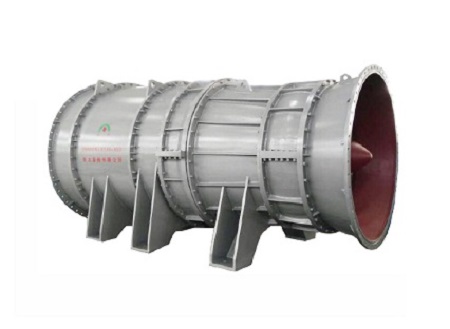
The tubular direction covers large-flow, low-head stations, with single- and double-direction versions. In a bidirectional design, reversing the motor can serve combined irrigation and drainage. The source discusses symmetrical blades with lower reverse-direction efficiency and a forward-direction trade-off against comparable one-way designs. Do not assume identical duty or efficiency in both directions.
The bidirectional discussion points to low heads of about 2–5 m and use where reversing is frequent but annual operating hours may be relatively low. Compare the two duty curves, yearly operating pattern and electricity demand. The page contains flow figures without a time unit; they are not adopted here as rated capacities.
The described horizontal installation places the unit in a normally dry service space beside the water passage. Both end connections need expansion joints; anchors and embedded supports must address axial water thrust. Small direct-drive and larger geared constructions are different layouts, so the actual drawing controls the space and foundations.
The ordering notes list the pump, embedded steel, anchor bolts and control cabinet as supply items, while allowing the two essential expansion joints to be sourced separately. Optional trash racks, gates, flap valves, terminal boxes and level devices also need a named supplier and installer. “Optional purchase” does not mean an expansion joint is optional in the station design.
Fix the station duty
Record forward and reverse water levels, flows, operating hours and any simultaneous units. Obtain curves for each required direction.
Agree the supply drawing
Assign expansion joints, anchors, embedded steel, gates, trash control, cabinet and level devices; check service and lifting space.
Define isolation for removal
Agree the means to isolate water and drain the service space before releasing joints and lifting the unit, using the selected installation instructions.
Portable permanent-magnet equipment: buy a workable hose-and-power package
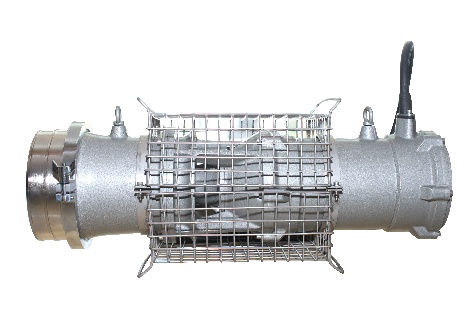
The portable direction is described for flood response and drought irrigation, with submerged operation or suspension using a floating ring. Its catalogue discusses permanent-magnet synchronous motors over a 3,000–6,000 r/min range and variable-frequency control. That range is not a single pump’s rated speed or a substitute for its curve.
The published package list includes one pump, one cabinet, two DN200 hoses of 25 m each, one quick-coupling set and a 15 m cable. Check the quoted configuration item by item. A pair of hoses does not establish the usable flow over every 50 m route: lift, hose friction, bends, outlet conditions and actual connections affect the duty.
Specify the available mains or generator supply and confirm the required voltage, phases, frequency, drive input and electrical loading. The page describes an IP55 cabinet; this is a cabinet enclosure statement, not permission to immerse the cabinet or a pump protection rating. Agree a dry location, cable routing and safe access for operation.
For deployment, ask for the assembled masses and lifting points, hose handling method, floating arrangement if required, coupling sizes and transport plan. The company’s single-person handling description must not be applied to every package without checking its actual mass and the site conditions. Vehicle-mounted or towed systems require their own equipment and control scope.
| Published item | Quantity / size | Check for the actual deployment |
|---|---|---|
| Pump and control cabinet | One of each | Selected curve, speed, electrical input and protection logic. |
| Discharge hose | Two DN200 lengths, 25 m each | Route, couplings, pressure duty and any extra length. |
| Quick coupling set | One set | Compatible pump, hose and outlet connections. |
| Electrical cable | 15 m | Cabinet position, extension provision and electrical design. |
Ask for the selected assembly’s evidence and the responsibilities around it
The national standards platform identifies 亚太泵阀有限公司 among the drafting organisations for GB/T 24674-2021, Submersible sewage pumps, published on 30 April 2021 and implemented on 1 November 2021. This supports a documented standards contribution. It does not certify a particular QW pump or establish compliance with a purchaser’s test specification.
A Taixing municipal report dated 24 March 2025 described a company-developed tracked flood-drainage robot being assembled for delivery and reported cooperation with Jiangsu University’s fluid research centre. This corroborates a dated emergency-equipment activity. Its reported robot capacity is not used as the rating of the portable pump shown above.
For a station order, make the hydraulic selection and the supply/installation boundaries explicit. For an emergency package, make deployment and power interfaces equally explicit. Request dated documents for the actual assembly rather than relying on an undated company award or a broad catalogue limit.
Wastewater lifting
- Fluid temperature, pH, debris, fibres and abrasive loading; required simultaneous flow and head.
- Wet-well drawing and liquid levels, cooling arrangement, coupling, retrieval and cable route.
- Sensor schedule, cabinet logic, exact curve, seal/wear references and operating instructions.
Fixed low-head station
- Water levels and curves for each required direction, duty combinations and electrical supply.
- Civil and maintenance drawing with anchors, joints, gates, trash-control and removal access.
- Supplier/installer responsibilities, acceptance conditions and commissioning checks.
Temporary flood response
- Intake access, discharge elevation, actual hose route, water/debris conditions and operating duration.
- Complete pump, cabinet, hose, coupling, cable and power-source schedule.
- Masses, handling plan, protection response, spares and deployment instructions.
Submit through KanBeng’s enquiry form with this factory named in your request.