
Tanker loading · burner fuel feed · submerged oil extraction
Botou Special Pump & Valve Manufacturing Co., Ltd.
Botou Special Pump & Valve’s catalogue is useful when the installation is part of the selection: a pump driven from a tanker’s power take-off, a heated fuel-feed unit beside a burner, or a long-shaft pump reaching into a storage tank. These arrangements differ in drive geometry, cold-start behaviour, liquid level and pressure control. Choose the installation route first, then specify the oil and operating duty for that assembly.
- Company identity
- 泊头市特种泵阀制造有限公司
- Published location
- Nancang Street, Botou, Hebei, China
- Reviewed directions
- YHCB tanker · TB fuel booster · LYB submerged · RYB internal gear
- Order focus
- Drive interfaces, fuel conditions and installation drawing
Match the pump to the vehicle, burner or tank arrangement
The published company name is 泊头市特种泵阀制造有限公司, with an address on Nancang Street in Botou. Its wider catalogue also includes KCB, residual-oil, jacketed bitumen and screw-pump directions. Keep the quoted manufacturer and full model explicit: another pump maker in the same city or a familiar series code does not establish the same supplier, construction or performance.
| Installation | Series to discuss | First information to send |
|---|---|---|
| A tanker needs to load or unload oil | YHCB circular-arc gear | Vehicle/transmission/PTO identification, shaft layout, loading direction, hoses and tank levels. |
| A boiler, kiln or asphalt plant needs burner fuel feed | TB light/heavy fuel booster | Fuel grade, cold viscosity, required burner pressure, return circuit and any jacket heat source. |
| Oil must be taken from a tank or pit through a submerged pump head | LYB vertical submerged gear | Tank drawing, minimum level, immersion length, mounting support and removal access. |
| Stationary lubrication or clean-oil transfer needs a compact internal-gear option | RYB cycloidal internal gear | Oil cleanliness, temperature, flow, pressure and exact motor/installation selection. |
YHCB is an installation and drive decision as well as a liquid decision
The YHCB page describes a double-circular-arc gear pump for tanker and other mobile oil-transfer equipment. It offers a vehicle power-take-off drive or an electric-motor arrangement, with mechanical or packing seals and alternative gear materials. The existing YHCB listing is a family description; the reviewed page does not give a model-by-model capacity and speed table, so do not size the truck package from the family label alone.
The documented liquid envelope is clean, non-corrosive oil without solids, 5–1,500 cSt and no more than 80°C. The page mentions gasoline, kerosene, diesel and lubricating oil, with copper-gear options for low-flash-point service. For flammable liquid, request approval of the complete pump, seals, drive and operating arrangement for the fuel and required jurisdiction; a gear-material option is not a complete hazardous-service approval.
The manufacturer describes reversible operation, with inlet and outlet roles determined by rotation. Confirm port mapping and the compatible protection arrangement for each required direction. An unloading circuit with filters, non-return valves or directional valves must support that mode rather than assuming that reversing the drive reverses the whole system safely.
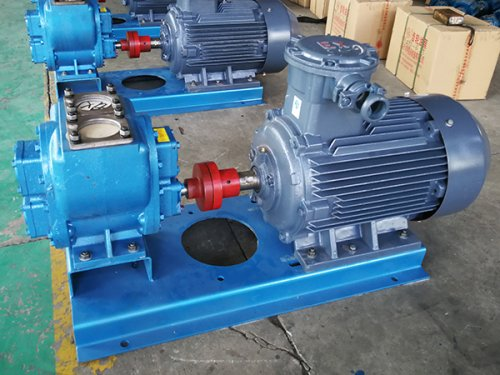
View the reviewed product family →
Resolve shaft speed, viewing direction and suction before fabrication
Botou Special gives an installation angle of no more than 7° between the pump and drive shafts and a vertical suction-pipe limit of 5 m. Treat those as catalogue layout statements, not proof of acceptable driveline vibration or a guaranteed five-metre lift for every oil, hose and speed. Submit the actual shaft offsets and angles, suction length/diameter, fittings, filter and lowest tank level for approval.
PTO speed is not automatically engine speed. Original PTO-manufacturer guidance relates output speed to the transmission and PTO ratio, and requires the output rotation to match the driven component. Agree the engine operating range, actual PTO ratio, pump speed range, torque and rotation viewed from a stated end. The PTO supplier should verify the transmission interface and installation; no third-party PTO compatibility is established by this pump profile.
Freeze the vehicle interfaces
Provide transmission and PTO identifiers, output flange/spline, mounting space, shaft supports and a drawing with viewing directions.
Check the liquid path
Define tank levels, hoses, inlet filter pressure loss, loading/unloading modes and where any bypass returns. Request the approved suction conditions at cold-start viscosity.
Agree commissioning and maintenance
Obtain the startup ramp, valve positions, allowed speed/torque, protection settings and maintenance schedule for the supplied arrangement. The official YHCB instructions call for open valves at startup and gradual speed increase.
TB fuel-feed selection must separate pressure control from overload relief
The TB product page describes a five-piece gear-pump construction, alloy gears, thrust plates and an internal return valve for burner-feed duties. It distinguishes an ordinary construction from a jacketed option heated by steam or thermal oil. For heavy fuel that thickens or sets on cooling, send the cold viscosity and required preheat conditions; do not start against solidified material.
The detailed page specifies lubricating fuel without hard metal particles or long fibres, 5–1,500 mm²/s, and excludes strongly corrosive or readily volatile low-flash-point service. The company overview separately mentions alcohol-based fuel. Those passages do not establish a general alcohol-fuel approval. Supply the full fuel composition and request written compatibility of metals, seals and lubricity before using this direction for a blended or alternative fuel.
The internal return valve is described as short-term overload protection, not continuous pressure regulation. A burner circuit may need a separate pressure-control and return arrangement. Ask for the required feed pressure, allowed variation, control method, low/high-pressure protection and return destination; no numerical TB capacity or pressure rating should be inferred from a claim of stable burner supply.
Fuel and heating
- Grade/composition, contaminants, viscosity at startup and running temperatures, and filtration requirement.
- Jacket heat source, supply conditions, temperature limits and heat-up/shutdown sequence.
Burner interface
- Flow and pressure demanded by the burner, minimum/maximum firing conditions and operating cycle.
- Control and return diagram, seals/materials, motor supply and required area classification.
Submit through KanBeng’s enquiry form with this factory named in your request.
LYB requires tank geometry and liquid-level control
LYB places the gear-pump head below the liquid and the motor above it, with a long transmission shaft and tank-cover mounting. The company describes adjustable shaft-length arrangements and material lubrication by the pumped liquid. Give the immersion requirement as a drawing, including minimum and maximum levels, rather than ordering only a nominal shaft length.
The documented direction is lubricating liquid without strong corrosion, hard particles or long fibres; the page excludes heavily contaminated and readily volatile media. Submergence can simplify taking liquid from the tank, but it does not remove all suction, low-level or bearing conditions. Ask for minimum submergence, inlet-screen requirements, support loads, allowable shaft arrangement and dry-running protection.
The webpage describes seal access without lifting the complete pump. Confirm the service drawing for the supplied immersion length, the clearance needed to remove the shaft/pump head and the parts that can actually be serviced in place. This turns a general maintenance claim into a usable tank-layout decision.
RYB uses an eccentric internal rotor pair for stationary oil duties
RYB is described as an internal-gear positive-displacement pump with inner and outer rotors differing by one tooth, positioned eccentrically without a crescent divider. The catalogue names clean mechanical oil, turbine oil and diesel, excludes hard particles and gives a temperature ceiling of 120°C.
The page lists a family flow range of 10–160 L/min, 0.6 MPa working pressure, 1,500 r/min and motors from 0.75 to 4.0 kW. It does not provide a complete row tying every motor to a specific capacity. Request the exact selected model and curve. Its accompanying cubic-metre conversion is inconsistent at the lower end, so use the stated L/min range and a confirmed selection sheet rather than repeating both numbers.
For a lubrication circuit, agree inlet filtration and its cold-oil pressure loss, permitted pressure variation, return path and the relief setting. The official RYB instructions also distinguish overload protection from long-term pressure reduction. Claims of a one-to-two-times life increase over ordinary gears have no comparable test conditions here and should not determine the maintenance or spare-parts plan.
Send an installation-specific package through the platform
Request performance and protection checks for the exact assembly, including the stated test liquid, speed, suction and discharge conditions. For a mobile unit, add an approved interface drawing; for a heated unit, add jacket and seal ratings; for LYB, add the immersion and servicing drawing. Current certificates, if required by the order, must identify their holder, scope, issuer and validity.
Reviewed on 8 October 2026 from the company, YHCB, TB, LYB and RYB pages. PTO speed/rotation context was checked against original PTO-manufacturer documentation. Installation and enquiry guidance is procurement analysis; it is not a vehicle approval, witnessed factory inspection or completed pump test.
Identify the assembly
- Exact series/full model or existing nameplate; vehicle PTO, electric drive, burner feed or submerged installation.
- Duty drawing with ports, rotation/viewing direction, tank levels, hoses or piping and mounting/removal space.
Define operating and supply requirements
- Liquid composition, cleanliness, viscosity at cold start and operation, density and temperatures.
- Required flow/pressure and allowed variation, drive speed/torque, control and bypass arrangements.
- Pump-only or complete-drive scope, confirmed materials/seals, inspection and test conditions, maintenance instructions, spare parts, quantity and destination.
Submit through KanBeng’s enquiry form with this factory named in your request.
Report an outdated detail · Return to the enquiry checklist ↑