
ZLB / ZLD axial-flow pumps · drainage stations · QL gate hoists
Changde Qiyi Water Pump Manufacturing Co., Ltd.
For Changde Qiyi, the useful buying decision is the complete station fit: a selected axial-flow duty, shaft and support arrangement, workable sump, and clearly defined gate-hoist and installation scope.
- Chinese company name
- 常德七一水泵制造有限公司
- Published base
- Changde, Hunan
- Main pump direction
- ZLB / ZLD axial-flow pumps
- Related equipment
- QL gate hoists · valves
Start with the drainage station, not a pump diameter
Changde Qiyi Water Pump Manufacturing Co., Ltd. is 常德七一水泵制造有限公司 in Changde, Hunan. Its published range centres on ZLB and ZLD axial-flow pumps, together with gate hoists and valves. This makes a drainage or irrigation station a more useful starting point for an enquiry than an unspecified centrifugal or slurry-pump request. The company introduction lists axial-flow diameters from 200 to 1,200 mm; the catalogue separately shows 250ZLB-4 variants, 300ZB-4 variants, 350ZLB-6 variants and 500ZLB-3.5.
For a station upgrade, describe the water levels and the civil works before asking for a size. Give the required discharge, lowest and highest intake levels, outlet water levels, discharge-pipe route and losses, number of operating units and standby arrangement. A nominal diameter identifies only part of the assembly. The hydraulic selection, motor, installed length and support layout still have to work together.
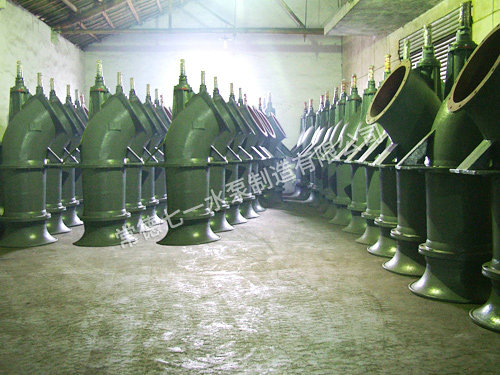
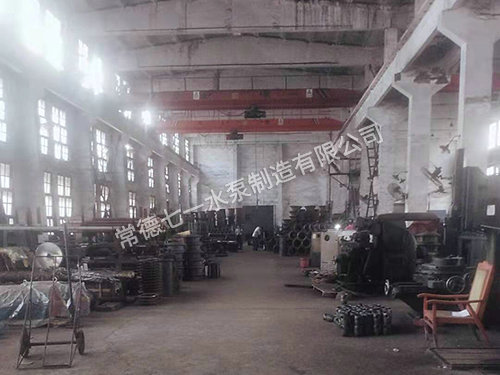
The company describes a manufacturing lineage beginning in 1951 and a change to its present name in 2011. Those are its published historical statements, rather than a claim that the current legal entity was incorporated in 1951. Its displayed workshop photographs show axial-flow assemblies and machining areas; they do not establish a current production capacity or delivery date.
| Your station task | Send before selection | Resolve in the offer |
|---|---|---|
| Replace an existing vertical unit | Full nameplate, operating record, pit and support measurements | Hydraulic duty plus exact shaft, support, flange and motor interfaces |
| Increase or restore drainage capacity | Required discharge and seasonal intake/outlet levels | Curve over the working head range, power demand and operating-unit plan |
| Replace a gate or its hoist | Gate drawing, travel, load and mounting arrangement | Pump, gate, hoist and electrical responsibilities as separate scope items |
Keep the complete suffix and distinguish operating figures from motor power
The small-pump catalogue gives separate entries for 250ZLB-4, -4A, -4B and -4C, and separate 350ZLB-6, -6A, -6B and -6C entries. Do not remove the suffix when asking for a replacement or assume that the neighbouring catalogue photograph represents the same hydraulic selection. Provide the complete original code and request the selected impeller configuration, speed, curve and installation drawing.
The illustrated 250ZLB-4 nameplate records 432 m³/h at 3.65 m head and 1,470 r/min. On that same plate, 5.67 kW is shaft power and 7.5 kW is the matching motor entry. These figures describe the pictured historical unit, not the performance of every 250 mm pump or a guarantee for a newly quoted variant.
Use that distinction when reviewing an offer: the pump duty belongs to a specified configuration and speed, while the motor must be selected for the agreed operating envelope. Ask for flow, head, efficiency, absorbed power and permitted operating range together. A single nameplate point cannot establish performance at every seasonal water level, the required minimum submergence or the suitability of the water quality.
| Pictured 250ZLB-4 entry | Published figure | How to use it |
|---|---|---|
| Flow and head | 432 m³/h at 3.65 m | A paired duty point, not two unrelated maxima |
| Rotational speed | 1,470 r/min | Keep the selected speed with the duty and curve |
| Shaft power | 5.67 kW | Pump absorbed-power entry; not the motor nameplate rating |
| Matching motor | 7.5 kW | Confirm the motor selected for your operating range |
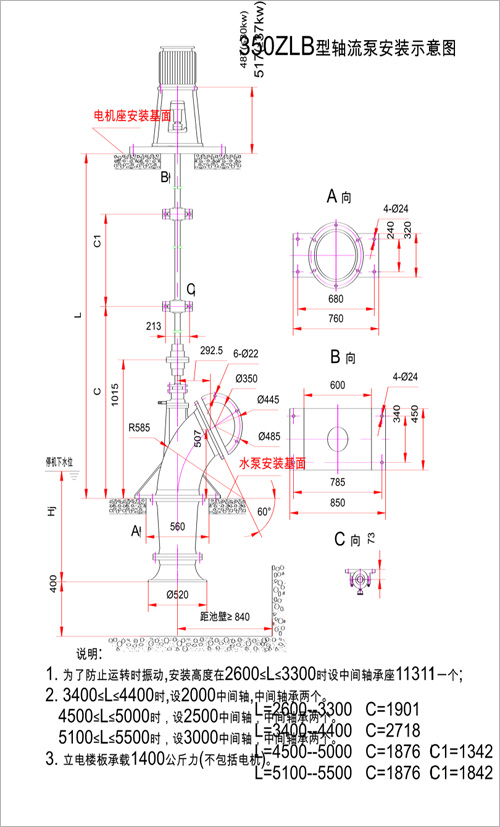
The 350ZLB drawing makes installed length an engineering decision
Qiyi publishes a dedicated 350ZLB installation drawing with separate motor, pump and intermediate-support references. It labels the total installation dimension L, pump support, motor support and an intermediate C support. Its notes distinguish several installed-length bands and add intermediate bearing arrangements as the assembly becomes longer. A longer shaft assembly therefore cannot be priced accurately by changing a length in a generic product description.
For an existing station, measure from the pump mounting plane to the motor mounting plane and identify every support. Include the intake position, outlet bend and flange, floor openings, lifting clearance, beam arrangement and the existing shaft and coupling details. Ask the supplier to return a dimensioned drawing for the selected configuration, with support loads, bearing positions, alignment procedure and required civil changes.
The source drawing is useful for discussing those interfaces; it is not a construction release for a different station or motor. Confirm the bearing schedule and support details for the selected installed length. Obtain a legible, project-specific drawing before approving foundation work, shaft manufacture or a replacement intermediate support.
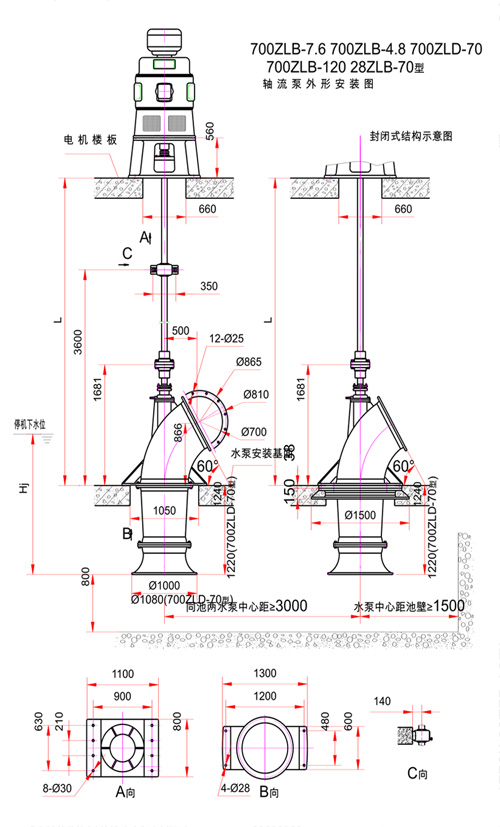
Compare the two 700-series installation arrangements before reusing a sump
The published 700-series outline places an open arrangement beside a closed arrangement and identifies the pump centreline, intake, supports and pit clearances. Its sheet names several 700ZLB variants. The drawing therefore supports an installation discussion, but it does not make every named variant interchangeable or supply a common flow and head rating.
On this particular sheet, the pit internal diameter is marked at least 3,000 mm and the distance from the pump centreline to the pit wall at least 1,500 mm. Retain both dimensions with the depicted arrangement. They are not permission to use an arbitrary rectangular sump, nor a universal rule for every pump size. The illustrated low-water-level dimension H1 has no numerical value on the sheet; do not invent a minimum submergence from the photograph.
If the existing civil works differ, send plan and section drawings showing intake approach, adjacent pumps, screens, sediment, lowest operating level and outlet geometry. Have the selected pump and station arrangement reviewed together. Also confirm access to remove the shaft and impeller, the discharge bend lifting path and how the gate will isolate the equipment for maintenance.
Treat the QL gate hoist as a separate load and travel selection
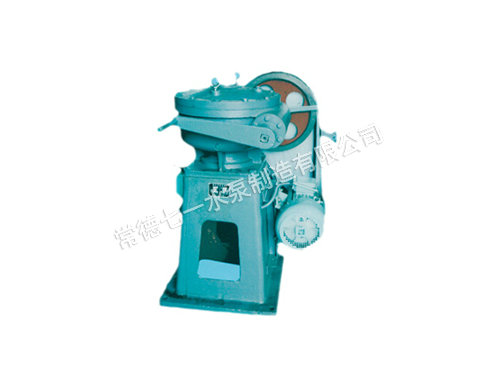
The company introduction lists QL hoist sizes from 1 T through 30 T, and the product catalogue shows a mechanical gate-hoist assembly. Those listed sizes describe the hoist range, not a pump capacity and not an automatic choice for a gate of the same nominal weight. Gate travel, operating load, mounting and drive arrangements need their own selection.
For a combined station package, separate the pump, gate, hoist, valve and electrical items on the equipment schedule. Provide the gate dimensions and drawing, travel, intended opening sequence, water-level conditions and the existing hoist supports. Ask for the selected hoist load rating, operating and limit arrangements, manual operation provision and the gate interface. Specify who supplies the gate leaf, spindle, guides, civil embeds and controls.
Qiyi’s historical project list includes packages combining pumps, motors, starting cabinets and hoists, rather than pumps alone. This is useful for defining an enquiry scope; the supplier-published list is not a current contract award, a present availability statement or proof of the entire package scope for your project. Valves are stated in the company range, but a specific current valve specification should be requested rather than inferred from the pump or hoist listing.
Use the documented local repair context to plan support, not an overseas SLA
A report published by the Hunan provincial united-front department on 23 August 2024, credited to its Changde counterpart, identifies Changde Qiyi by its full Chinese company name. It describes technicians inspecting a failed drainage station in Xianfeng village and replacing a pump during that July’s flood season. This provides a concrete local maintenance context, without identifying the installed model, flow, head or an overseas response commitment.
The company’s service page discusses installation guidance, commissioning, operator instruction, technical information and quality-related repairs. Its domestic response statements use different conditions and times; an overseas buyer should agree the actual service location, language, remote-support route, commissioning responsibilities, spare-parts list and transport costs in the purchase terms. Do not plan an export project around a domestic on-site response time.
For a drainage station where downtime matters, identify the replaceable bearings, seals, shaft sections, coupling parts and motor interfaces in the selected assembly. Agree the inspection and acceptance documents, operating manual and alignment records. The displayed historical honours and licences need current scope and validity checking against the proposed equipment; they are not presented here as a verified certification badge.
Build a station-specific enquiry that can produce a usable quotation
A useful Qiyi request combines hydraulic duty with the physical station interfaces. If you are replacing a failed pump, start with its nameplate and the problem history; if you are changing capacity, start with the required station discharge and water-level range. Keep the pump and hoist decisions separate even when both are in one purchase.
Use the platform enquiry to attach drawings and request a selected curve, dimensioned assembly, component schedule and acceptance scope. Ask the offer to distinguish equipment supply, civil alterations, installation, electrical work, commissioning and spare parts. That makes a price comparison meaningful and reduces the risk of a pump arriving with a shaft or mounting arrangement that does not fit.
Use the pump RFQ preparation guide →
Hydraulic and operating record
- Required flow with intake and outlet water levels; pipe route and losses.
- Existing complete model, speed, nameplate, motor and failure history.
- Water quality, sediment and debris conditions, screens and operating-unit plan.
Measured station interfaces
- Pit plan and section, pump centreline and lowest water level.
- Pump and motor support planes, total installed length and intermediate supports.
- Discharge flange, floor openings, removal route and lifting access.
Package and acceptance
- Pump-only or pump, gate, QL hoist, valves and electrical package.
- Selected curve, project drawing, bearing/support arrangement and materials.
- Inspection records, manuals, commissioning scope, spares and service terms.
Submit through KanBeng’s enquiry form with this factory named in your request.