
JG progressing-cavity pumps, feed arrangements and rotor–stator replacements
Chongqing Jiangguan Pump Co., Ltd.
Jiangguan’s JG range starts with the condition of the liquid at the inlet. A flowing wastewater stream, thick dewatered sludge and a low-pulsation dosing duty need different feeding, rotor–stator and drive decisions, even when their requested delivery is similar.
- Company identity
- 重庆江冠泵业有限公司
- Location
- Luohuang industrial park, Jiangjin, Chongqing
- Core mechanism
- JG eccentric screw rotor and helical stator
- Ordering decisions
- Feedability · pressure band · speed · elastomer
Specify a JG pumping assembly rather than an unspecified screw pump
Chongqing Jiangguan Pump Co., Ltd. identifies itself as 重庆江冠泵业有限公司 and locates its factory in Luohuang industrial park’s B zone in Jiangjin. Its company introduction describes screw pumps, rotor pumps and related components for single liquids and multiphase mixtures. The detailed JG material reviewed here concerns progressing-cavity screw pumps; it should not be transferred to a rotary-lobe pump merely because both appear in the company introduction.
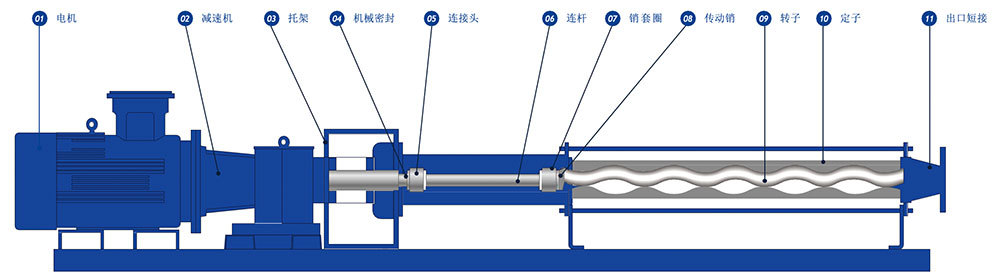
In the illustrated JG mechanism, an eccentric screw rotor moves within a helical stator and transports successive cavities of liquid. The assembly drawing separately identifies the motor, reducer, bracket, mechanical seal, joint and connecting rod. This makes the quotation boundary practical: identify the complete driven set, its inlet arrangement, seal and coupling protection, and the replaceable rotor–stator pair.
The current product gallery names assemblies such as JG3006TM08JTZ, JG2016 and JG2009TM3SD, but their detail pages repeat a general JG selection table. Obtain a configuration-specific drawing and performance schedule for the named assembly instead of treating the repeated table as a separate test report for each gallery product.
Decide whether the liquid reaches the cavities reliably
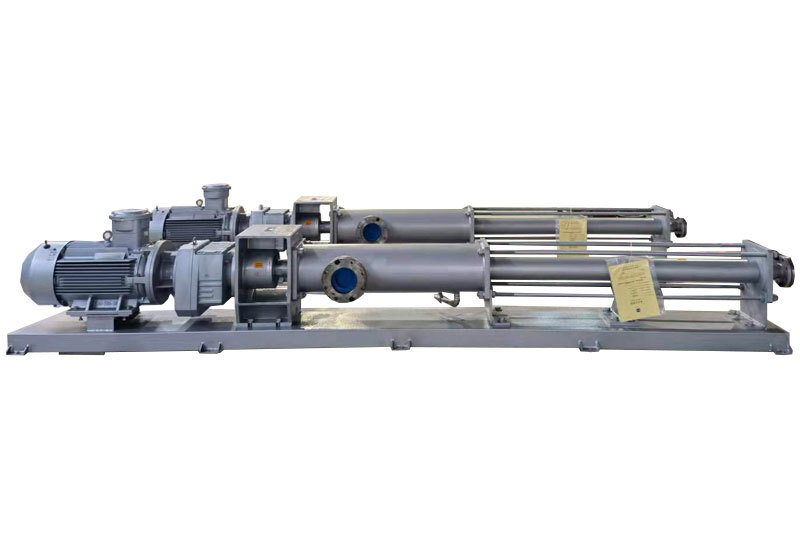
Jiangguan distinguishes horizontal direct-coupled, bearing-pedestal and overhead-motor layouts from vertical, hopper-fed and bridge-breaking arrangements. The direct-coupled version places the reducer and motor in a compact drive line. Its bearing-pedestal description uses a separate drive arrangement; the overhead-motor layout reduces floor length through belt transmission. State footprint, guard access, alignment and drive-maintenance clearance, not just the pump’s nominal size.
The hopper-fed arrangement is specifically presented for concentrated liquids and poorly flowing dewatered sludge, using a feed screw in the inlet chamber. The bridge-breaking version adds an enlarged hopper for material that forms an arch above the inlet. A feed screw is therefore a material-handling decision, not an optional decoration on an otherwise identical water pump.
For a well, pond or other restricted installation, the vertical arrangements include base, wall, suspended and insertion variants. Provide liquid-level variation, installed depth, support position, lifting clearance and maintenance-removal space. A photo of a horizontal set does not resolve these vertical interfaces.
| Inlet/site condition | JG arrangement to discuss | Drawing or process input |
|---|---|---|
| Flowing liquid; short floor footprint | Horizontal direct-coupled | Reducer/motor, coupling access and service space |
| Separate drive or constrained motor location | Bearing-pedestal or overhead-motor | Transmission, guards, alignment and removal path |
| Poorly flowing sludge or concentrated liquid | Hopper with feed screw | Feed consistency, inlet level, solids and hopper interface |
| Material bridges above the inlet | Bridge-breaking enlarged hopper | Sample behaviour, upstream handling and shutdown procedure |
| Well or pond installation | Vertical mounting variant | Depth, liquid level, support and lifting clearance |
Pressure band, speed and motor must stay in the same selection
The general table calls its values maximum theoretical parameters under clear-water conditions. It also says continuously adjustable flow needs an additional variable-frequency control system, and that the listed motor/reducer package corresponds to the minimum delivery. A different delivery can require a different motor and reducer. These conditions matter before using the table for viscous liquid or slurry.
For JG003, the table lists a 4–8 m³/h reasonable flow range and 300–600 r/min preferred speed range. Its 0.2–0.6 MPa pressure band pairs with 2.2 kW and a 5 m³/h reference at 400 r/min; the 1.9–2.4 MPa band pairs with 5.5 kW and 4.5 m³/h at that speed. The shared particle entry is 6 mm and the flange entries are 80 mm. This is a useful example of selecting a pressure row, not attaching one motor to every duty.
The catalogue’s larger JG005 and subsequent sizes print a preferred range of 120–320 r/min while retaining a separate “flow at 400 r/min” column. Do not interpret that reference column as the recommended operating speed. Ask for the selected flow/pressure at the quoted speed, liquid viscosity and temperature, together with absorbed power and starting torque.
Particle diameter alone does not cover long fibres, sharp abrasive solids, settling or feed blockage. Supply the size distribution, concentration, fibre dimensions and abrasion information. Request the agreed liquid-specific operating envelope and protection settings rather than extrapolating clean-water limits.
Rotor geometry and rubber compatibility are separate decisions
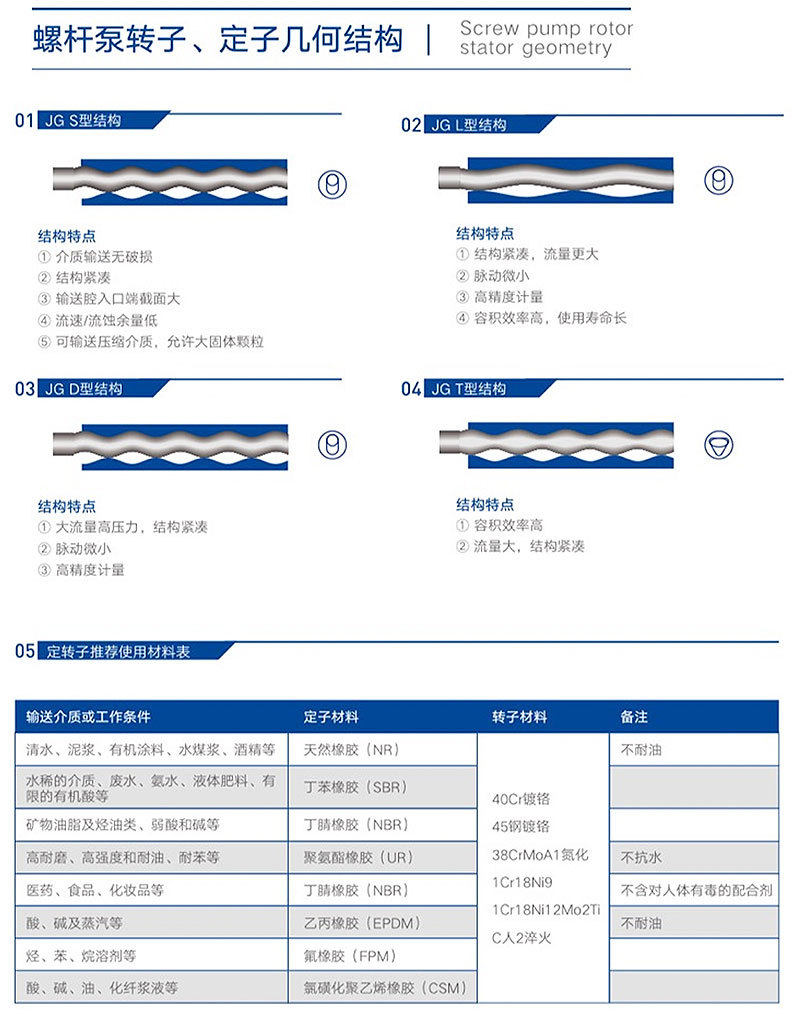
The geometry sheet distinguishes JG S, L, D and T arrangements. It describes S for general conveyance including larger solids, L for greater delivery and low pulsation, and D for a compact high-flow/high-pressure direction. T is a further geometry option. These are catalogue distinctions, not quantified efficiency, precision or lifetime guarantees. Ask for the actual rotor profile, number of pressure stages and intended speed.
Its recommended stator table names NR, SBR, NBR, UR, EPDM, FPM and CSM against different media. Two useful limitations are explicit: the NR entry is not oil-resistant, and the high-abrasion UR entry is marked not water-resistant. EPDM is also marked not oil-resistant. Use those warnings to eliminate unsuitable offers, then confirm the exact compound against your complete liquid and cleaning chemistry.
The sheet’s food/pharmaceutical NBR entry calls for a compound without harmful additives. That statement does not establish food-contact approval of every pump. Require the actual elastomer designation, applicable conformity documents, rotor finish, seal materials and cleaning procedure for the delivered assembly. For chemical mixtures, specify concentrations and normal/cleaning temperatures instead of ordering by a broad label such as “acid-resistant”.
Make storage and restart part of the site procedure
Jiangguan’s maintenance guidance calls for removing the retained medium before an extended shutdown so it cannot freeze, harden or age in the pump. It describes flushing through provided ports or a top connection and draining at the low point in freezing conditions. Specify a chemically compatible flushing liquid, collection route and isolation procedure for the actual process.
For extended storage it discusses avoiding permanent deformation of the stator, keeping components in a cool dry place, preventing rust on carbon-steel rotors and periodically rotating standby units to change the contact position. Define who carries out preservation and how the stored rotor–stator set is identified before dispatch or a long site delay.
Its cold-start instructions explicitly prohibit admitting steam directly into a frozen pump and require freeing rotation before energising. Its fault table separates feed/inlet problems, alignment and foundation issues, damaged rotor/stator, joint trouble and seal leakage. Stop and isolate a defective assembly; use the approved fault procedure instead of attempting to overcome blockage by repeatedly starting the motor.
The website gives reducer-oil and bearing-grease intervals for its described equipment. Put the actual supplied reducer and bearing instructions into the handover pack, and restore guards after maintenance. Order rotor, stator, joint and seal parts by the selected drawing and material code; matching only the JG prefix is insufficient.
Turn a low-pulsation claim into a measurable delivery requirement
The company says flow is proportional to rotational speed and describes metering use. That is a selection direction, not a certified dosing-accuracy figure. If your purchase is for chemical addition, polymer dosing or another controlled rate, state the required turndown, accuracy criterion, calibration liquid, backpressure and how changes in viscosity or wear are handled.
For sludge service, agree feed conditions and liquid-specific tests; for viscous transfer, include cold-start torque and temperature; for multiphase liquid, describe gas content and inlet behaviour. Require the selected pump’s delivery, differential pressure, speed, electrical input and operating temperature to be recorded under the agreed test conditions.
The manufacturer’s equipment gallery includes production and inspection photographs. These support a discussion about manufacturing and testing scope; they do not establish a witnessed test of your pump. Request dimensional checks, identified wetted materials, seal/drive specifications, an assembly drawing, test records and operating instructions tied to the supplied serial number.
Set the shipment boundary explicitly: driven pump, VFD and cabinet, hopper/feed equipment, inlet and outlet interfaces, guards, start/stop protection, installation consumables and initial wear parts. This prevents two apparently similar quotations from differing in the equipment needed to operate.
For environmental solids/fibre service, HJ 2524-2012 provides a useful acceptance reference: it separates routine factory inspection from type testing and calls for rotation and no-dry-running markings. Agree the applicable document and tests in the order. This reference does not assert that Jiangguan holds a certificate or that a particular JG pump has passed those tests.
Send the feed and operating cases with the package drawing
Use the platform enquiry to name Jiangguan and attach the selected duty cases, medium information and site layout. Keep required performance separate from optional accessories, and state quantity, destination, inspection and commissioning responsibilities.
Prepare the pump quotation request and duty schedule →
Liquid and feeding
- Composition, concentration, viscosity versus temperature, gas, particle distribution and fibres.
- Whether the medium flows, bridges or requires hopper/auger assistance; upstream feed and minimum liquid level.
- Cleaning chemistry, emptying, freezing exposure and preservation/storage requirements.
Selected pumping and control duty
- Normal/minimum/peak delivery, inlet condition, differential pressure and continuous/intermittent cycle.
- Quoted rotor geometry/stages, speed, paired motor/reducer and stator compound.
- VFD/control scope, dosing calibration if applicable, feed-loss and pressure protection.
Installation, test and maintenance handover
- Horizontal/vertical layout, hopper interfaces, support, guards, lifting and removal clearance.
- Agreed test liquid, duty record, material identification, drawing and applicable order documents.
- Rotor/stator/joint/seal part identities, reducer instructions, spare set and destination service terms.
Submit through KanBeng’s enquiry form with this factory named in your request.