Water-supply equipment, pump installations and control scope
Changsha Tongda Pump Industry Co., Ltd.
Choose the incoming-water arrangement and equipment boundary first. Tongda’s catalogue separates tank-fed supply, direct-network boosting, individual surface and submersible pumps, and electrical controls; the drawings and duty inputs differ for each.
- Company identity
- 长沙同大水泵实业有限公司
- Site distinction
- Changsha registered address · Xiangtan production address in company documents
- Supply choices
- Tank-fed · network-fed · separate controls
- Pump routes
- Multistage · split-case · QJ · drainage/sewage
A pump order and a water-supply installation are separate briefs
Changsha Tongda Pump Industry Co., Ltd. uses the Chinese company name 长沙同大水泵实业有限公司. Its current introduction lists supply equipment, sewage and centrifugal pumps, inline and metering pumps, together with sales and installation. The catalogue includes individual pump units, packaged supply systems, electrical cabinets and stainless-steel tanks. Decide which of those boundaries belongs in the order before comparing a price.
The company’s published management-system documents distinguish a registered address in Changsha from business and production addresses in Tianyi Economic Development Zone, Xiangtan County, Hunan. That distinction matters when agreeing the supplier, inspection location and delivery documents. It does not establish plant ownership, production capacity or the configuration of any particular photographed pump.
Constant-pressure supply and non-negative-pressure supply use different inlet arrangements
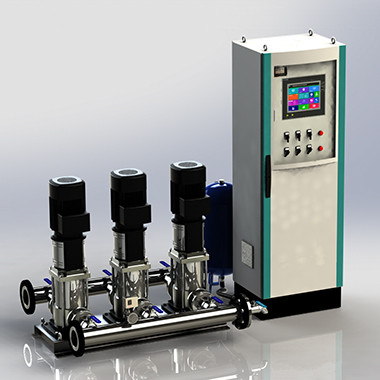
Tongda’s constant-pressure equipment description says its inlet draws from a storage tank or reservoir where municipal pressure is insufficient. The non-negative-pressure description instead connects directly to the municipal network where incoming pressure is available. The catalogue also separates a constant-pressure supply unit and GSK/BM/P variable-speed cabinets. A cabinet-only order is therefore different from a complete hydraulic package.
For a tank-fed installation, provide the available storage volume, operating water levels and pump inlet arrangement. For direct network boosting, provide incoming pressure and available flow at peak demand, together with the permitted connection conditions. Define the outlet pressure and demand profile in both cases, but do not assume the same source-water arrangement or uninterrupted supply.
The illustrated descriptions list 50/60 Hz and broad catalogue ranges. Select the actual pump count, curves, motor ratings, voltage, controller and vessel schedule in the quotation. Catalogue maximum flow and maximum head are not a paired duty point; a package photograph does not determine those ratings.
| Catalogue route | Inlet or supply scope | What to define first |
|---|---|---|
| Variable-speed constant-pressure supply | Water drawn from a tank or reservoir | Tank levels, usable storage, inlet layout and required outlet duty. |
| Variable-speed non-negative-pressure supply | Direct municipal-network boosting | Available inlet pressure/flow and water-supplier connection conditions. |
| GSK/BM/P cabinet | Separately listed electrical control equipment | Existing pumps/motors, control sequence, protection and wiring boundary. |
Stainless multistage selection needs a curve and a maintenance plan
The stainless-steel multistage entry describes a non-self-priming vertical centrifugal arrangement, with a coupling between motor and pump shafts. It lists stamped and welded stainless flow-guiding components, inlet and outlet on the same horizontal line, and maintenance without disturbing the full pipe arrangement. These are useful layout and service questions for a replacement order.
Its technical image lists a catalogue flow range of 0.4–240 m³/h and a head range of 4–305 m. Those values cover the listed direction; they do not describe one operating point. The image labels −15 to 105°C as ambient temperature, so that figure is not adopted as a pumped-liquid temperature rating.
Send a paired flow/head requirement and the inlet pressure, fluid chemistry and temperature. Ask for the selected stage count, material grades, seal arrangement, motor specification and curve at the agreed speed. For an existing installation, attach the connection drawing and available motor-removal height. A stainless product label alone does not define all wetted materials or establish sanitary approval.
The catalogue’s drainage labels do not replace a hydraulic selection
Tongda lists single-stage double-suction split-case, mixed-flow and submersible axial-flow pumps, as well as QJ borehole pumps and drainage/sewage variants. Its submersible product category also contains ZX and ZW self-priming listings. Treat the individual construction and installation drawing as the selection basis; the category heading alone is not a reliable instruction to submerge a pump.
For a surface installation, send the source water levels, suction-pipe layout, elevation and available maintenance space. For an axial or mixed-flow station, provide the required flow and head at the expected high and low water levels, the inlet structure and the proposed discharge arrangement. Request a curve and an installation drawing for the particular pump rather than transferring performance from a similarly named family.
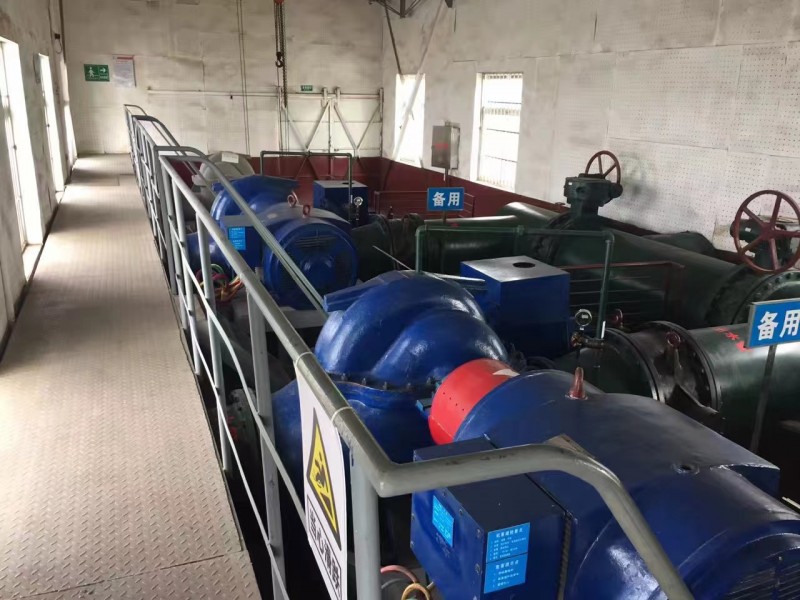
The split-case catalogue photograph shows installed pumps, pipework and a walkway. It is useful for discussing valve and service access, but it is not evidence of the illustrated station’s capacity or a named customer. Replacement work also needs the flange positions, rotation, coupling and base dimensions, with the motor and pump treated as a matched assembly.
Borehole dimensions and solids change the equipment brief
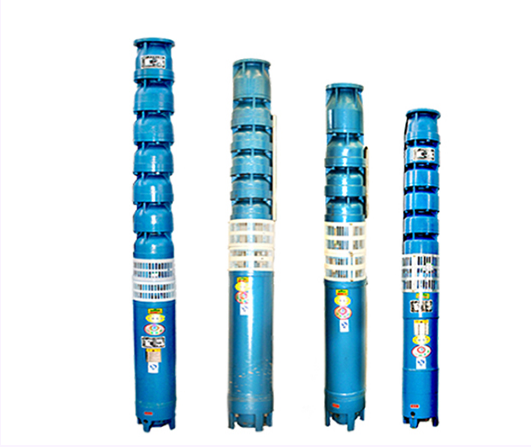
The QJ entry is specifically labelled cast-iron deep-well submersible equipment. The catalogue separately lists hot-water submersible pumps, oil-immersed QY pumps, WQK/QG cutter-equipped sewage pumps and a 304 stainless drainage/sewage direction. Those names describe different choices, not interchangeable versions of one universal submersible pump.
For a borehole, provide internal diameter, well depth, static and pumping water levels, required flow, discharge elevation, sand conditions and cable length. Request the complete pump-and-motor dimensions, stage selection, curve and electrical schedule. The QJ page calls for overload and short-circuit protection and isolation before lowering, lifting or servicing equipment. Have a qualified electrical designer specify earthing, cable protection and the applicable installation requirements.
For sewage duty, provide solids and fibre characteristics, sump dimensions, starting frequency, liquid temperature, required discharge duty and removal access. A cutter label does not establish a solids-passage rating. Ask for the selected impeller/cutter arrangement, guide or mounting system, cable entries, level controls and maintenance procedure.
Company system documents and pump acceptance serve different purposes
The company hosts Chinese and English copies of quality, environmental and occupational-health management-system certificates. The Chinese copies identify the same company and cover centrifugal pumps, Class III, and accessories; the printed dates run from March 2024 to March 2027. For a purchase, obtain the current issuer record and confirm that the relevant production site and scope match the proposed order. A management-system document is not a product curve or a witnessed hydraulic test.
Its gallery also includes a pump-group energy-optimisation software copyright document registered to the company in April 2022. That document identifies software rights; it does not demonstrate a measured energy-saving percentage for an installation. Ask for the actual controller version, communication interfaces, permitted configuration access and commissioning settings when control software is part of the order.
The Hunan provincial government’s May 2013 notice names this company in a public notice concerning the 2012 contract-and-credit programme. This is a historical identity reference, not a current fulfilment guarantee. For acceptance, agree the tested pump duty, motor data, protection functions and delivered documentation independently of those company-history records.
Send a brief that matches the selected catalogue direction
Attach the existing nameplate and drawings for replacement work, or the site design inputs for a new system. State whether the order includes one pump, a pump-and-motor assembly, a cabinet, a complete supply package or installation. Keep the supplier’s equipment schedule and the installer’s work schedule explicit.
Compare manufacturer profiles →
Pump or station replacement
- Paired flow/head, source and discharge water levels, fluid/solids conditions and operating hours.
- Connection positions, pump footprint, motor/coupling data, rotation and removal access.
- Selected curve, material/seal schedule, installation drawing and agreed performance test.
Tank, network or borehole supply
- Tank levels/storage for tank-fed systems; measured pressure/flow and connection conditions for network-fed systems.
- Well diameter/depth, pumping level, sand conditions and cable length for QJ equipment.
- Required pump count, duty/standby arrangement, level or pressure sensing and electrical protection.
Controls and handover
- Cabinet-only versus complete-package scope, exact voltage/frequency, control logic and remote interfaces.
- Current site/scope documents, controller version, wiring, commissioning settings and spare-parts schedule.
- Responsibility for pipework, civil work, lifting, cables, installation and acceptance records.
Submit through KanBeng’s enquiry form with this factory named in your request.