Choose the casing, suction arrangement and cold-service package
Dalian Deep Blue Pump Co., Ltd.
Distinguish a hot process pump from a low-NPSH can pump or an immersed cryogenic unit. Build the offer around the selected curve, maintenance route and auxiliary systems.
- Listed base
- Dalian, Liaoning
- Process constructions
- BB2 · BB3 · BB5 · vertical can
- Cold-service directions
- In-tank · high-pressure · ammonia
- Package decisions
- Seals · lubrication · inspection
Start with liquid conditions and maintenance access, then choose the construction
Dalian Deep Blue Pump Co., Ltd. is the Dalian manufacturer identified here by the Chinese name 大连深蓝泵业有限公司. Its company account dates its establishment to 1988. The published business includes pump equipment, casting, mechanical seals and support systems, and rotating-equipment services. Those directions help define a package enquiry; they do not establish that every item is included in a pump quotation.
Its process range separates HD single-stage BB2, SCSK axially split multistage BB3 and DCSG double-casing BB5 machines. VBP and LDBA address a different question: how to position the first-stage suction when available NPSH is limited. The cryogenic range adds immersed pump-and-motor arrangements for tank transfer, higher-pressure service and liquid ammonia.
Choose between these arrangements using the actual fluid, suction state, required duty and maintenance route. A family label or a maximum catalogue head is insufficient to select an impeller, stage count, casing pressure or motor. The existing KanBeng family listings provide navigation; obtain a current selection for the named series rather than treating their broad ranges as a selected offer.
| Project question | Documented direction | Resolve before comparing offers |
|---|---|---|
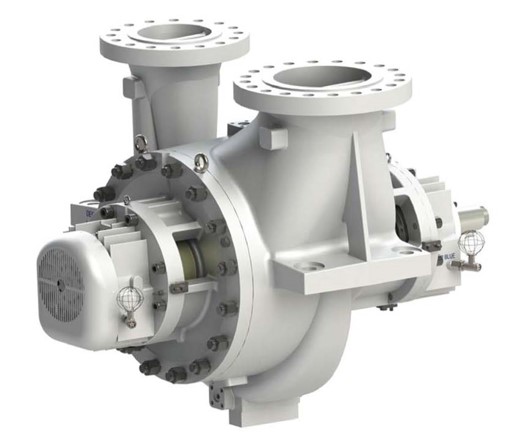
| Single-stage process duty with a centreline-supported casing | HD / BB2 | Suction conditions, selected curve, nozzle loads and seal system |
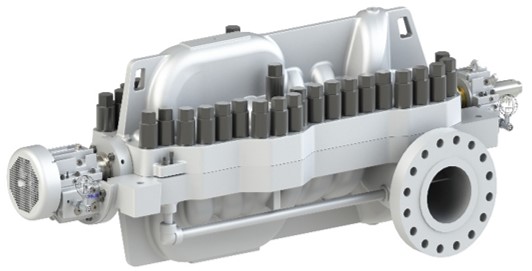
| Multistage duty with axial casing access | SCSK / BB3 | Stage count, thrust arrangement and lifting clearance |
| Higher-pressure duty with a barrel and removable inner assembly | DCSG / BB5 | Casing pressure, extraction route and bearing/lubrication option |
| Limited available NPSH | VBP or LDBA vertical can arrangements | Liquid levels, vapour pressure, can length and first-stage conditions |
| Low-temperature tank or process transfer | RCG, RCH or application-specific RCN | Fluid, pressure boundary, immersed motor and complete installation scope |
Compare how the casing opens and how the rotating assembly is serviced
HD is described as a horizontal, radially split, single-stage process pump with top suction and discharge and centreline support. Its double-suction impeller and cartridge mechanical-seal arrangement are relevant to suction performance and service access. Request the selected NPSH curve and seal arrangement; the construction description does not provide the suction margin or seal plan for a particular liquid.
SCSK uses an axially split multistage casing and opposed impellers. Its documented thrust-balancing arrangement and double-volute design differ from simply adding stages to HD. The manufacturer describes a double-suction first stage for most sizes, not every selection. Identify the actual first-stage construction, bearing arrangement and clearance needed to lift the casing.
DCSG has an outer barrel and an inner assembly with inline impellers. The inner casing can be withdrawn for maintenance. Confirm the direction and space for that extraction, including pipework, coupling and lifting constraints. The product description distinguishes ball-bearing arrangements from optional pressure-lubricated sleeve or tilting-pad arrangements; the lubrication equipment and interfaces must match the ordered configuration.
Review the existing BB2 family listing →
Review the existing BB3 family listing →
Use the documented envelopes to screen a family, not to promise a duty point
The current individual product pages publish the following series limits. Maximum capacity, head, pressure and temperature are separate envelope values. They do not establish that one machine can reach all maxima together. Pressure limits also require their own selected casing, material and temperature basis.
The HD description references API 610 and ISO 13709; SCSK and DCSG also reference API process-pump constructions. Specify the required edition, data sheet, inspection scope and deviations in the contract. A website standard reference is not an independent certificate for the selected package.
| Series / construction | Published capacity limit | Published head limit | Other published limits |
|---|---|---|---|
| HD / single-stage BB2 | Up to 4,000 m³/h | Up to 450 m | Up to 50 bar; temperature up to 425°C |
| SCSK / axially split BB3 | Up to 2,200 m³/h | Up to 1,500 m | Up to 150 bar; temperature up to 200°C |
| DCSG / double-casing BB5 | Up to 1,200 m³/h | Up to 2,600 m | Up to 300 bar; −80 to 425°C |
Specify the first-stage suction conditions and the can installation together
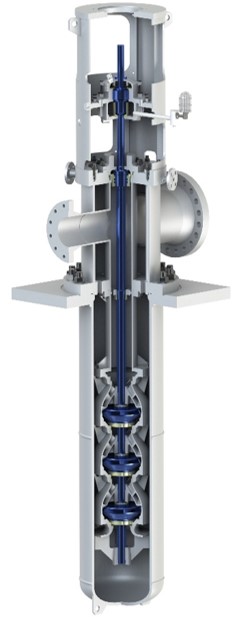
VBP and LDBA are documented for applications where available NPSH is restricted by the system or by a liquid operating near its vapour pressure. Their pump and can lengths are selection variables. Lowering the first stage changes the installation as well as the suction arrangement: provide minimum liquid level, vessel pressure, temperature and suction losses for the intended operating cases.
The product descriptions identify VS6 as a usual arrangement, with VS1 sump-cover or tank configurations also offered. Do not assume that every VBP or LDBA order is the same VS6 construction. The selected drawing should identify the can, column, bowl assembly, flange elevations, support and removal route.
The documentation describes PEEK bushings and a balance drum when high thrust requires it. LDBA is positioned around higher head per stage, while VBP has its own published envelope. Ask for a stage-by-stage selection, total head, NPSH requirement, bearing/thrust arrangement and motor position. Confirm the current envelope and curve for the offered unit rather than transferring a generic vertical-can range.
Review the existing vertical-can family listing →
Separate the cryogenic transfer task from the fluid-specific motor arrangement
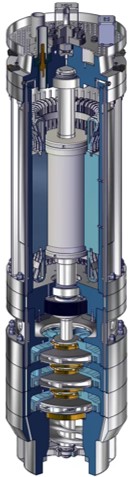
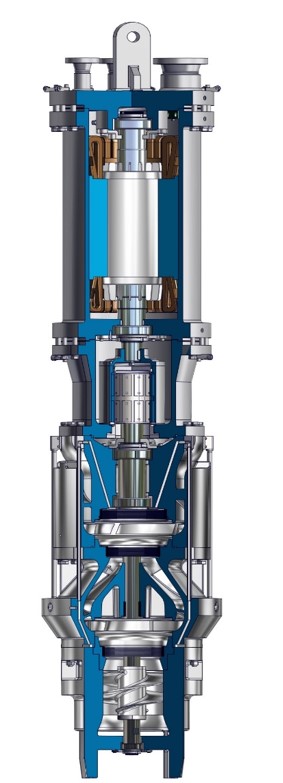
RCG is described as a vertical single-stage or multistage centrifugal pump with the pump and motor coaxial and immersed in the low-temperature medium. Its stated task is to pressurise liquid in a storage tank and deliver it to the downstream process. RCH is a vertical multistage immersed arrangement installed outside the storage tank for higher-pressure downstream service.
The RCG page publishes capacity 10–2,800 m³/h, head 50–810 m, pressure below 65 bar and temperature −196 to +60°C. RCH publishes 5–550 m³/h, 180–2,900 m, below 160 bar and the same stated temperature interval. These are catalogue envelopes, not paired duty points or approval for every liquid within the temperature interval.
RCN is specifically described for liquid ammonia: a magnetic coupling transmits torque while separating the hydraulic part from the motor cavity. That fluid-specific isolation is a different selection question from a general LNG transfer duty. Identify the actual liquid phase, operating temperature, compatible materials and electrical arrangement in the selected offer.
For an immersed unit, agree motor cooling, minimum operating liquid conditions, tank or external vessel interfaces, extraction and inspection access, and the intended control/interlock scope. The absence of a moving seal in a construction description does not remove the need to assess pressure containment, hazardous-area requirements or operating protection.
Review the existing cryogenic family listing →
Include the support-system duty and responsibility in the offer
Deep Blue’s published range includes mechanical seals, seal support and barrier-fluid systems, bearing isolators and lubricating-oil stations. A barrier-fluid system supplies pressurised clean fluid to the seal arrangement; its compatibility and pressure relative to the seal chamber are part of the selection. Identify the selected seal configuration, barrier-fluid specification and monitoring required by the process.
The lubricating-oil station description concerns clean, filtered oil supplied at controlled temperature and pressure to bearings or gearboxes. It describes pressure, level and flow monitoring and duty/standby arrangements in major systems. Those features must be listed for the supplied skid; they are not automatic inclusions with every pump.
The support-system pages reference API 614, while process-pump seal-chamber descriptions reference API 682. Establish which requirement applies to the selected equipment and identify deviations. Agree cooler utilities, filter maintenance, instruments, control signals and failure response across pump, motor and auxiliary suppliers.
Ask for evidence that matches the actual manufacturer and equipment scope
The national nuclear-safety authority’s January 2021 notice identifies 大连深蓝泵业有限公司 and renewed design and manufacturing permissions at that date. The reviewed design licence S(21)04 states validity through 31 March 2026 and a defined nuclear-class 2/3 centrifugal-pump scope with exclusions. That reviewed document has passed its stated validity date; it cannot establish current permission for a new nuclear-safety order.
For a regulated project, obtain the current licence, holder, validity and equipment scope before qualifying the offer. Keep design and manufacturing permissions distinct, and check any excluded equipment and subcontracted activities against the contract. This historical organisational record does not certify the ordinary process or cryogenic catalogue.
The company describes sand and precision casting, several alloy directions, and maintenance, spares and testing services. Request the material specification, traceability, inspection and test records required for the selected order. A foundry description or a service-business page does not establish a witnessed test, a guaranteed response time or a specific spare-parts inventory.
Send a process and installation brief that can become a selected offer
For a new process pump, define operating cases and the selected construction before comparing price. For a replacement, attach the nameplate, serial number, current arrangement and maintenance history, and distinguish a like-for-like repair from a change in hydraulic duty. A change from axial-split to barrel construction, or from external motor to immersed equipment, changes the installation and service work.
Ask the offer to separate the pump, driver, seal and lubrication systems, instruments, controls, testing and site work. Confirm what is included and who owns each interface. Require the current selected curve and drawings to agree with the quoted model and document revisions.
Prepare a structured pump RFQ →
Process and suction cases
- Liquid identity/composition, density, viscosity, solids and normal/start-up temperatures
- Normal, minimum and maximum duty; suction pressure, liquid levels and available NPSH basis
- For cold service: tank/external-vessel arrangement, liquid phase and motor cooling conditions
Construction and installation
- HD/SCSK/DCSG or selected vertical/immersed arrangement; stage count and selected curve
- Nozzle positions/loads, foundation, can or barrel dimensions, lifting and extraction space
- Material/pressure basis, seals, bearings, lubrication and cooling utilities
Complete offer and acceptance
- Legal manufacturer, exact equipment designation, document editions and stated deviations
- Pump/driver/auxiliary scope, instruments, interlocks and commissioning responsibilities
- Selected inspection/test reports, applicable current licences, spares and operating instructions
Submit through KanBeng’s enquiry form with this factory named in your request.