
Prefabricated stations, secondary water supply and individual pumps
Guangdong Quanneng Pump Co., Ltd.
A buried wastewater lift station, a secondary water-supply room and a standalone multistage pump need different site inputs. Use Quanneng’s specific equipment descriptions to define the hydraulic, civil-work and control boundaries before requesting a quotation.
- Company identity
- 广东泉能泵业股份有限公司
- Published location
- Huadu, Guangzhou, Guangdong
- Package directions
- QNYTHBF lift station · QNZHBF pump room · QNWFYGS supply
- Individual pump choices
- DF horizontal multistage · CDM vertical multistage · QN(WQ) sewage
Choose a pump, an assembled package or installation work
Guangdong Quanneng Pump Co., Ltd. presents its Chinese legal name as 广东泉能泵业股份有限公司 and gives a Huadu, Guangzhou location. Its introduction covers development, manufacture, sales, installation and service. The catalogue extends beyond individual pumps to stainless tanks, prefabricated stations, water-supply equipment and electrical controls; an enquiry should identify which of these is included.
The company describes Guangdong as its production centre and separately mentions cooperating production businesses in other provinces. Agree the contracting entity, assembly location, inspection location and equipment manufacturer for the selected order. Partner businesses and other-brand logos displayed on the company site do not establish ownership of those plants or an authorised dealership.
For installation work, put delivery, foundations, lifting, pipe connections, electrical wiring and commissioning into an explicit scope schedule. A packaged-equipment description alone does not determine who performs every task at the destination.
QNYTHBF and QNZHBF address different site problems
The QNYTHBF prefabricated station description concerns liquid lifting and drainage. It lists a reinforced glass-fibre cylinder with internal pressure pipework, a maintenance platform and ladder, screening, coupling and pump-lifting equipment, ventilation, a cover and lighting. Treat that list as the equipment direction; the order drawing must identify the supplied items, dimensions and selected pumps.
For a wastewater or stormwater site, send normal and peak inflow, discharge levels and pipe losses, inlet elevation, ground levels and groundwater conditions. Confirm screening and solids handling, the duty/standby arrangement, alarm levels and safe maintenance access. Civil design must address the actual excavation, foundation and groundwater conditions rather than relying on a generic cylinder photograph.
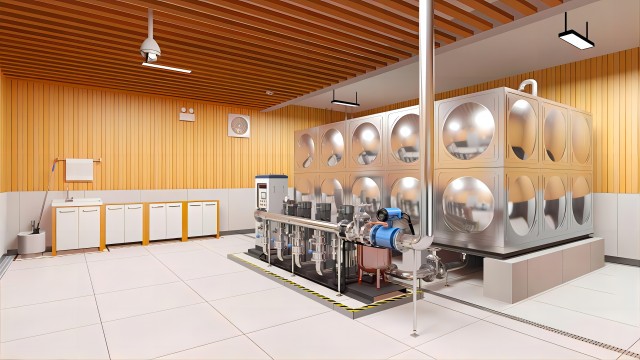
The QNZHBF smart pump-room entry instead addresses secondary water supply, particularly sites without a suitable room or with limited existing space. Its description lists a stainless enclosure/frame, security and access control, video, water-quality supervision, flow monitoring and cloud-based maintenance functions. Ask which functions and sensors are included in the priced configuration and who operates them after handover.
For a retrofit pump room, supply the usable footprint, access route, installation height, existing tank and pipe interfaces, electrical supply and maintenance clearances. Define drainage, ventilation, environmental control and operator access with the installation team. The company illustration is a visual layout example, not a verified completed project.
| Equipment direction | Primary purpose | First drawings and decisions |
|---|---|---|
| QNYTHBF prefabricated station | Collect and lift wastewater or stormwater | Inlet/discharge elevations, inflow, screening, pump retrieval and civil interfaces. |
| QNZHBF smart pump room | Enclosed secondary water-supply installation | Room footprint, source water, tanks/pumps, access, controls and monitoring ownership. |
QNWFYGS boosting depends on the municipal inlet conditions
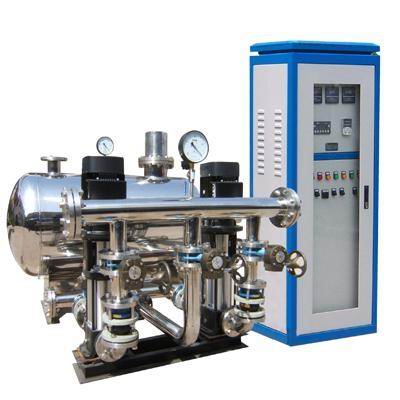
The tank-type and box-type non-negative-pressure entries both use the QNWFYGS designation and describe municipal-network boosting with inlet-flow control and pressure compensation. They discuss maintaining upstream service pressure, compensating a temporary shortfall and using a small expansion vessel during low demand. The two descriptions repeat the same principle; the box-type photograph alone does not establish an identical internal hydraulic layout.
Provide measured incoming pressure and available flow during peak demand, the required outlet pressure and the demand pattern. Request the proposed hydraulic schematic, permitted network connection, low-inlet-pressure response, usable compensation volume and restart sequence. A pressure-compensation arrangement does not create an unlimited water reserve or guarantee supply throughout a mains interruption.
For the box configuration, identify the tank material and usable storage, inlet/overflow/drain connections, cleaning access and water turnover. For either configuration, agree pump count, duty curves, vessel settings, control sequence and the exact boundary between the equipment and site pipework. Obtain the relevant water-supplier connection requirements for the destination.
Fluid chemistry and maintenance access decide the multistage route
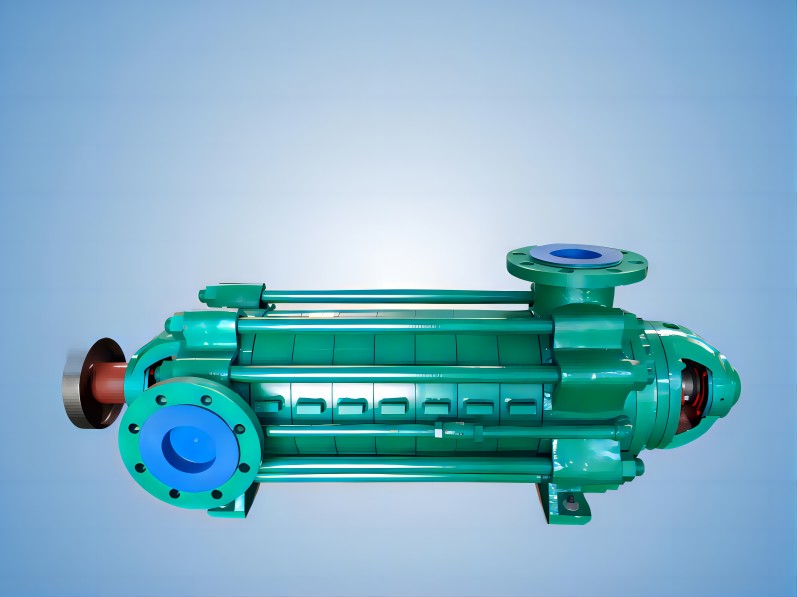
The DF entry describes a horizontal single-suction, multistage sectional pump with horizontal suction and upward discharge, a coupling drive and a hydraulic balance-disc arrangement. Its stated DF service is corrosive liquid without solids, at −20 to 105°C, with permitted inlet pressure below 0.6 MPa. These are conditions from that DF description, not ratings for every pump in the catalogue.
Send the liquid name, concentration, density, operating temperature and inlet pressure, together with paired flow and head. Request the selected material grades, seals, stage count, motor size and curve. For replacement work, provide base and flange positions and access for coupling, bearings and balance components. Corrosive-liquid wording is not permission to use one material with every chemical.
The CDM/CDMF entry describes non-self-priming vertical multistage construction and discusses a cooling-equipped high-temperature configuration. Establish the flooded inlet or priming arrangement and the exact seal/cooling version before selecting hot-water service. Confirm liquid and seal-chamber temperature limits for the quoted configuration, rather than treating the page’s general high-temperature wording as a universal CDM rating.
For a vertical replacement, provide pipe positions, connection size, available removal height and the existing nameplate. Efficiency-index and motor-efficiency marketing need documentation for the actual pump/motor combination; they do not substitute for a curve at the selected duty.
Installation and approval questions differ for QN(WQ) and XBD-W
The cast-iron QN(WQ) sewage entry lists fixed auto-coupling and movable installation choices, with a dual-guide-rail arrangement available on request. It also describes leakage sensing, motor temperature sensing and optional automatic controls. Provide wet-well dimensions, solids and fibres, liquid conditions, cable route, required duty and the proposed retrieval method. Ask for the selected pump’s actual passage and protection connections.
Do not infer clog-free operation, seal life or solids passage from broad catalogue claims. Agree the supplied sensors, compatible cabinet inputs, trip/alarm actions, isolation and maintenance procedure. A pump sensor is useful only when the delivered control system supports and tests it.
The XBD-W entry is labelled horizontal fire-water pumping for clean liquid without solids. A fire-system enquiry needs the prescribed duty, suction conditions, applicable destination requirements and documentation for the exact pump, driver and controller. Obtain the selected assembly drawing and test evidence; general company system documents do not certify a fire-pump package. Do not transfer sewage or general supply controls to a fire-system duty without the responsible designer’s requirements.
List protection functions and prove them during commissioning
The control-cabinet entry lists single- and multiple-pump modes, duty/standby switching and different starting arrangements. Its stated functions include overload, short-circuit and phase-loss protection, plus leakage and motor-temperature inputs. Specify the actual motor loads, supply, starting method, sensors and operating sequence instead of quoting the cabinet title alone.
For a monitored pump room, define local operation during a network outage, alarm recipients, user permissions, communication interfaces and access to configuration and maintenance records. Confirm ownership and ongoing costs of cloud or remote functions in the quotation; the catalogue does not fix those commercial terms.
Agree an acceptance plan covering the selected hydraulic duty, leakage checks, cabinet wiring documentation, sensor and alarm simulations, standby changeover, protective actions and operator training. Record setpoints and provide spare-part identifiers and maintenance instructions for the delivered configuration.
Historical identity evidence and product acceptance serve different purposes
A Guangdong government 2021 proposed technology-based SME list names 广东泉能泵业股份有限公司 in Guangzhou. This is a historical identity reference and a proposed-list record, not a current certification or product approval.
The company introduction contains management-system and after-sales statements. For purchasing, request current documents with matching entity, site, scope and issuer status, together with the written warranty and service territory for this order. Agree labour, travel, commissioning and spare-part responsibilities explicitly. A domestic response-time statement cannot determine service availability at an overseas site.
Prepare an enquiry around the selected equipment boundary
Choose the package direction first, attach the drawings or operating data, and state whether the quotation is equipment-only or includes installation. For replacement pumps, attach readable nameplates and connection dimensions. Separate technical acceptance, destination requirements and service scope so proposals can be compared on the same basis.
Build a structured pump enquiry →
Buried lift station
- Normal/peak inflow, solids, inlet elevation and discharge duty.
- Wet-well dimensions, groundwater, civil drawing and lifting/access constraints.
- Screening, pump retrieval, standby arrangement, alarms and commissioning boundary.
Supply room or network booster
- Peak inlet pressure/flow, outlet duty, demand pattern and tank arrangement.
- Footprint, access, electrical supply and installation/pipe interfaces.
- Pump/vessel schedule, monitoring functions, offline operation and operator handover.
Individual pump or cabinet
- Paired flow/head, liquid chemistry/temperature, inlet pressure and nameplate.
- DF materials/seals or CDM cooling version; connection and maintenance clearances.
- Motor loads, sensors, control sequence, order-specific test documents and spares.
Submit through KanBeng’s enquiry form with this factory named in your request.