
Choose the water station, hydraulic curve and supply boundary
Hunan Credo Pump Co., Ltd.
Plan circulation, intake, drainage or fire-water service with the right pump arrangement. Compare selected-speed curves, complete wetted materials, installation drawings and equipment records.
- Listed base
- Xiangtan · Hunan
- Main directions
- Split case · vertical turbine · mixed flow · fire
- Selection priorities
- Speed · intake setting · wetted materials
- Order documents
- Curves · installation · test programme
Choose the water movement and installation first
Hunan Credo Pump Co., Ltd. is based in Xiangtan, Hunan. Its linked Chinese website identifies the business as 湖南凯利特泵业有限公司. The manufacturer specialises in large industrial water equipment: CPS/CPSV split-case pumps, VCP vertical turbines, HB/HK mixed-flow pumps and several fire-pump arrangements. These are different ways to build a pumping station, rather than interchangeable names for one water pump.
A cooling-water station with accessible horizontal pipework, a river intake with submerged bowls, a high-volume drainage station and a fire room call for different selection documents. Begin with the required operating cases and available civil layout. Establish whether the order is for a bare pump, pump and driver, or a complete package with controls and pipework.
The company describes a technical predecessor founded in 1961 and a move to its Jiuhua manufacturing base in May 2010. That history is distinct from the incorporation date of the present supplying entity. Use the actual entity, equipment designation and drawing revision on the quotation and purchase order.
| Station task | Credo direction | Drawing or record needed |
|---|---|---|
| Accessible clean-water transfer or circulation | CPS/CPSV split-case | Duty curve, suction arrangement, seal and maintenance space |
| Intake with bowls below water level | VCP vertical turbine | Lowest water level, setting depth, column and discharge drawing |
| Large-volume drainage at moderate head | HB/HK mixed-flow | Operating water levels, civil openings and removal arrangement |
| Dedicated fire-water service | CSF/CLF/CDF or a defined packaged set | Rated duty, applicable listing and component schedule |
Read the CPS curve at the quoted speed
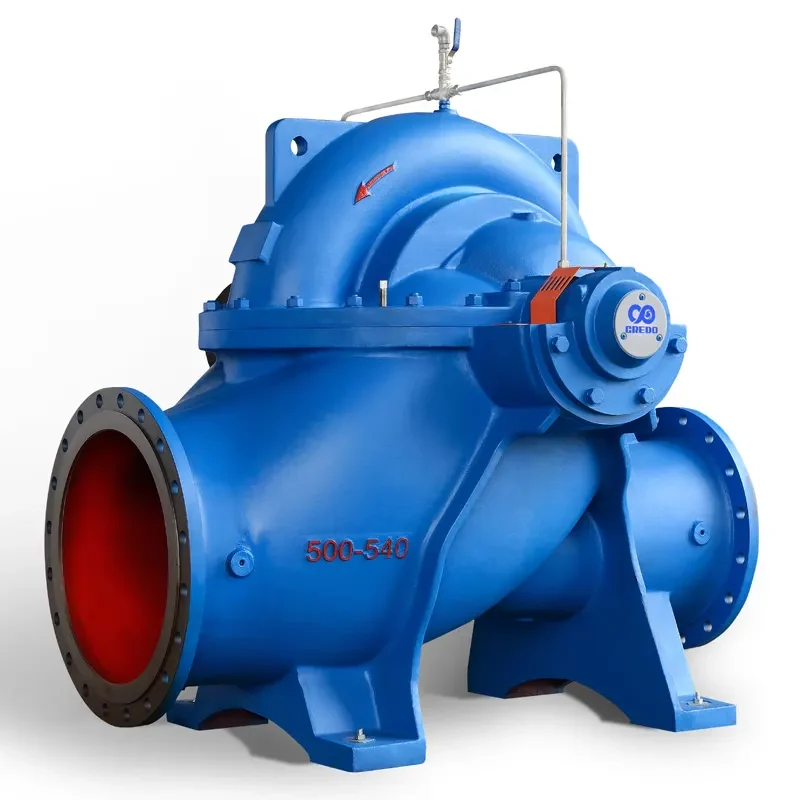
CPS uses a single-stage, double-suction impeller. Its product description offers grease or optional oil bearing lubrication and packing or mechanical shaft seals. These choices affect maintenance supplies and auxiliary connections. Ask for the selected seal drawing, lubrication arrangement, shaft rotation and flange standard before fixing the pipework.
The current parameter tab separates a faster-speed group from a slower-speed group. Its downloaded 50 Hz range chart maps individual hydraulic sizes across the flow/head plane. Use it to find candidates, then request the exact impeller-diameter curve. A point inside a coloured family area does not determine absorbed power, NPSH or the best operating range.
The material table distinguishes clear water, sewage and seawater constructions. For seawater it lists stainless or super-duplex options for the casing and shaft, with stainless, super-duplex or tin-bronze alternatives for impeller and wear ring. Compare the entire wetted bill of materials against chloride content, temperature and suspended solids; the impeller material alone cannot describe the complete pump.
For an existing split-case installation, send the nameplate, nozzle sizes and positions, coupling arrangement and measured service space. Confirm the manufacturer’s current CPS designation against the actual equipment being replaced instead of assuming that a similar family name establishes interchangeability.
Review the split-case catalogue entry →
Specify the complete VCP setting, not only flow and head
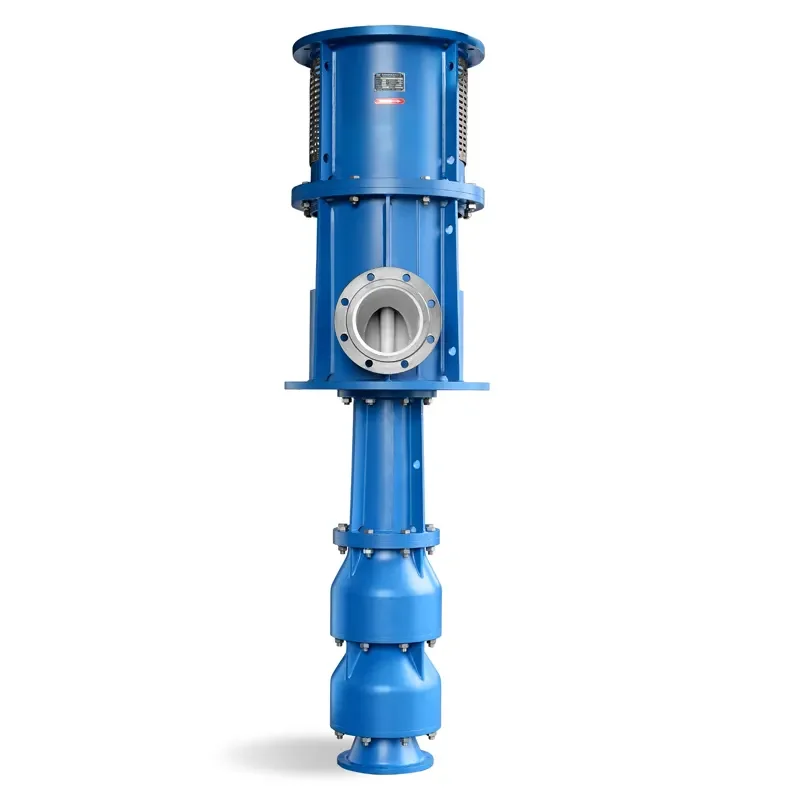
VCP is described as a VS1 vertical turbine in single-stage and multistage configurations. The parameter page separates a 1,480 rpm group from a 590–980 rpm group; the latter covers much larger flow. The manufacturer supplies separate range charts and individual curves. Water level and setting depth are additional design inputs, independent of the hydraulic duty.
One downloaded example, the 1000VCP-96 curve, is explicitly marked 50 Hz and 590 r/min. It shows three impeller diameters, efficiency contours and separate absorbed-power curves, with an ISO 9906 Grade 2 note. The power rises across the plotted flow range. A motor therefore needs to be checked over the intended operating range, not selected from the model suffix or one head value.
Prepare normal and minimum water levels, intake geometry, proposed bowl position, column length, floor elevation, discharge direction and lifting clearance. Request the setting and assembly drawings, selected submergence and NPSH requirements, line-shaft/guide-bearing arrangement and removal procedure. Include river debris, sediment, salinity and temperature when choosing materials.
The VCP component table separates discharge elbow, diffuser/suction bell, impeller, shaft, sleeve and guide bearings. Its seawater column lists stainless and super-duplex options. Ask the supplier to identify the actual grade of each quoted component and bearing lubrication requirements. A vertical layout reduces floor footprint but still requires a practical route to lift the long assembly.
Review the vertical-turbine catalogue entry →
Compare HB/HK against the drainage operating envelope
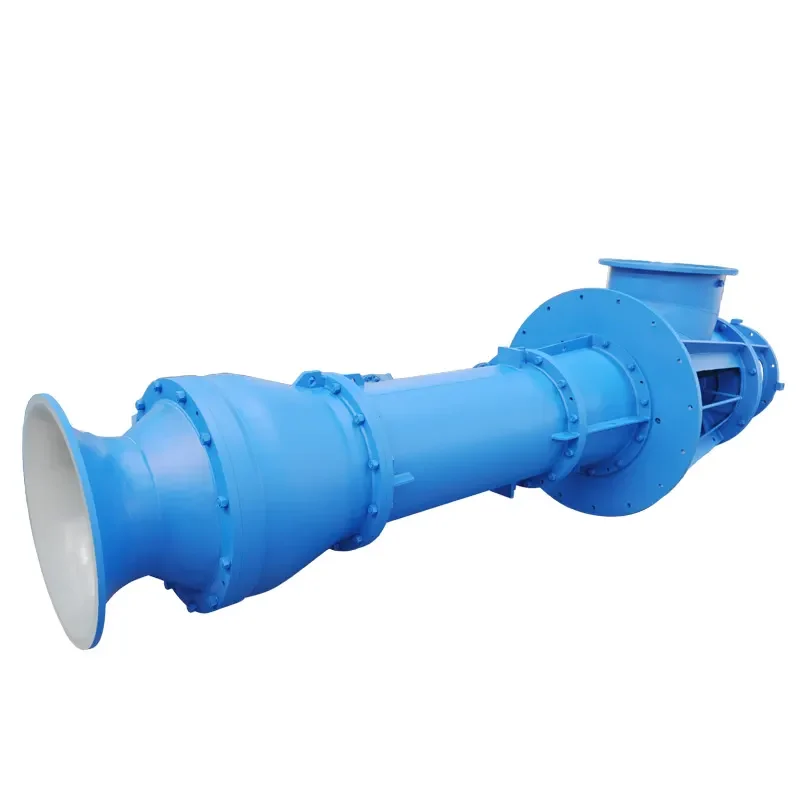
HB/HK is the mixed-flow direction for large water volumes at moderate head. The current parameter tab gives 0.32–20 m³/s and 5–50 m head, with speeds of 245–1,480 rpm. For a brief written in hourly units, the flow interval converts to 1,152–72,000 m³/h. The downloaded HB/HK chart is a family map; it is not an individual selected-pump curve.
Use the minimum and maximum source and discharge levels to build the station operating envelope, including parallel-pump cases where relevant. Request the selected curve and permissible operating range at the quoted speed. Check the intake opening, sump arrangement, foundation loads, discharge connections and lifting method together with the hydraulic selection.
The manufacturer offers different material schedules for clear water, solids-bearing water and seawater/corrosive liquids. The schedule covers suction bell, impeller chamber, diffuser, column, shaft, guide bearings and discharge elbow. Describe the actual solids and corrosive conditions; a family-level reference to wastewater does not establish a universal solids-passage size.
Review the mixed-flow catalogue entry →
Match the fire-pump designation to its approval record
Credo’s fire range distinguishes CSF split-case pumps, CLF vertical turbine pumps, CDF end-suction pumps, jockey pumps and skid-mounted systems. Choose the arrangement from water source, rated flow/pressure, available suction and required driver. A jockey pump has a different job from the main fire pump.
The public UL Product iQ record QXJY7.EX28346 identifies Hunan Credo Pump Co Ltd as the holder for split-case centrifugal fire pumps certified for Canada. The visible models include CSF200-330, CSF150-270, CSF200-315 and CSF125-250. This is useful, specific product evidence. Match the exact ordered designation, rating and intended market to the applicable record; it does not make an ordinary CPS water pump a listed fire pump.
For a packaged set, list the main pump, driver, controller, jockey equipment, valves, gauges and connecting pipework separately. The manufacturer’s skid description allows configurations with or without an enclosure and customised dimensions. Resolve ventilation, power or diesel utilities, access for service, transport size and site interfaces before treating the package as ready to install.
Confirm the current approval documents for the components and complete project requirements with the responsible fire designer. Agree factory and site test scope, rated and additional test points, controller settings and commissioning responsibilities. The 2026 trade-show listing corroborates the manufacturer’s exhibited fire-pump offering, but is not a substitute for the issuing body’s product record.
Make the selected test programme part of the order
The company presents product development, mould/casting, machining, assembly and testing as separate manufacturing stages. Its introduction describes vertical lathes, boring, turning and milling equipment. For the buyer, the practical deliverables are controlled drawings, material identification, selected-part inspection and a test report tied to the ordered pump.
The product testing pages state a test capability of motor power up to 2,800 kW and suction diameter up to 2,500 mm. Some product power headlines exceed that motor figure. Ask how the selected duty and driver will be tested, at which speed and under which acceptance standard; do not assume a family maximum is a demonstrated full-load test on the quoted unit.
Define required flow/head points, efficiency or absorbed-power checks, vibration and leak checks, instrument calibration records and witnessing arrangements. The individual VCP curve’s Grade 2 note gives a concrete starting point for discussing hydraulic acceptance, while the actual purchase specification must state the agreed tolerances and reporting conditions.
Send an enquiry that produces comparable offers
Bring the hydraulic brief, civil arrangement and approval requirements into one selected-equipment schedule. Ask for an itemised offer showing pump and driver, materials, seals, controls, accessories, drawings, testing and site work. Mark optional items and exclusions so that a bare-pump quote is not compared with a complete station package.
For handover, agree the final curves and assembly drawings, serial identification, operation and maintenance instructions, spare-part list and installation/commissioning responsibilities. For replacement work, add the existing nameplate and measured interfaces. Discuss delivery and service commitments for the actual destination rather than assuming that a general company service statement applies everywhere.
Prepare a structured pump RFQ →
Hydraulic and intake brief
- Flow/head operating cases, water levels, suction conditions and frequency/speed
- Liquid temperature, salinity, sediment and solids description
- Intake geometry, setting depth and parallel-pump scenarios
Installation and supply scope
- Nozzle/column layout, foundations, lifting and removal space
- Pump, driver, seal/bearing lubrication and full material schedule
- Controllers, valves, enclosure, utilities and site interfaces
Evidence and acceptance
- Exact fire listing designation, intended market and component records where applicable
- Selected performance and power curves, acceptance standard and witnessing
- Final drawings, maintenance instructions, spares and commissioning responsibilities
Submit through KanBeng’s enquiry form with this factory named in your request.