
Match the water source and installation to the pump package
Hunan Neptune Pump Co., Ltd.
Choose fixed intake, submerged seawater service, fire protection or cold-liquid transfer. For drainage, separate a floating station from mobile emergency equipment before defining the supply scope.
- Listed base
- Changsha, Hunan
- Water equipment
- Vertical turbine · NPS/NPKS
- System directions
- Fire · cold liquid · drainage
- Selection documents
- Intake layout · selected curve · scope
Define the source of liquid and the complete installation before choosing a pump
Hunan Neptune Pump Co., Ltd. uses the NEP brand and is based in Changsha, Hunan. Its bilingual company catalogue identifies 湖南耐普泵业股份有限公司. A 2022 application-stage exchange disclosure identifies the same Chinese company and describes industrial pumps and mobile emergency water-supply/drainage equipment. It is a dated business record, not proof of current stock-exchange listing or a product approval.
NEP’s useful procurement directions include vertical turbine and mixed-flow intake pumps, NPS/NPKS horizontal split-case pumps, fire systems, immersed cryogenic equipment and floating pumping stations. These are different installations: a civil intake with a long shaft, an accessible horizontal pump, a fire package and an immersed cold-liquid unit need different drawings and acceptance documents.
For a new installation, supply the water source, levels, liquid conditions and operating cases. For a replacement, add the original nameplate, shaft/bowl setting, nozzle arrangement and maintenance history. Define whether the purchase is a pump, a complete skid, an intake arrangement or a deployable system before comparing quotations.
| Installation problem | Direction to investigate | Decisive information |
|---|---|---|
| Fixed sump, raw-water intake or large circulation duty | Vertical turbine / vertical mixed flow | Water levels, bowl setting, discharge elevation and rotor removal |
| Accessible horizontal water pump or higher-head two-stage duty | NPS / NPKS split case | Selected curve, pressure, nozzle layout and casing-lift space |
| Fire protection with a defined water source | Vertical or horizontal fire package | Exact pump/driver/controller approval scope and site requirements |
| Immersed cold-liquid transfer | Cryogenic submersible pump | Fluid, temperature, NPSH curve and immersed motor conditions |
| Water source with substantial level changes | Floating pumping station | Mooring, shoreline pipework, power/control and maintenance access |
| Temporary flood or emergency deployment | Mobile drainage equipment | Transport, lift/handling, hoses, power and complete supplying entity |
Use the intake drawing to select the long-shaft or submerged-motor arrangement
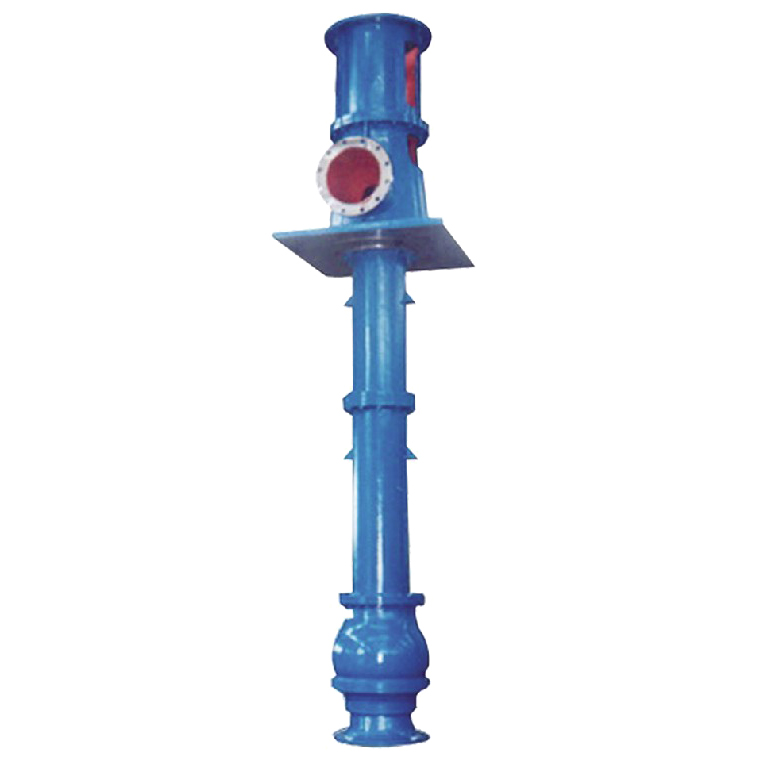
The vertical turbine page describes single-stage or multistage diffuser-bowl construction with enclosed or semi-open impellers, the motor above the installation base, and above- or below-ground discharge. Wet-pit and dry-pit arrangements are offered. Shaft connections, water-lubricated guide bearings and thrust support must be identified for the selected length and installation.
The vertical mixed-flow page describes a mixed-flow impeller and an adjustable below-foundation length. It distinguishes pull-out from non-pull-out rotors in its construction guidance. Ask the offer to show exactly which parts can be removed without disturbing the column or civil installation, and what lifting height and laydown area are needed.
The ordinary turbine description gives liquid temperature no higher than 55°C, but its special-design statement differs from the older catalogue: the web page says up to 150°C, while the catalogue says 90°C. Require the selected materials, bearing lubrication and temperature rating rather than adopting the larger number as a universal capability.
QSD is a separate bottom-suction submersible seawater direction with a submerged motor, seawater-lubricated pump bearings and specified motor-cooling conditions. Its page calls for at least 2 m inlet clearance from the sea bottom and motor-surface seawater velocity at least 0.3 m/s. Have the selected drawing and installation instructions resolve the actual depth, intake clearance, cooling flow, cable and corrosion-material schedule; a long-shaft water pump cannot simply be substituted for this arrangement.
Review the existing vertical turbine family listing →
Separate single-stage double suction from the higher-head two-stage construction
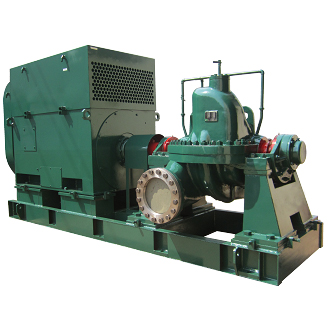
NPS is documented as a single-stage double-suction horizontal split-case pump. The individual product page gives capacity 100–25,000 m³/h and head 6–200 m. It identifies −20 to +80°C and pH 5–9 for its documented liquid scope. The page’s ordinary-material working pressure is 1.6 MPa, described as inlet pressure plus pumping pressure; higher pressure requires a different selected pressure-part configuration.
NPKS is documented as a two-stage single-suction split-case pump with symmetrical impellers and bearings supporting both sides of the shaft. Its individual page gives 50–3,000 m³/h and 110–370 m head. The casing split allows access to the rotating element without disturbing the pipework, but the ordered drawing must establish actual nozzle positions and maintenance clearance.
These capacity/head ranges are family envelopes, not paired duty points. Select speed, impeller, stage arrangement and motor from the actual curve. Both descriptions offer packing or mechanical seals and grease/oil bearing-lubrication choices. Include those choices in the offer rather than assuming the photographed unit fixes every material, seal and bearing detail.
Review the existing split-case water family listing →
Treat the pump, driver, controller and site approval as separate parts of the fire-system enquiry
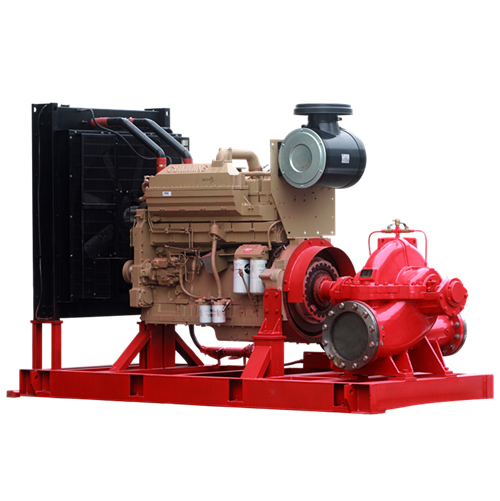
NEP publishes vertical fire pumps, horizontal split-case fire pumps and pre-packaged systems. The package page describes skid-mounted or housed arrangements, electric or diesel drivers, controls and pipework. It also discusses cooling, fuel and exhaust systems. Require an itemised boundary showing which of those items, instruments and installation services are included.
The horizontal fire-pump description uses single-stage double suction and offers rotation choices, packing or mechanical seals and grease/oil lubrication. The vertical fire arrangement sets stage count and column length for the required installation. Resolve the water source and suction arrangement before choosing the package layout or driver.
The pages reference NFPA 20 and make UL/FM or marine-classification statements. For the actual order, check the currently applicable document, listed manufacturer, precise pump model/rating, driver and controller, and any limitations. A company certificate gallery does not establish that all combinations or a complete offshore package have the same approval.
Agree the selected performance and hydrostatic test reports, site acceptance requirements, engine utilities and starting/control responsibilities. The published pre-package capacity/head range covers several possible arrangements; it should not be treated as a single approved fire-pump rating.
Review the existing fire pump family listing →
Identify the cryogenic liquid, operating phase and motor conditions before accepting an immersed unit
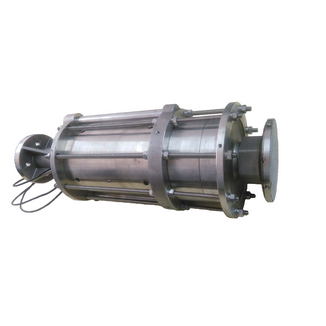
The cryogenic submersible product page describes a permanent-magnet motor and impeller on the same shaft, a fully immersed arrangement without an external shaft coupling, and liquid-nitrogen testing at −196°C. It publishes capacity up to 150 m³/h and head up to 450 m. The older catalogue separately shows a magnetic centrifugal pump: that external configuration is not the same immersed equipment.
The page’s isolated 1.8 m minimum-NPSH statement does not identify the selected duty and full curve. Obtain the NPSH requirement at the actual flow, fluid condition and operating cases. Define minimum liquid level, suction pressure, temperature, start-up/cool-down procedure and motor cooling/lubrication conditions for the quoted unit.
The catalogue names LNG, liquid nitrogen, oxygen and argon, while the web introduction also names helium. These liquids have different selection requirements. Specify the exact medium, material compatibility, pressure boundary and electrical protection instead of treating one low-temperature test or general application list as approval for every cryogenic liquid.
Ask for the complete vessel or tank interfaces, cable/feedthrough arrangement, control signals, inspection/removal method and current operating instructions. Seal-free construction and immersion are design features; they do not justify blanket promises of zero risk or maintenance-free operation.
Review the existing cryogenic family listing →
Decide whether the pump follows a water level or travels to an emergency site
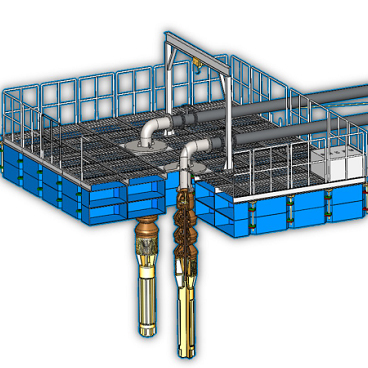
The floating-station description addresses lakes, reservoirs and other sources with substantial water-level changes. It describes a pontoon-based system with pumps, lifting equipment, valves, piping, local controls, lighting, anchoring and PLC-based remote control. The listed pump choices include submerged seawater, vertical turbine and horizontal split-case arrangements.
For a floating station, prepare the water-level range, raw-water conditions, mooring location, shoreline route, power cable and discharge connection. Agree access for inspection, lifting and removal. The published 100–5,000 m³/h and 20–200 m envelope does not resolve platform stability, a chosen pump’s suction conditions or the responsibility for shore works.
Mobile emergency drainage is a different deployment problem. The reviewed 2022 exchange record identified Diwo Technology as the operating subsidiary for mobile emergency water-supply/drainage equipment at that time. Confirm the current supplying/manufacturing entity and package documentation, rather than assigning every vehicle or portable unit to the same ordinary pump record.
For emergency equipment, specify transport access, lifting/handling, the intake location, discharge distance and elevation, hoses, connections, debris conditions and available power. Request the selected operating curve and deployment instructions for the complete system; the generic emergency-drainage listing does not identify a particular vehicle or portable pump.
Review the existing emergency drainage family listing →
Connect the selected arrangement to its test, interface and operating records
NEP describes CNC machining, balancing, inspection and a hydraulic test centre in its company documentation. Use that information to ask for the test method and records that match the selected size, speed, medium basis and package. A published facility photograph or test-centre capacity does not establish a witnessed test of the equipment being purchased.
For large intake equipment, agree hydraulic testing, rotor balance, thrust/bearing arrangement, material traceability and dimensional inspection. For fire systems, resolve the exact approval and complete-system acceptance requirements. For cryogenic or deployable equipment, include the relevant operating conditions and installation/deployment procedure with the selected curve.
The existing family pages remain broad navigation records. Request an offer with the actual legal supplier, exact designation, drawings and revisions, supplied accessories and exclusions. Identify who owns civil, mechanical, electrical and control interfaces so that the complete installation can be assessed.
Prepare a structured pump RFQ →
Source, fluid and duty
- Fixed intake, submerged seawater, fire, cold-liquid, floating or mobile deployment task
- Liquid analysis/identity, temperature, level/pressure cases, flow/head and suction-condition basis
- Existing nameplate, arrangement, installation limits and replacement objective
Installation and complete package
- Bowl/can setting, shaft or submerged motor, rotor extraction and lifting/transport route
- Pump/driver, seals/bearings, control panel, utilities, pipe/hoses and site interfaces
- For floating/mobile systems: mooring or access, power, handling, shoreline/discharge connections
Evidence and handover
- Current selected curves, drawings, document revisions and supplier/manufacturer identity
- Required actual model/package approvals with holder, rating, scope and applicable dates
- Inspection/test records, spares, operating instructions and site acceptance responsibilities
Submit through KanBeng’s enquiry form with this factory named in your request.