
Evaporator circulation · self-priming transfer · process service
Jiangsu Jinxin Pump Industry Co., Ltd.
An evaporation plant can need a circulation pump, a feed-transfer pump and a chemical process pump in the same project. Jiangsu Jinxin’s reviewed catalogue covers these distinct tasks through FJX, WFB and ZA/ZE. Separate the hydraulic duty and installation for each position: high-volume circulation at low head, lifting liquid from a tank, and a pressurised process line require different suction, support and seal decisions.
- Company identity
- 江苏金新泵业有限公司
- Published location
- Xinqiao, Jingjiang, Jiangsu, China
- Reviewed catalogue
- FJX250-5 · 50WFB-A · ZA / ZE
- Project interfaces
- Evaporator, suction tank, pipe loads, seals and utilities
Start with the pump’s position in the process
A shared liquid does not make these pumps interchangeable. Give each position its own equipment tag and operating cases, including start-up, normal duty, turndown and cleaning. The reviewed FJX250-5 and 50WFB-A rows are useful reference points for different tasks; neither is a complete plant selection.
| Plant position | Reviewed direction | Decisive information |
|---|---|---|
| Evaporator / crystalliser circulation | FJX axial-flow circulation | Loop resistance, liquid level and inlet conditions, crystal size/concentration, temperature and thermal movement. |
| Transfer from a lower tank | WFB self-priming | Lowest tank level, suction lift/losses, first fill, retained liquid and air-valve/stop-seal operation. |
| Chemical process line | ZA / ZE centrifugal | Flow/head and inlet pressure, fluid properties, casing support, materials, seal arrangement and pressure-temperature rating. |
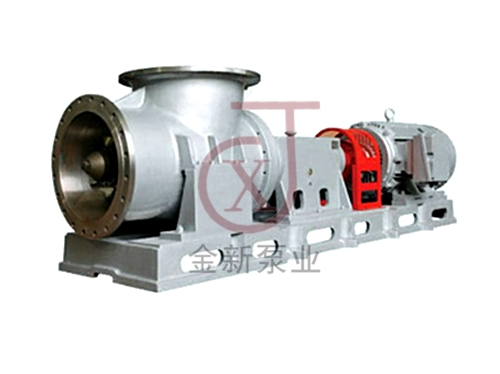
FJX250-5: large circulation flow with a small differential head
The official FJX table lists FJX250-5 at 756 m³/h (210 L/s), 5 m head and 1,450 r/min, with 64.9% catalogue efficiency and 15.86 kW shaft power. Shaft power is not the selected motor rating. The neighbouring FJX250-5-L row lists 680 m³/h, while FJX250-4 lists 756 m³/h at 4 m head: the suffix and precise row matter.
The manufacturer describes axial-flow circulation for evaporation, concentration and crystallisation, including salt and chemical processes. Its page discusses blade-angle and speed changes, slow-running configurations and crystal breakage. Request the curve and permitted adjustment for the offered pump, with actual slurry density, viscosity, crystal size and solids concentration; the water-like catalogue duty does not establish performance or wear life in every crystallising liquid.
For an evaporator with a low liquid level or inlet-side heating chamber, provide the inlet pressure, temperature and vapour-pressure information throughout the operating cycle. Ask the supplier to check the available suction conditions against the offered pump’s requirements. A statement about good cavitation performance cannot replace that calculation.
The FJX page describes centre support, a back-pull-out rotor and elastic-base or suspended options for thermal compensation. Send the piping/evaporator drawing and thermal movements before choosing the arrangement. Agree nozzle loads, foundation or suspension responsibility, seal/cooling utilities and the space needed to withdraw the rotor. Do not assume every photographed assembly includes the same supports.
View the reviewed product family →
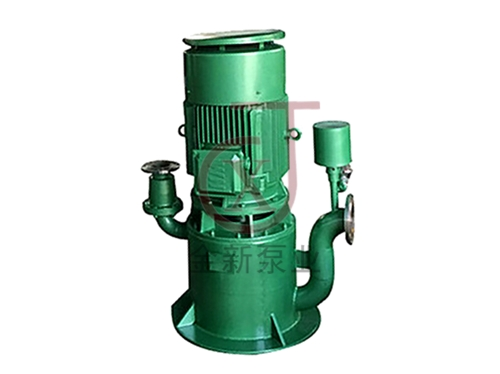
50WFB-A: include priming and shutdown in the operating specification
The 50WFB-A table lists 12.5 m³/h at 26 m head, 2,900 r/min and 5.5 kW matching power, with 50 mm suction and 40 mm discharge connections. The same row group also lists 7.5 m³/h at 28 m and 15 m³/h at 24.5 m. These are catalogue points for this model, not a guaranteed operating range for an unreviewed liquid.
Its permissible suction-depth column gives no more than 5 m. Supply the lowest liquid level, actual suction-pipe route and losses, temperature, density and operating conditions. Treat 5 m as a catalogue limit requiring a site check, rather than the available lift after every pipe loss or a promise for hot liquid.
The WFB explanation requires liquid to be present in the pump before operation. Air and liquid mix and separate during priming. The auxiliary impeller provides a dynamic seal during rotation; the page also calls for a shutdown seal because that impeller does not act when stopped. “No seal” in the family name therefore does not mean dry-start capability or absence of shutdown sealing components.
The electrically controlled air valve closes for priming and opens on stopping to break the siphon. The discharge check valve and retained pump liquid also affect the next start. Include first-fill procedure, air-valve sequence, stop seal, check valve, loss-of-prime protection and power-failure behaviour in the offer. For frequent cycling or unattended transfer, request an operating sequence and commissioning demonstration for the supplied controls.
View the reviewed product family →
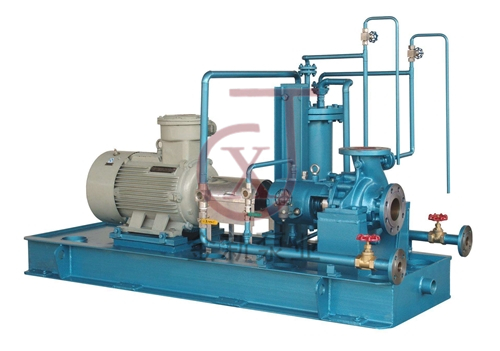
ZA and ZE differ in casing support; qualify the complete package
The official page describes single-stage horizontal centrifugal pumps: ZA is foot supported and ZE is centreline supported. It describes replaceable wear rings and a removable rotor assembly, with packing or mechanical seals and cooling, flushing or seal-liquid arrangements. Confirm the support and seal system for the actual temperature, fluid and piping layout.
The published family envelope is DN25–400, up to 2,600 m³/h and 250 m head, with a stated temperature span of −80°C to 450°C and maximum use pressures of 2.5 MPa for ZA and 5.0 MPa for ZE. These are family statements, not one simultaneous operating point or an approved pressure-temperature rating for every material. Obtain the exact pump curve, material schedule, allowable inlet/casing pressure and temperature rating.
A specific table example is ZA25-200 with impeller form A at 2,900 r/min: 11.5 m³/h, 49 m head and 42% efficiency. The listed motor power changes from 5.5 kW at relative density 1 to 7.5 kW at 1.35 and 11 kW at 1.84. The different density columns make it important to send the actual liquid properties rather than copy the water-duty motor.
The catalogue references API 610 without identifying an edition or providing a configuration-specific compliance dossier. If your project requires it, state the required edition and ask for a completed datasheet, deviations, drawings, seal/utility schedule and agreed test documents. The family name and website statement alone do not establish third-party certification or compliance of the offered unit.
View the reviewed product family →
Separate the pump, auxiliaries and site work in the quotation
The company identifies a casting workshop and separate machining, assembly and testing operations in Xinqiao, Jingjiang. Its home page also says it manufactures or acts as an agent for a broad pump range. Ask which items are manufactured by Jinxin and which are sourced, with the component maker and responsibility for the complete package recorded in the quotation.
Its company page lists fluoroplastic, submerged, slurry and filter-press directions in addition to the three reviewed families. Those names broaden the enquiry options; they do not establish that FJX, WFB or ZA/ZE has the same lining, solids capability or chemical compatibility. Specify exact wetted parts, corrosion/erosion considerations and seal elastomers for the actual liquid.
Equipment and documents
- Exact pump configuration, motor rating, speed and electrical supply.
- Base/supports, coupling/guard, seals, auxiliary piping and valves included.
- Approved arrangement, materials, performance curve, operation manual and agreed test reports.
Plant responsibilities
- Pipe support, allowable loads, thermal compensation and rotor-removal access.
- Cooling, flushing or seal-liquid supply, drainage and electrical/control interfaces.
- Installation, commissioning, acceptance demonstration and spare-parts responsibility.
Submit through KanBeng’s enquiry form with this factory named in your request.
Plan maintenance around retained prime, crystals and removable assemblies
For FJX, agree shutdown/cleaning procedures for crystallising liquid, seal utilities, bearing lubrication/cooling and safe rotor withdrawal. The page gives seal-life figures, but they are not a service guarantee for your chemistry, abrasion or cleaning cycle. Ask for the recommended inspection interval and parts for the selected construction.
For WFB, include checks of the air valve, shutdown seal, check valve and retained liquid after stops. For ZA/ZE, identify the wear rings, bearing lubrication/cooling and seal components to inspect, with alignment and leak checks following reassembly.
API’s published RP 697 overview describes a repair workflow covering field/shop inspection, defined work scopes, replaced or repaired components, and a before/after documentation package, followed by leak testing and return to service. It provides a useful basis for agreeing repair records where applicable; it does not verify Jinxin’s facility or certify these catalogue pumps.
Send a tagged process sketch with the operating cases
Reviewed on 8 October 2026 from the official company and FJX, WFB and ZA/ZE pages and original parameter tables, with API’s original repair-guidance overview used for technical context. Company facilities remain manufacturer-described capabilities. Images illustrate the published families; confirm the exact offer, current drawings and acceptance documents for the project.
Liquid and hydraulic duty
- Pump position/tag, normal/minimum/maximum flow and required head.
- Composition, concentration, density, viscosity, temperature and vapour conditions.
- Solids/crystal size and concentration, corrosion information, cleaning and shutdown conditions.
Installation and acceptance
- Evaporator/loop drawing or suction-tank levels and pipe route; inlet pressure and thermal movement.
- Support arrangement, electrical supply, start frequency, controls, seals and utility availability.
- Required standard/edition, documents/tests, quantity, destination, spares and delivery requirement.
Submit through KanBeng’s enquiry form with this factory named in your request.
Report an outdated detail · Return to the enquiry checklist ↑