
XBD fire-water pumps · ZW[L] pressure stabilisation · building-water equipment
Jiangxi Ruifeng Pump Co., Ltd.
Choose the system role first: a main fire-water duty, a pressure-stabilising package or everyday building supply. Then keep Ruifeng’s complete model, hydraulic curve, controls and acceptance documents together.
- Chinese company name
- 江西省瑞丰制泵有限公司
- Published base
- Ducheng, Gao’an, Jiangxi
- Fire-pump directions
- XBD-GDL / DLL / DL / IS
- Packaged equipment
- ZW[L] stabilisation · GDY supply
Separate the main fire pump, pressure stabilisation and everyday water supply
Jiangxi Ruifeng Pump Co., Ltd. is 江西省瑞丰制泵有限公司, based in the Ducheng industrial area of Gao’an, Jiangxi. Its company introduction describes pump design, development, manufacture, testing, sales and installation. The catalogue combines XBD fire-pump families with water-supply equipment and motors. For a buyer, the first decision is which part of the water system is being purchased: the main fire-pump duty, a pressure-stabilising package, or daily building-water supply.
The listed XBD-GDL, XBD-DLL and XBD-DL families are vertical multistage arrangements; XBD-IS is a horizontal single-stage arrangement. ZW[L] is presented as a pressure-boosting and stabilising equipment package with a pressure vessel and pumps. GDY is named in the company introduction as variable-frequency constant-pressure supply equipment. These headings do not make the systems interchangeable, and a packaged stabiliser is not automatically the selected main fire pump.
Start an enquiry with the system drawing, required flow and pressure, suction conditions and the applicable project acceptance requirements. Identify whether you need a pump and motor, a duty/standby set, controls, a vessel package or installation assistance. Keep fire-protection and everyday water-supply requirements separate on the equipment schedule, even when the same building has both.
| Procurement task | Ruifeng catalogue direction | Resolve in the offer |
|---|---|---|
| Main fire-water duty | Complete XBD family and model | Selected flow/pressure curve, suction conditions, motor and controls |
| Maintain system pressure | ZW[L] stabilising package | Vessel, effective water volumes, setpoints and main-pump interface |
| Daily building-water supply | GDY / water-supply equipment | Demand profile, control arrangement and exact supply scope |
XBD-GDL: retain pressure, flow and the G/W duty letter
The published XBD-GDL arrangement has inlet and outlet on the same axis with equal nominal diameters. The description identifies a stainless-steel shaft, sleeve and outer cylinder, and a mechanical seal. Those component statements do not establish an all-stainless wetted assembly or a particular stainless grade. Ask for the selected model’s wetted-material schedule, seal materials, flange form and dimensions.
Ruifeng’s model-code illustration reads XBD 4.4 / 5 G-GDL. It labels 4.4 as design working pressure expressed in MPa multiplied by ten, and 5 as design flow in L/s. In that illustration, the pressure is therefore 0.44 MPa. The G letter denotes water supply and W denotes pressure stabilisation. Keeping the complete code prevents a small stabilising pump from being confused with a larger main-duty selection.
The catalogue’s GDL table also includes separate operating rows around a model’s rated point. For example, XBD3.5/0.56W-GDL is listed at 2 m³/h, 0.56 L/s, 0.35 MPa and 36 m head, with a 2,900 r/min, 1.1 kW motor entry. Treat these as one published configuration. Do not combine one model’s pressure with another model’s flow or assume the family’s largest flow and highest head occur together.
The existing GDL catalogue link on this platform uses the shorter family designation. For a fire-protection purchase, send the full proposed XBD code and request the matching documents; the shorter GDL name alone does not identify the inspected fire-pump configuration.
View the existing GDL catalogue record →
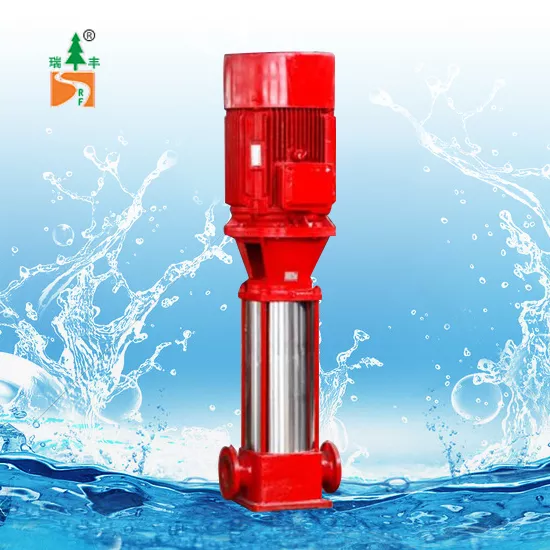

DLL, DL and IS differ in installation and maintenance interfaces
XBD-DLL is described as a vertical multistage sectional pump with one impeller and guide element per stage. The sections are clamped together, with hydraulic balancing, grease-lubricated ball bearings and a mechanical seal. Its catalogue gives a family range of 5–50 L/s and 25–240 m at 2,950 r/min, with nominal ports from 50 to 150 mm. These are family limits, not a single pump’s guaranteed duty point.
XBD-DL is also a vertical multistage sectional arrangement, but its description allows packing or a sealing structure, with mechanical sealing offered according to the user’s requirements. Do not specify DLL and DL as equivalent without resolving the actual seal, component materials, service access and mounting. Both descriptions place the inlet low and the outlet high; confirm the selected discharge orientation on the supplied assembly drawing.
XBD-IS is listed as a horizontal single-stage, single-suction fire pump for ambient-temperature clean water. Its arrangement calls for a different foundation, coupling and maintenance space from a vertical multistage assembly. The published applications do not establish suitability for sewage, slurry, corrosive chemicals or seawater.
The DLL page specifies a 380 V, three-phase, 50 Hz supply. Give the destination voltage and frequency before accepting a motor or performance schedule. A 50 Hz curve cannot simply be relabelled for another frequency. Request the selected pump-and-motor curve, absorbed-power envelope, starting arrangement and the space needed to remove the seal and motor.
Compare effective fire-water volume with stabilising storage and pressure setpoints
The ZW[L] page shows a complete vertical vessel-and-pump assembly and a table of type I and type II selections. The equipment code matters: the table varies vessel size, pressure range, designated fire-water volume, pump reference and operating weight. Choose from the system’s pressure requirements and arrangement rather than from a photograph of the vessel.
One published row, ZW[L]-I-X-7, uses an SQL800×0.6 vessel and lists 300 L nominal fire-water volume, 319 L actual fire-water volume and 54 L stabilising storage. These are different entries with different roles; neither 300 L nor 54 L should be presented as the total geometric vessel volume. The row also lists a 25LG3-10×4 pump reference and a 1.5 kW motor entry. The sheet states that matching pumps are for reference, so the quoted package still needs an agreed bill of materials.
For that same row, P1 is 0.10 MPa, P2 is 0.23 MPa, Ps1 is 0.26 MPa and Ps2 is 0.31 MPa. The sheet defines P1 as gas precharge corresponding to the required fire pressure, P2 as main fire-pump start pressure, Ps1 as stabilising-pump start pressure and Ps2 as stabilising-pump stop pressure. These values belong to the illustrated selection; they are not settings to copy into another building.
Ruifeng distinguishes type I equipment associated with an elevated water-tank room from type II equipment associated with the fire-pump or storage-water room. Send the actual elevation and piping arrangement, then have the designer and supplier agree the selected operating range, safety valve, gauge, pressure switches and control sequence together.
| ZW[L]-I-X-7 table entry | Published value | Confirm before ordering |
|---|---|---|
| Vessel reference | SQL800×0.6 | Pressure-vessel specification and supplied configuration |
| Fire-water volume | 300 L nominal / 319 L actual | Effective volume definition for the selected system |
| Stabilising storage | 54 L | Keep distinct from designated fire-water volume |
| Pressure sequence | P1 0.10 / P2 0.23 / Ps1 0.26 / Ps2 0.31 MPa | Precharge, main-pump start, stabiliser start and stop |

Read the inspected configuration and curve, not just a certificate heading
The company’s download area provides reports under specific model names. The published copy of report Zb2017M1650 identifies XBD4.0/1W-GDL, names 江西省瑞丰制泵有限公司 and records sample acceptance on 26 April 2017. It is a historical type-test document under the stated GB 6245-2006 basis. Its scope should stay with the identified configuration and document date.
The configuration page gives a rated flow of 1 L/s, rated pressure of 0.400 MPa, four impellers, speed of 2,900 r/min and a 2.2 kW motor. The measured performance table records 1.02 L/s at 0.415 MPa and 1.53 L/s at 0.364 MPa. At zero flow it records 0.509 MPa. These distinctions matter: rated pressure, a measured operating point and shutoff pressure are not the same number.
Use that example to review a proposed purchase. Match the full model code, manufacturer, motor, stage arrangement, document date and test conditions to the offered equipment. Ask for the selected curve and the documents required for the destination and project. A historical test report for one small W-GDL configuration is not blanket certification for every GDL, DLL, DL, IS or vessel package, and does not establish today’s certificate validity.
Agree pipe support, maintenance access and the stabiliser’s bladder service
Ruifeng’s installation article calls for independently supported inlet and outlet pipes so that piping weight does not load the pump flanges. For a vertical multistage replacement, send the foundation and anchor dimensions, suction and discharge flange positions, motor height and the available withdrawal space. For a horizontal IS assembly, include coupling access and the space needed to service the rotating assembly.
The DL description names the shaft sleeve, lower bearing and impeller as components to assess for wear during overhaul. Define the actual supplied seal arrangement before making a spare-parts list. Ask for part references, assembly information and the agreed inspection procedure rather than ordering a generic seal for the whole family.
The ZW[L] sheet states that bladder damage affects package operation and calls for replacement when necessary. It also requires the vessel precharge to match the selected setting. Agree isolation, depressurisation, precharge checks, bladder access and competent maintenance responsibilities in the supplied manual. Do not adjust a vessel’s pressure from a catalogue example or treat it as a substitute for the main fire-pump test and control plan.
The factory and workshop panorama provides manufacturing context. It does not establish current stock, annual output or an export commissioning commitment. Put installation support, operator training, spare parts, documentation language and the handover tests explicitly into the quotation.
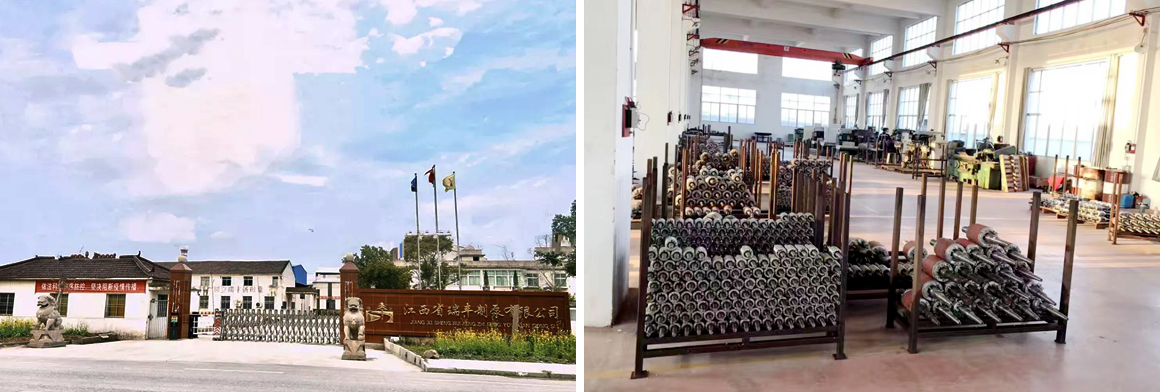
Request a selection that can be checked against the building and acceptance scope
A useful Ruifeng enquiry ties the complete model to the system duty and the offered package. For replacement work, attach the current nameplate, installation drawing and operating problem. For a new system, supply the hydraulic requirement and ask for the selected curve, arrangement drawing and controls schedule.
Specify how pump supply, controls, vessel equipment, electrical work, installation and commissioning will be divided. Ask the quotation to identify the document set and tests for the exact equipment being supplied. This produces a comparable technical offer instead of a price for an unspecified “fire pump”.
System and duty
- Main fire duty, stabilising duty or everyday building-water supply.
- Required flow/pressure, suction water levels, piping arrangement and destination supply voltage/frequency.
- Complete proposed XBD or ZW[L] code, or existing nameplate and replacement interfaces.
Equipment and controls
- Pump/motor, duty/standby units, controller and pressure-vessel scope.
- Selected curve, wetted materials, seal arrangement and installation drawing.
- Vessel effective volumes, pressure sequence and main-pump interface for a stabilising package.
Documents and handover
- Model-matched reports and current documents required by the destination/project.
- Inspection and functional tests, manuals, spare-parts schedule and maintenance access.
- Installation, electrical and commissioning responsibilities with agreed acceptance records.
Submit through KanBeng’s enquiry form with this factory named in your request.