
Select the gas route and the complete vacuum arrangement
Jiangyin Suyi Vacuum Equipment Co., Ltd.
Suyi lists several vacuum technologies. Compare wet-gas handling, oil-sealed operation, backing stages and stored-vacuum demand using pressure-specific data and a complete utility schedule.
- Company identity
- 江阴苏一真空设备有限公司
- Listed base
- Yuecheng, Jiangyin, Jiangsu
- Selection focus
- Gas load · pressure basis · backing stages
- Catalogue examples
- 2SK · 2XZ · ZJ · ZKJ · H-150
A vacuum pump selection starts with what leaves the process
Jiangyin Suyi Vacuum Equipment Co., Ltd. identifies itself as 江阴苏一真空设备有限公司 and lists its base in Yuecheng, Jiangyin, Jiangsu. Its catalogue spans water-ring pumps, single- and two-stage rotary-vane pumps, Roots boosters, assembled vacuum units and piston-type equipment. These constructions address different gas loads and utility arrangements; a required vacuum number alone does not select the pump.
Begin with the process pressure, vessel volume and pump-down time, then describe the continuous gas load: air leakage, permanent gases, water vapour, solvent vapour, entrained liquid and particles. Distinguish evacuation of an empty vessel from maintaining pressure while a wet process releases vapour. A pump selected only by nominal pumping speed may not deliver that speed through the installed pipework or at the required operating pressure.
Choose the backing technology before specifying a booster
Suyi lists both stand-alone pumps and complete Roots-based units. Choose the gas-handling route and its supporting services together. A booster and its backing pump must be evaluated as a working combination.
| Catalogue route | Selection question | Information to include |
|---|---|---|
| 2BE / SZ / 2SK water-ring | Can the process and utilities accommodate the sealing liquid? | Gas chemistry, liquid carryover, seal-liquid temperature, separator and discharge treatment |
| 2X / 2XZ rotary vane | Is the inlet load suitable for the proposed oil-sealed pump? | Vapour partial pressure, gas-ballast configuration, inlet protection, oil and exhaust handling |
| ZJ Roots / water-ring unit | Which backing pump handles startup and continuous throughput? | Pressure-dependent curves, maximum forepressure, starting sequence and exact stage schedule |
| ZKJ vacuum reservoir | Does intermittent demand require stored vacuum? | Receiver volume, pressure limits, demand cycle, controls and restart logic |
| H piston-type pump | Can the site supply its cooling, oil and service provisions? | Continuous inlet pressure, cooling-water basis, oil schedule and maintenance access |
Water-ring capacity and water consumption use different test pressures
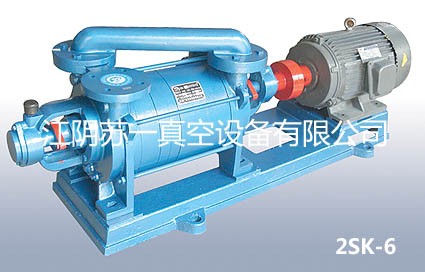
The 2SK table reports a pumping-rate column at −0.093 MPa inlet gauge pressure. Its stated atmosphere is 0.1013 MPa, so this corresponds to about 8.3 kPa absolute under those test conditions. This is a working-pressure data point, not the ultimate-vacuum column and not a fixed absolute pressure at every site elevation.
The same table uses 15°C inlet water and 20°C inlet air. Its water-consumption values apply at −0.05 MPa inlet gauge pressure; the source notes that demand can be higher at greater vacuum. Specify available water temperature and pressure, water quality, makeup capacity and discharge restrictions. Do not use the water values below as a guaranteed consumption at −0.093 MPa.
A liquid-ring proposal also needs a circuit definition: once-through, partial recirculation or a cooled recirculation loop. Recirculated liquid can warm up and collect process condensate. Request a separator, heat-removal duty and liquid-quality limits for the actual process. Seal-liquid vapour pressure affects achievable vacuum, so a cold-water catalogue result cannot simply be assigned to warm summer operation.
| 2SK size | Rate at −0.093 MPa gauge | Power / speed | Water at −0.05 MPa gauge |
|---|---|---|---|
| 2SK-1.5 | ≥0.9 m³/min | 4 kW / 1,440 rpm | 10–15 L/min |
| 2SK-3 | ≥2 m³/min | 7.5 kW / 1,440 rpm | 15–20 L/min |
| 2SK-6 | ≥4 m³/min | 15 kW / 1,460 rpm | 25–35 L/min |
2XZ size, power and inlet connection must remain paired
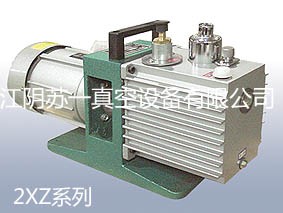
Suyi describes 2XZ as a direct-coupled, two-stage rotary-vane pump for instruments, laboratories and other vacuum equipment. The examples below retain the pumping speed, motor power and inlet diameter from each corresponding catalogue column. They are screening values; request the actual pressure-dependent performance curve and connection drawing for the quotation.
The catalogue lists a pressure limit of 6 × 10⁻² Pa for these sizes. That value does not establish a loaded vessel pressure, a pump-down time or water-vapour tolerance. Inlet leakage, outgassing, vapour load and piping conductance affect the installed result. Specify total versus partial pressure measurement and the gauge location in the acceptance procedure.
For a vapour-producing process, give vapour identity, mass rate and partial pressure at operating conditions. Ask whether the proposed pump has gas ballast, what vapour tolerance applies with it, and which inlet condenser or trap is required. Establish exhaust oil-mist handling and the oil-change/contamination procedure. A published laboratory application does not certify every gas mixture or hazardous-area installation.
| 2XZ size | Listed pumping speed | Motor power | Inlet diameter |
|---|---|---|---|
| 2XZ-2 | 2 L/s | 0.37 kW | 25 mm |
| 2XZ-4 | 4 L/s | 0.55 kW | 25 mm |
| 2XZ-8 | 8 L/s | 1.1 kW | 40 mm |
ZJ requires a backing pump and an agreed starting sequence
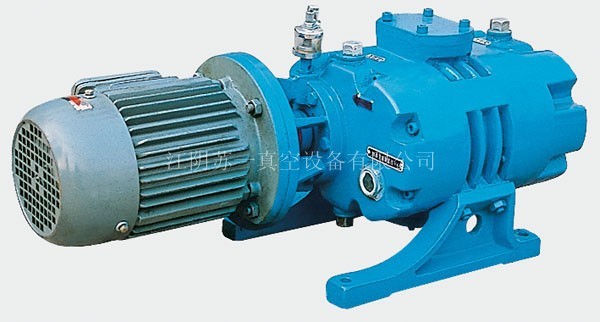
The ZJ entry explicitly requires a backing pump. Its examples pair ZJ-30 with 2X-4A, ZJ-70 with 2X-8A and ZJ-150A with 2X-15. These are catalogue recommendations, not a reason to omit the backing-pump curve. Verify throughput, permitted pressure difference and forepressure through startup and normal duty; nominal booster speed alone does not prove the backing stage can handle the load.
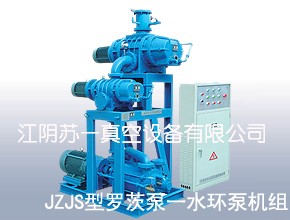
Suyi’s water-ring unit page uses JZJS in the heading and JZJ2S in its configuration table. One clearly identified table row is JZJ2S150-1: ZJ150 main pump, 2SK-6 backing pump, 150 L/s listed speed, 267 Pa listed pressure and 18 kW total power. Ask for this complete stage designation and a curve for the operating pressure. The listed speed and pressure columns do not establish that 150 L/s is delivered at 267 Pa under the buyer’s vapour load.
The separate JZJX description concerns Roots with rotary-vane backing, while the displayed performance table names water-ring backing pumps. Request a configuration-specific JZJX schedule rather than reusing those water-ring rows. For either route, define who supplies valves, bypass or pressure protection, sensors, interlocks and the control sequence for starting, unloading and shutdown.
ZKJ adds a receiver, not an unlimited vacuum supply
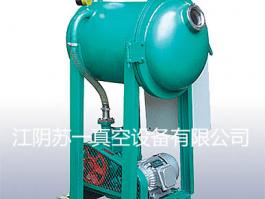
The ZKJ entry identifies five main elements: a 2X pump, vacuum tank, electrical control box, vacuum gauge and solenoid vent valve. This is a useful starting point for an intermittent vacuum service, but the published entry does not specify receiver volume or pressure switching thresholds.
Provide peak withdrawal, cycle frequency, required pressure band, number of users and recovery time. Request the tank volume and pressure rating, pump selection, valve functions and control setpoints in the proposal. Agree the response to air ingress, power failure and restart. A reservoir buffers demand; its actual usefulness depends on the permitted pressure rise and how quickly the pump restores the required vacuum.
For several machines sharing a receiver, specify branch isolation and which process contaminants may reach the common system. Include access for tank inspection, drainage and gauge servicing. Do not infer the tank capacity or pressure rating from the catalogue photograph.
Keep geometrical speed separate from installed pumping performance
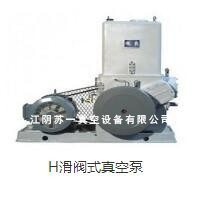
The H-150 entry lists geometrical pumping speed of 150 L/s, 450 rpm and an 11 kW motor. Geometrical speed is a displacement basis; it should not be relabelled as an effective vessel pumping rate. Request the pressure-dependent curve, piping loss allowance and test basis for the actual installation.
The same entry lists a maximum continuous inlet pressure of 1.3 × 10⁴ Pa and cooling-water consumption of 700 L/h. Preserve the hourly water unit when sizing site services. Its N100 vacuum-pump oil listing and 30 kg oil quantity provide a maintenance-planning reference, but the ordered manual must establish the approved lubricant, fill/check method and service intervals.
Agree cooling-water temperature and pressure, discharge handling, oil drainage access, foundation and lifting provisions. Define startup and continuous operation separately, especially when replacing an existing pump. Supply the old connection and foundation drawings; the family name does not establish dimensional interchangeability.
Test the working pressure, gas load and utilities together
Ask the proposal to state a measurable duty: initial and final absolute pressure, vessel volume, pump-down time, continuous gas/vapour load and utility conditions. Separate a pump’s ultimate-pressure test from a process acceptance test under load. Identify gauge type, location and total/partial-pressure basis before comparing measurements.
For wet loads, establish what is condensed upstream and what reaches the pump. For water-ring equipment, record seal-liquid temperature and circulation arrangement during the test. For an oil-sealed proposal, record gas-ballast state and inlet/exhaust protection. For a Roots unit, include the backing pressure and staged control sequence.
Request the selected curves, pump-stage schedule, materials and seals, circuit/valve drawing, control description, utility schedule and operating instructions. Agree commissioning responsibilities and drawing-linked spare parts. Dry-pump and vertical oil-free catalogue categories require their own gas-compatibility and performance documents; their names alone do not establish suitability for a corrosive or explosive process.
Send a gas-load brief and an acceptance target
Prepare one enquiry for one actual process. Identify whether the priority is wet-gas evacuation, laboratory vacuum, a Roots-assisted operating range or intermittent demand through a receiver, and ask for a complete configuration.
Review the existing Suyi vacuum-pump catalogue record →
Prepare a structured vacuum-system enquiry →
Process load
- Vessel volume, initial/final absolute pressure, pump-down time and continuous working-pressure range.
- Gas and vapour identities, mass/volume rates, temperature, liquid carryover and particles.
- Batch cycle, leakage allowance, simultaneous users and cleaning/shutdown conditions.
Site and utilities
- Inlet pipe lengths, diameters, valves and gauge positions; existing connection drawings for replacement.
- Seal-liquid supply/temperature/discharge, cooling-water availability, electrical supply and exhaust treatment.
- Space, receiver requirements, drainage, lifting and maintenance access.
Proposal and verification
- Exact main/backing pump stages, materials, protection devices and start/stop interlocks.
- Pressure-dependent curves, utility schedule, ordered manual, receiver drawings and spare-parts list.
- Agreed load test and gauge basis; keep ultimate-pressure, pump-down and continuous-duty acceptance distinct.
Submit through KanBeng’s enquiry form with this factory named in your request.