Specify the dose, its control and how it will be measured
Lianyungang Haipu Metering Pump Co., Ltd.
Haipu documents mechanical and hydraulic diaphragm pumps, plunger constructions and dosing accessories. Select the chemical-contact assembly and control method, then verify delivery over your working range.
- Company identity
- 连云港海普计量泵有限公司
- Listed base
- Guannan, Lianyungang, Jiangsu
- Selection focus
- Dose · materials · controls · calibration
- Catalogue examples
- GM-A · GB(JZM-A) · JZM · 2JD
Begin with the dosing requirement and its operating range
Lianyungang Haipu Metering Pump Co., Ltd. identifies itself as 连云港海普计量泵有限公司, based in Guannan Economic Development Zone, Lianyungang, Jiangsu. Its documented range includes mechanical and hydraulic diaphragm metering pumps, plunger pumps, special metering constructions and dosing-system accessories. Start an enquiry with the chemical addition task, minimum/normal/maximum dose and the pressure at the injection point.
For proportional dosing, provide the process flow range, chemical concentration, required addition ratio and how the command is generated. For batch addition, state the batch quantity, dosing interval and stopping requirement. Include density, viscosity, temperature, entrained gas, solids and crystallisation tendency. Those conditions determine whether a small pump can fill consistently and whether its valves, diaphragm or packing suit the liquid.
Haipu lists packaged dosing equipment in its company scope, while the reviewed dosing-category page does not define a complete package specification. A pump quotation and an integrated chemical system are different scopes: identify the tank, mixer, instruments, pipework, controls and commissioning you need rather than assuming they are all included.
Use the full series designation to distinguish mechanical and hydraulic diaphragm pumps
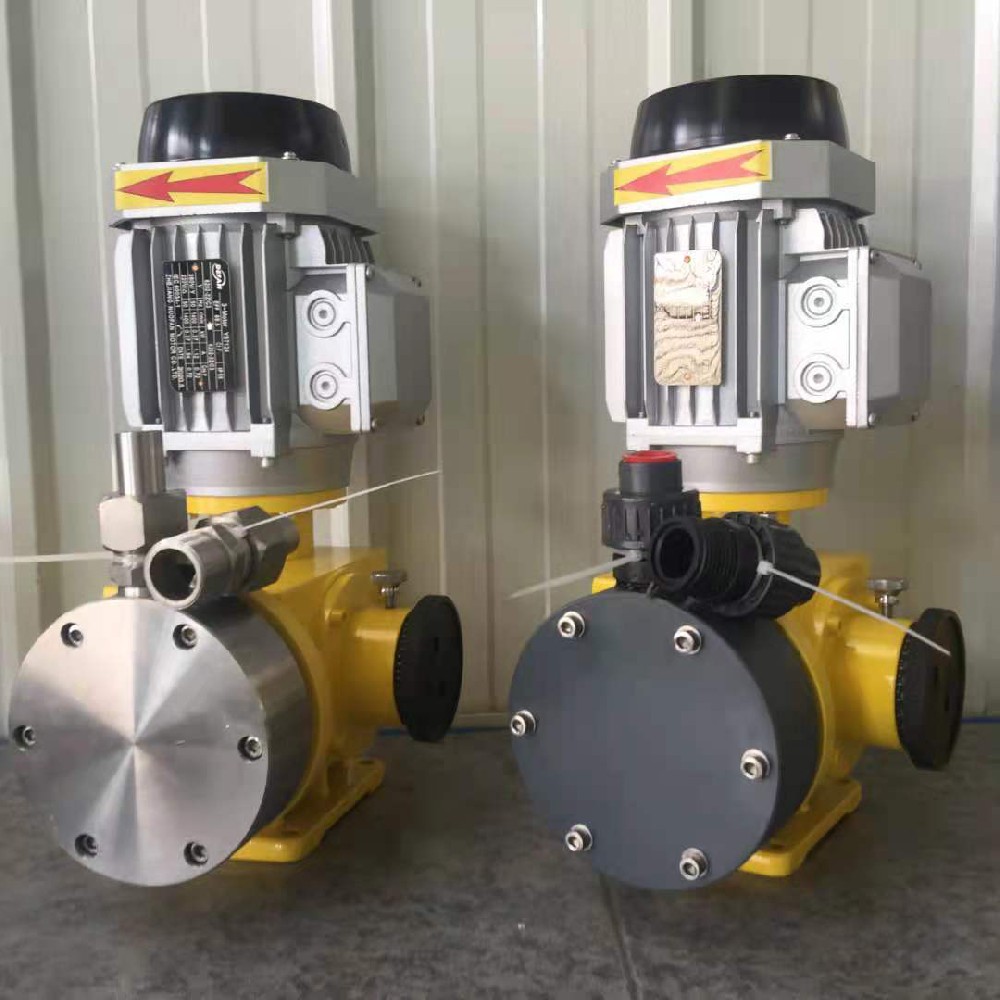
The official catalogue groups the constructions below separately. In particular, GB(JZM-A) belongs to the mechanical-diaphragm category, whereas JZM is a hydraulic-diaphragm entry. An abbreviated name can select a different mechanism.
| Documented direction | Actual distinction | Decision for the proposal |
|---|---|---|
| GM-A / GM(JXM-A) / GB(JZM-A) | Motor-driven mechanical diaphragm with manual and listed automatic options | Exact head/valve materials, selected capacity at pressure and control arrangement |
| JZM / JDM / 2JXM / 2JTM | Hydraulic diaphragm entries; selected pages describe internal pressure-release provisions | Hydraulic/diaphragm protection, alarm interfaces and service scope |
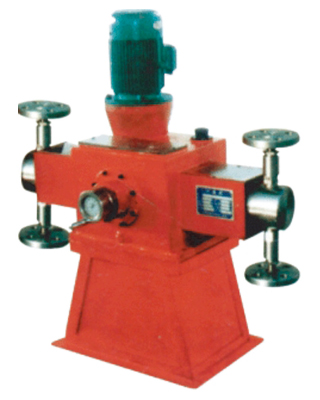
| JW / JD / 2JD plunger | Plunger entries with different drives and single/double-cylinder arrangements | Packing containment, actual cylinder selection and maintained delivery during service |
| Special constructions | High-pressure multi-plunger and special metering entries | Specific drawing, selected flow/pressure and test evidence |
A materials list and a 4–20 mA option must become an ordered configuration
The GM-A, GM(JXM-A) and GB(JZM-A) pages list head options including stainless steel and several polymers, PTFE-lined rubber diaphragms, and valve-ball options such as zirconia, stainless steel or ceramic. Select the entire wetted assembly against the chemical, not just the visible pump head. A polymer head with unsuitable valve or gasket material can remain a poor selection.
These entries list manual control and automatic control receiving 4–20 mA. Ask the proposal to show whether that signal changes stroke length, drive speed or an actuator setting; include signal scaling, loss-of-signal behaviour, local/remote selection and any required feedback. An analogue command is not evidence of closed-loop measured chemical flow. Confirm the exact motor supply and enclosure for the destination.
The pages show a pressure-family reference up to 1.0 MPa, but several flow labels omit the time unit and associated parameter-image links could not be read. Choose from a complete model-specific capacity/pressure table and curve rather than converting those abbreviated labels into L/h. The motor alternatives listed on a family page do not establish which motor covers your duty.
Specify diaphragm protection, hydraulic service and the pressure-release path
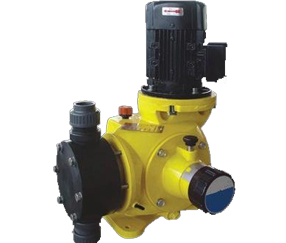
The JZM hydraulic-diaphragm entry describes flow adjustment with the pump running or stopped and an internal pressure-release system. The 2JTM summary describes a two-cylinder construction and automatic oil replenishment, venting and pressure release. Identify the exact oil-side arrangement, diaphragm assembly, adjustment method and maintenance instructions on the selected unit.
Haipu’s company introduction also lists single- and double-diaphragm directions and pressure-alarm developments. That scope does not establish that every JZM or 2JTM includes a double diaphragm or rupture detector. If chemical separation or early leak detection is important, specify the diaphragm count, interspace monitoring, alarm contacts and what happens after a fault.
Ask whether an internal release protects the hydraulic mechanism, the process discharge, or both. The process line still needs an agreed overpressure arrangement and destination for released liquid. Request a drawing and valve schedule so a buyer can identify each protective function; do not treat an internal feature as evidence that the whole dosing installation is protected.
Two cylinders require a delivery and isolation plan, not a no-downtime promise
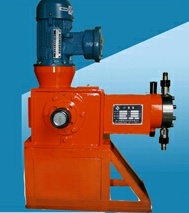
The JD and 2JD pages identify plunger constructions, while JW is a smaller drive direction. The 2JD entry describes a two-cylinder pump and says single-cylinder operation can support maintenance. Confirm the selected capacity with one cylinder isolated, whether each head has independent adjustment and how the isolated head is made safe for service. Two cylinders do not necessarily provide full-duty standby capacity.
For a plunger enquiry, include the acceptable packing leakage and collection arrangement, flushing requirements, chemical exposure and service access. Request the exact plunger diameter, stroke and valve schedule supporting the quoted pressure and capacity. Motor rpm values on the page should not be copied as dosing strokes per minute without the drive ratio.
Where smooth injection is important, ask for the phasing and pulsation-control proposal at the actual stroke settings. A statement that pressure is steadier with two heads is not a quantified pulsation guarantee at your injection point.
Separate steady-state accuracy, linearity and repeatability
Haipu’s technical article distinguishes three checks for mechanical-diaphragm dosing. Steady-state accuracy measures delivery at an unchanged setting over time; linearity compares measurements at different stroke settings with a fitted relationship; repeatability checks delivery after leaving and returning to a setting. Agree the test liquid, temperature, backpressure, stroke/speed, measurement duration and reference quantity for each check.
The article expresses its example tolerances against rated flow, not against every reduced operating flow. Its illustrative 1,000 L/h full-stroke reference gives ±20 L/h for a ±2% rated-flow tolerance. The same absolute allowance would be 20% of a 100 L/h dose. This arithmetic example is a reason to request acceptance at your minimum working dose; it is not an independently measured performance result for a Haipu model.
Provide the intended turndown and request calibration points over that working range, plus a return-to-setting check. Agree how the measurements will be made safely with the chemical, or what substitute liquid and correction are acceptable. Primary metering-pump test guidance distinguishes performance checks from mechanical integrity; a satisfactory pressure test alone does not demonstrate dosage accuracy.
Design the inlet and discharge accessories as part of the dosing duty
Haipu lists check valves, foot valves, Y-strainers, mixers and a backpressure valve. Its backpressure entry discusses reducing siphoning and dose variation from injection-pressure changes, with an adjustment reference of 0–0.6 MPa. Confirm the ordered valve’s materials, connection, set pressure and flow capacity. A backpressure setting and a safety-relief set point are different functions, even when a similar valve body is pictured.
Reciprocating dosing creates a pulsing inlet demand. Primary Hydraulic Institute guidance explains that long, narrow or restrictive suction lines and liquid vapour pressure can reduce available inlet pressure. Provide the lowest tank level, pipe length/diameter, bends, strainers and chemical temperature. Ask for the selected pump’s inlet-pressure assessment and where any dampener belongs rather than choosing tubing only from average flow.
At discharge, define the injection-point pressure range, siphon potential, isolation valves and safe relief return. Agree dampener material, location, volume and maintenance where needed. For a system with several pumps, include the common-header arrangement and whether pumps can operate simultaneously; accessories that work for one head may need a different selection for the complete system.
Send a chemical, control and acceptance brief
Use the groups below to request a defined pump or dosing package through KanBeng. The original general metering-family record remains a category reference; this factory profile does not assign a newly researched series to that old record.
Review the existing Haipu metering-family record →
Prepare a defined pump-system enquiry →
Chemical and dose
- Mixture/concentration, density, viscosity, temperature, gas, solids and crystallisation behaviour.
- Minimum/normal/maximum addition rate, batch timing or process-flow ratio and required turndown.
- Injection-point pressure range and requested wetted parts, containment and diaphragm/packing arrangement.
Plant and control
- Lowest source level and suction layout; discharge header, valves, safe relief return and pulsation requirements.
- Electrical supply, local/remote operation, 4–20 mA scaling or other confirmed interface, feedback and fault behaviour.
- Pump-only or package scope: tank/mixer, instruments, accessories, panels, piping and commissioning boundaries.
Selection and evidence
- Full series designation, exact head/cylinder/drive configuration and capacity at the specified pressure.
- Calibration and repeatability acceptance at actual working doses, agreed test liquid and measurement basis.
- Drawings, material/seal schedule, protective-device paths, operating instructions and traceable spare parts.
Submit through KanBeng’s enquiry form with this factory named in your request.