
Define the wet end, installation and complete supply package
Modo Pump Co., Ltd.
Separate abrasive transfer, submerged dredging, corrosive liquids and water duty. Compare the actual construction, replacement interfaces and documents before requesting an itemised offer.
- Listed base
- Boye, Baoding, Hebei
- Product directions
- Slurry · dredging · chemical · water
- Replacement priority
- Drawing and material compatibility
- Order scope
- Pump · driver · controls · spares
Modo procurement: separate a slurry wet end, a submerged package and a chemical duty
Modo Pump Co., Ltd. presents its pump business from Boye County, Baoding, Hebei. Its official product range includes horizontal, vertical and submersible slurry pumps, split-case and multistage water pumps, self-priming equipment and centrifugal chemical pumps. It also offers replaceable parts and OEM work. This breadth makes the first enquiry decision important: identify whether the order is a complete pump set, a bare pump, replacement wear parts or a configured pumping package.
Abrasive mining transfer, submerged sediment removal and corrosive chemical transfer need different information and different constructions. Use the routes below to make the enquiry specific. A photograph of a pump does not establish its duty, material grade, supplied controls or compatibility with an installed machine.
Ask the quotation to name the manufacturer and seller, the offered series and the document issuer. For an OEM or replacement order, establish whose drawing and part numbering apply before approving production. This is more useful than selecting on a broad family name alone.
| Procurement task | Official product direction | Decision that changes the offer |
|---|---|---|
| Abrasive transfer from a process sump | Horizontal slurry or vertical sump pump | Slurry composition, suction arrangement, wear materials and seal utilities |
| Remove settled sand below water | Submersible dredging/slurry package | Agitation arrangement, lifting, electrical protection and cable/control scope |
| Transfer a corrosive liquid | IHF fluoroplastic or IH metal chemical pump | Exact chemistry, wetted materials, seal and operating temperature |
| Industrial water or irrigation | MIS end-suction and other water-pump ranges | Duty curve, suction conditions, driver and installation interfaces |
Describe the abrasive mixture before choosing a horizontal slurry construction
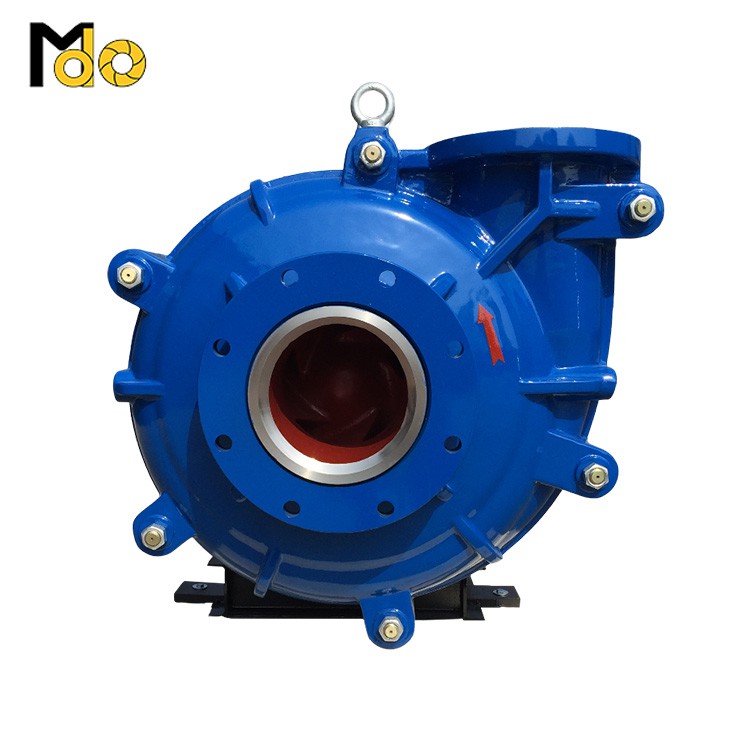
Modo’s horizontal slurry page shows a lined casing and promotes mining, mineral processing, sand and tailings duties. Request the selected liner and impeller material, particle passage, speed and duty curve. The page’s separate maximum flow, pressure and head figures should not be combined into a single guaranteed working point.
For an abrasive liquid, give the solids mineral, particle-size distribution, largest particle, angularity, concentration and liquid chemistry. State whether concentration is by mass or volume and provide the mixture density. Hydraulic Institute guidance explains why a slurry description must account for particle properties and the combined effects of corrosion and abrasion; a material choice may need operating experience or a trial.
Ask for a selection on the actual mixture, with motor load and the permitted operating region identified. Describe the worst feed condition as well as normal operation, especially if a sump can receive coarse solids or a dense batch after settling. Include the proposed suction layout and available liquid level rather than comparing only discharge pressure.
Make an AH-pattern replacement a drawing-controlled purchase
Modo offers replaceable spare parts and OEM supply. An AH-style designation or familiar casing outline is not enough to approve a part for an existing pump. Begin with the original nameplate, pump size, bearing frame, impeller identifier and current parts drawing. Record any previous modifications to liners, shaft sleeve, seal or drive.
For each wear item, agree the drawing revision, key dimensions, fit and material specification. An impeller, throat bush, liner and frame-plate insert should be checked as an assembly where interfaces affect clearance. Ask how material identity and inspection results will be traced to the shipped parts; a hardness value alone does not resolve chemistry, casting condition or dimensional fit.
Specify the seal arrangement in the offer. If clean seal water is required, identify its available pressure, flow, quality and control. If an expeller or mechanical seal is proposed, request the operating limits and startup/shutdown provisions for that configuration. Include adjustment access, lifting and the wear-parts removal route in the maintenance review.
Separate pump power, agitation and the submerged electrical system
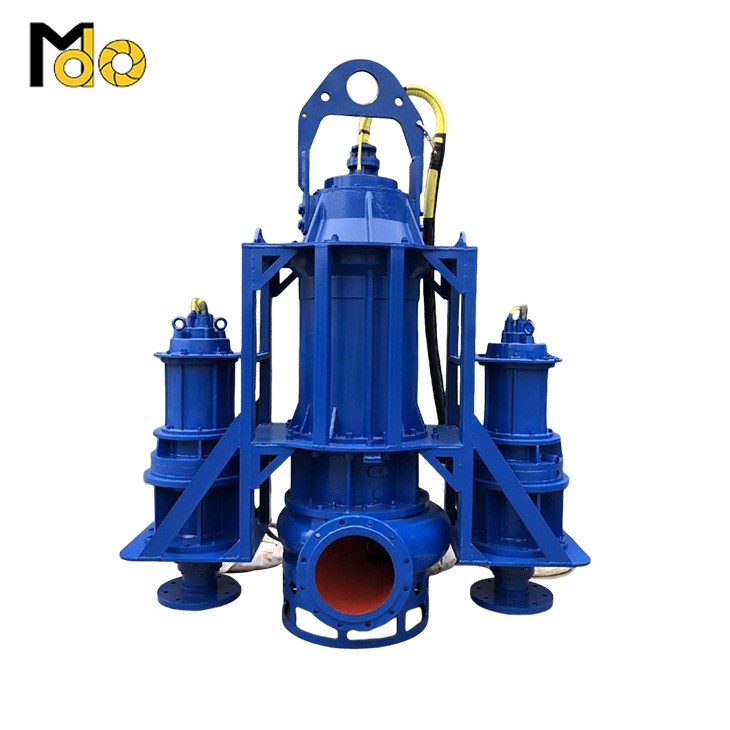
The official submersible sand-dredging page shows an assembly with additional side-mounted agitation equipment. Define whether the offer includes this arrangement, an integral agitator or a different configuration. Settled sediment and a freely flowing slurry are different intake conditions; describe bed depth, consolidation, particle content and how material reaches the inlet.
For the complete package, request a drawing showing dimensions, mass, lifting points, discharge, cable route and access around the agitation equipment. State minimum and maximum water levels, immersion depth, expected continuous operation and the available electrical supply. Confirm which motors, cables, panel and protection functions are included.
Ask for the alarm and trip schedule, signal wiring and recovery procedure for overheating, leakage or overload. Decide how the assembly will be lowered, kept stable and removed for cleaning or wear-part replacement. A submerged product label alone does not answer cooling, dry-running, lifting or site-commissioning questions.
Use the IHF80-50-200 row as a specific example, then check the chemistry
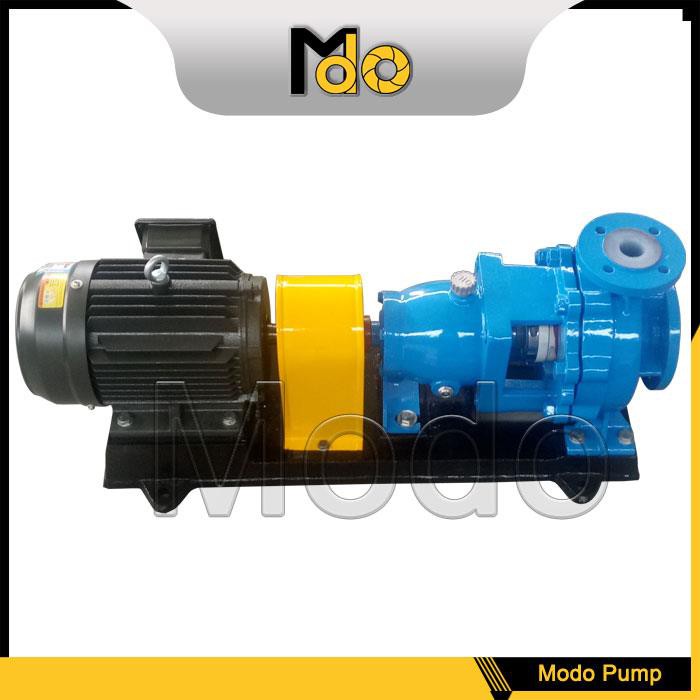
The IHF detail page describes a metal-supported F46 fluoroplastic lining and fluoroplastic-covered components. It lists the following duty for IHF80-50-200. Keep the model, speed and connection sizes together when requesting a curve or comparing a quotation; these values are not a performance envelope for every IHF pump.
The same page contains inconsistent broad temperature statements and claims suitability for many aggressive chemicals. Do not use those statements as a universal compatibility approval. Provide the chemical name, concentration, impurities, temperature during operation and cleaning, density and any solids. Request the exact lining, seal faces, elastomers and selected construction’s limits.
Modo also lists an IH stainless-steel chemical range. Fluoroplastic lining and a metal wet end are separate material routes. Compare them on the actual liquid and seal requirements, including upset conditions, cleaning and maintenance. Ask what inspection, lining checks and acceptance records apply to the offered unit.
| IHF80-50-200 published item | Value |
|---|---|
| Flow | 45 m³/h |
| Head | 28 m |
| Speed | 2,900 r/min |
| Efficiency as listed | 67% |
| Inlet / outlet | DN80 / DN50 |
Review the existing IHF family listing →
Keep end-suction water duty separate from slurry and chemical selection
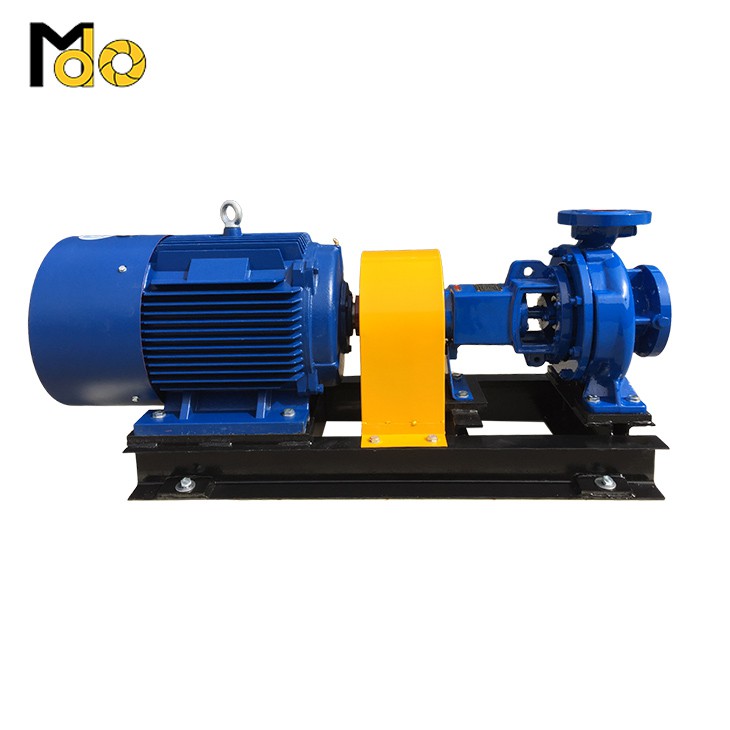
Modo’s end-suction page identifies MIS construction and lists the casing, cover, impeller, shaft, sleeve, packing components and bearing assembly. This gives a practical inspection route: establish the selected hydraulic size, impeller diameter, sealing arrangement and driver rather than assuming every offered set matches the pictured assembly.
The Modo-branded MIS download describes IS-type back pull-out construction: its extended coupling allows removal of the rotor assembly without moving the connected casing or motor. It describes water-like liquids at no more than 80°C. Confirm that construction and the current selected-model limit in the offer, and reserve space behind the bearing assembly.
For a water-supply or irrigation enquiry, send the required flow and total head, suction level, pipe losses, liquid temperature and available power. Include inlet/outlet sizes, baseplate space, coupling and maintenance access. Ask for the selected curve and installation drawing, with frequency and speed stated. An end-suction water selection is not a substitute for an abrasive-slurry wet end.
The water range also includes split-case, multistage and self-priming directions. Select among them from the system duty and suction arrangement. If priming is part of the requirement, describe the suction lift, line geometry and startup conditions explicitly instead of assuming a conventional end-suction pump will prime itself.
Align catalogue identity, selected drawings and order-specific tests
Modo’s factory page lists machining equipment including lathes, radial drilling and CNC machine tools. Use this description to ask which operations and inspections apply to the order. Agree the material records, dimensional checks, assembly inspection and pump test scope that will accompany the supplied equipment.
Two slurry documents linked from the download page carry Milestone wording, and the submerged document also contains a Yanshan drawing label. Before using such a document for a Modo order, obtain an issuer-confirmed selected-model specification and revision. Catalogue location alone does not prove that every pictured construction, curve or replacement part belongs to the offered machine.
For acceptance, specify the test liquid, flow/head point, speed, power measurement and tolerances. Separate hydraulic testing from motor insulation, protection-signal checks and site commissioning. If conformity documents are required, check the actual holder, covered model, scope and validity; do not replace an order-specific document check with a generic logo or historical statement.
Build a Modo enquiry around the duty, interfaces and supplied scope
Choose the procurement route first, then attach the information that controls the selection. A replacement-parts request needs drawings and identifiers; a dredging package needs a site arrangement and electrical scope; a chemical transfer needs a complete liquid description.
Ask for an itemised offer that ties the selected model, materials and documents to the equipment being supplied. Include spares and acceptance requirements before comparing price. Send the requirement through KanBeng with Modo named so the project context stays together.
Prepare a structured pump RFQ →
Duty and medium
- Normal and worst flow/head conditions and operating schedule
- Slurry density, mass/volume concentration, particle distribution and chemistry
- Chemical concentration, impurities, operating and cleaning temperatures
Equipment and interfaces
- Original nameplate, frame, part numbers and drawings for replacement work
- Suction, discharge, levels, foundations, lifting and maintenance access
- Pump, motor, agitators, cables, controls and seal-water scope
Documents and acceptance
- Actual manufacturer, seller, document issuer and selected model revision
- Material, fit, curve and inspection records for the offered construction
- Test conditions, protection checks, spares and commissioning responsibility
Submit through KanBeng’s enquiry form with this factory named in your request.