
Positive displacement pump selection for viscous fluids, sludge and process transfer
NETZSCH (Lanzhou) Pumps Co., Ltd.
NETZSCH’s China catalogue brings together four pumping principles. For a buyer, the useful starting point is whether the liquid can reach the pumping element, whether it lubricates or abrades it, and how the installed pump will be cleaned and serviced. Those choices matter more than choosing the largest published family rating.
- Chinese entity
- 耐驰(兰州)泵业有限公司
- China headquarters
- Lanzhou, Gansu
- Catalogue directions
- NEMO · TORNADO · NOTOS · PERIPRO
- Order decisions
- Feeding · materials · cleaning · service access
Distinguish the Lanzhou entity from the complete global product range
The China introduction traces the Lanzhou business to a 1993 joint venture and states that it became wholly German owned in 1999. It identifies Lanzhou as the China headquarters and describes a Jiaxing site opened in June 2023 for stator production and assembly. Specify the contracting entity, assembly site and component origin for the particular quotation; a global brand catalogue is not evidence that every listed assembly is manufactured at one Chinese site.
An original 2022 stock-exchange inquiry response identifies the exact Lanzhou legal entity in historical pump procurement. Its discussion of particular 15F, 20F and 30F purchases distinguishes supply from manufacture. This supports checking the order boundary, not assigning dealer status to the whole business or promising present stock and lead times.
The company publishes a CQC quality-system certificate for the Lanzhou entity, issued on 5 December 2024 with a printed expiry of 3 August 2027. The displayed scope covers design and manufacture of single/twin/triple screw, rotary lobe, peristaltic pumps and grinders. For a contractual qualification, request issuer confirmation of current status and the relevant scope. The separately displayed 2014 high-technology certificate had a three-year term; it is not a current qualification.

Match the fluid to a mechanism before choosing a series
NEMO uses a rotor and stator for progressive cavity pumping; TORNADO uses rotary lobes; NOTOS uses multiple screws; PERIPRO compresses a hose. The catalogue places all four in process-transfer applications, but their feeding, wear, lubrication and cleaning requirements differ. Describe the actual fluid at operating and starting temperatures, including solids, fibres, entrained gas and whether it settles during a stop.
Treat catalogue maxima as a family envelope. Maximum pressure, capacity, viscosity and temperature are not one combined duty point. Request a selected assembly, speed, absorbed power, material schedule and operating limits, with overpressure protection appropriate to a positive displacement system.
| Fluid or installation question | Direction to compare | Selection input |
|---|---|---|
| Viscous or sludge transfer with controlled feed | NEMO BY / SY | Stator compatibility, inlet supply, speed and dry-running protection |
| Non-flowing filter cake or bridging material | NEMO hopper / auger arrangement | Feed consistency, bridging tendency and inlet geometry |
| Service access around connected pipework | NEMO FSIP / TORNADO service arrangements | Clearance, parts removal and exact configuration |
| Lubricating oil versus poorly lubricating process liquid | NOTOS 2NS / 3NS / 4NS | Lubricity, abrasiveness, corrosion and viscosity |
| Abrasive or corrosive liquid with hose-only wetted path | PERIPRO | Hose compatibility, particle properties, temperature and hose life |
BY and SY separate the drive arrangement from the hydraulic choice
BY is the compact close-coupled arrangement with a flange-mounted gearbox. SY uses a bearing-supported free shaft for an external drive; the description names servo, diesel and hydraulic drive possibilities. Choose on installation space, available drive and shaft alignment as well as the pumping duty. A free-shaft offer needs a defined coupling, base and guarding boundary.
The BY page lists a family capacity up to 400 m³/h and differential pressure up to 24 bar. The SY headline gives 72 bar while its technical/application sections give 48 bar and capacity up to 500 m³/h. Do not resolve that discrepancy by combining the largest numbers. Obtain the current rotor/stator geometry, number of stages, speed and issued pressure duty for the selected pump.
Elastomer, rotor surface and seal selection must follow chemistry, temperature, abrasiveness and cleaning conditions. Specify inlet supply and protection against a starved stator, together with pressure monitoring and relief arrangements. A reference to an API seal option or dimensional standard does not certify the whole configured pump.
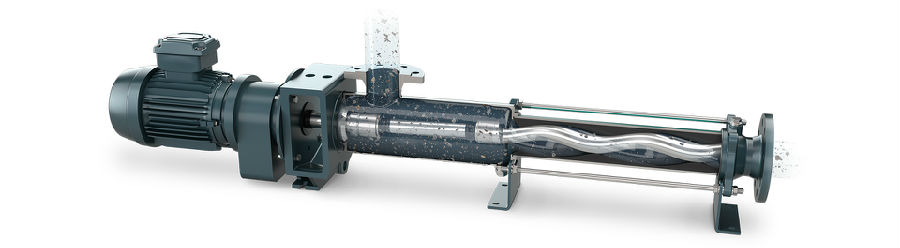
A hopper and auger address material that will not enter an ordinary suction connection
The BP description combines a rectangular hopper, horizontal feed auger, bridge-breaking arrangement and conical entry into the rotor/stator. It specifically discusses non-flowing filter cake and dewatered sludge. That arrangement solves a different inlet problem from pumping a freely flowing sludge through a pipe.
Send solids concentration with its measurement basis, consistency, bulk behaviour, maximum lump size and the upstream discharge pattern. Confirm hopper dimensions, feed rate, start/stop sequence, guarding and access for clearing a blockage. Feeding must keep pace with the pumping element without running the stator dry; a published family pressure or capacity does not describe the behaviour of every cake.
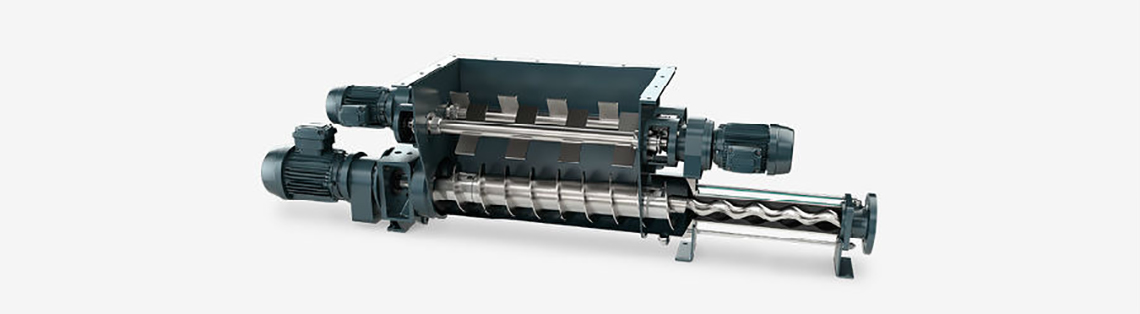
FSIP applicability is specific to sizes, stages and the installed layout
Full Service in Place is described as servicing the pump while it remains connected to the piping. The illustrated inspection cover and three-piece suction housing provide access to the internal assembly. The iFD stator uses a reusable outer housing and replaceable elastomer insert; include the correct insert, rotor and coupling parts in the maintenance schedule.
The retrofit statement names NM045–NM105 BY/SY pumps with one or two stages, rather than every NEMO pump. The six-size description lists 2–200 m³/h and differential pressure of 6 bar for one stage or 12 bar for two stages. Check the existing size, serial number, stage and housing arrangement before treating FSIP as a replacement option.
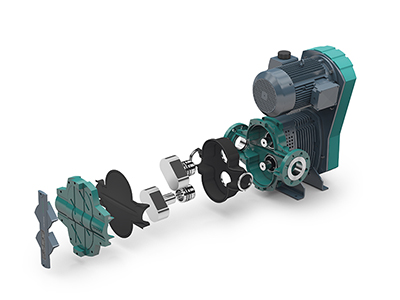
TORNADO service illustrations show front access, rotor/seal work and particular belt or timing arrangements. Compare the actual T1/T2 construction and material version, not just the shared series name. The page mixes T1 capacity/pressure wording with later application ratings; obtain the selected version’s data rather than using them as one universal rating. Ask for removal clearance, lifting and spare-kit content; do not turn promotional maintenance-time savings into a guaranteed outage duration.
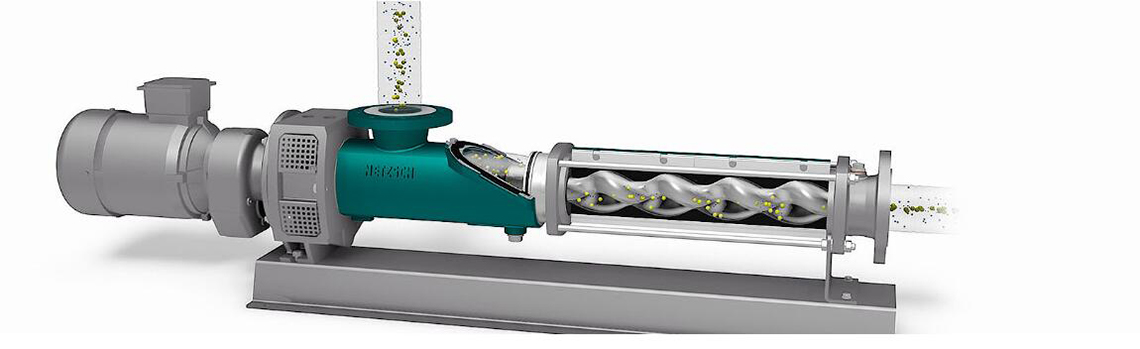
BH cleaning features need a defined cleaning circuit
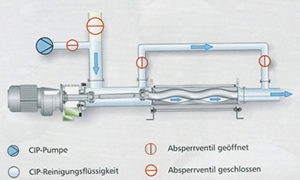
BH is the hygienic progressive cavity direction. Its documentation describes smooth open joints, a thin-wall stator and optional heating, tangential cleaning and an end-cleaning bypass arrangement. Define the food or process fluid and the full wetted-material list, including elastomer and seals, before choosing the construction.
The cleaning description refers to 1.5 m/s cleaning-liquid velocity. This is a condition in the manufacturer’s procedure, not proof that a particular installed circuit meets it. Agree cleaning flow, temperature, chemicals, contact time, drainability and the required bypass/return piping. Where SIP or aseptic operation is required, obtain configuration-specific validation and temperature/material limits. Rubber references to FDA or BfR do not constitute approval of the whole installed pump.
NOTOS screw choice and PERIPRO hose choice require different liquid information
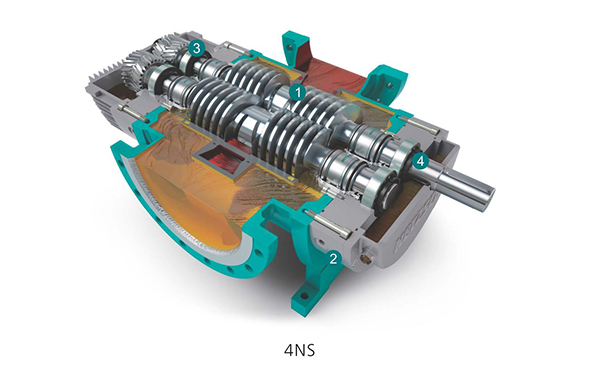
NOTOS 2NS is described for lubricating liquids of medium viscosity that may be slightly abrasive or corrosive. The 3NS description narrows this to non-abrasive, non-corrosive lubricating media. The 4NS double-suction two-screw arrangement uses synchronising gears and is described for higher-viscosity, poorly lubricating fluids with greater abrasion/corrosion demands. These differences matter when moving from clean oil to another process liquid; matching only flow and pressure can select the wrong mechanism.
For NOTOS, give viscosity at cold start and normal temperature, lubrication properties, solids and corrosion data. Define seals, jackets, inlet conditions and protection instruments with the assembly drawing. Its API 676 reference needs an agreed edition and compliance schedule when contractual; it is not a blanket product certificate.
PERIPRO’s industrial description places only the hose in contact with the liquid and avoids wetted valves or mechanical seals. This makes hose compatibility and replacement strategy central to selection. Its table lists 10 bar across the illustrated variants, but hose size, speed and capacity remain configuration-specific. The solids claim does not state a weight/volume basis, and accuracy/energy-saving comparisons lack a duty-specific baseline; use a confirmed test duty instead of universalising those figures.
Compare hose material, temperature, particle size and abrasiveness, required flow regulation, standby provision and safe hose replacement. Ask how leakage is detected and contained and how the drive is stopped. For either principle, select pressure protection and permitted start/stop conditions before operating against an isolated discharge.
Ask for an identifiable assembly and an acceptance procedure
The service description separates routine support from additional support arrangements. Specify destination coverage, commissioning, response hours and parts availability in the quotation. Its lifetime-service wording does not establish free lifetime replacement or a fixed response time.
Use the platform enquiry to identify the legal supplier and the intended duty. For a replacement, include the nameplate, serial number, dimensioned connections and existing rotor/stator, hose or seal references. Require an issued selection and interchangeability confirmation before ordering a kit or an assembly.
Structure the pump configuration enquiry →
Fluid and operating duty
- Composition, viscosity versus temperature, lubrication, corrosion, solids/fibres and starting consistency.
- Normal/peak flow, inlet and discharge conditions, regulation, operating cycle and permitted pressure.
- Cake feeding, cleaning/SIP requirements or hose compatibility according to the chosen principle.
Mechanical and package boundary
- BY close-coupled or SY external drive; selected stages, elastomer, seals and protective instruments.
- Assembly/manufacturing site, included drive/base/guarding, hopper or cleaning circuit and pipe connections.
- FSIP/rotor/hose replacement access, spares and destination commissioning/support scope.
Documents and acceptance
- Issued model/configuration schedule with matched duty, speed, power and operating limits.
- Applicable standard edition, materials documents and current issuer-confirmed qualifications where required.
- Agreed performance, leakage/protection and cleaning checks with traceable handover records.
Submit through KanBeng’s enquiry form with this factory named in your request.