
Match the backing pump to the gas and operating pressure
Nantong Weite Vacuum Equipment Co., Ltd.
Weite documents Roots boosters, two-stage and single-stage rotary-vane pumps, liquid-ring pumps and vacuum units. Choose the gas-compatible backing route, then verify performance at the vessel.
- Company identity
- 南通威特真空设备有限公司
- Listed base
- Bencha, Rudong, Jiangsu
- Selection focus
- Gas load · pressure · backing pump
- Catalogue directions
- ZJ · 2X · XD · JZJS
A vacuum-pump enquiry starts with gas load and pressure, not a liquid duty point
Nantong Weite Vacuum Equipment Co., Ltd. identifies itself as 南通威特真空设备有限公司, based in Bencha, Rudong, Jiangsu. Its company catalogue describes ZJ Roots pumps, 2X two-stage rotary-vane pumps, XD single-stage rotary-vane pumps, 2SK two-stage liquid-ring pumps and combined vacuum units. This range makes the backing-pump choice central to the proposal: a dry-gas vessel and a vapour-heavy drying process may need different combinations.
Send vessel volume, initial and final absolute pressure, required evacuation time and the gas load during operation. Separate a short pump-down from continuous gas removal. Add gas composition, temperature, condensable-vapour rate, droplets, dust and any chemical that can attack oil or construction materials. A nominal pumping speed alone does not describe removal capacity throughout the pressure range.
For an existing installation, include the actual pump and motor nameplates, inlet and foreline sizes, present pressure readings and the point where performance falls short. These details distinguish a pump replacement from a change in backing capacity, pipework or process protection.
Choose between oil-sealed, liquid-ring and boosted arrangements
The following routes reflect Weite’s published product scope. Select the gas-compatible backing arrangement first, then establish whether a Roots stage is needed for the required pumping speed and pressure.
| Route | Useful distinction | What the proposal must resolve |
|---|---|---|
| XD single-stage rotary vane | Air-cooled, direct motor connection; internal oil-mist and inlet non-return provisions described | Continuous inlet-pressure duty, oil compatibility, exhaust treatment and service access |
| 2X two-stage rotary vane | Standalone or backing service; selected larger sizes have gas ballast | Actual process pressure, vapour load, ballast operating state and oil maintenance |
| ZJ / ZJB / ZJP Roots | Booster requiring a backing pump; ZJB/ZJP pages describe bypass protection | Matched backing curve, allowable pressure differential, start/stop logic and temperature protection |
| JZJS Roots plus liquid ring | Published packaged direction for wet or condensable-gas processes | Seal-water conditions, gas chemistry, staged controls and complete-system performance |
| Roots plus rotary vane | Company scope and technical discussion describe this combination | Gas compatibility with oil, dust removal, condensate handling and package scope |
A bypass valve does not make the Roots pump independent of its backing pump
Weite’s ZJ product page explicitly requires a backing pump and says the system must reach the permitted starting condition before the Roots stage operates. It also describes bypass valves on ZJB and ZJP variants. Do not infer atmospheric-start permission for every variant from the presence of a bypass: ask for the operating instructions and control sequence for the exact offered unit.
The catalogue pairs ZJ-70 with a 2X-8 backing pump, ZJ-150A with 2X-15, ZJ-300 with 2X-30A and ZJ-600 with 2X-70A. These are published reference combinations, not proof that each will remove your vapour or gas load. Ask for the combined pumping-speed curve at the process pressure and the allowable differential pressure across the booster.
Primary Roots-pump guidance explains why a large pressure differential produces heat and why backing conditions affect system performance. For this procurement, specify how the controls respond to loss of backing vacuum, blocked exhaust, cooling loss and abnormal temperature. Agree restart conditions and any manual-reset requirement.
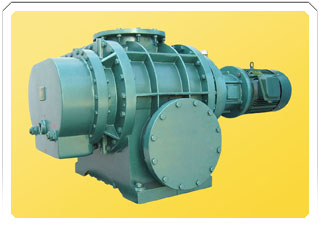
For 2X, specify gas ballast and the pressure measurement basis
The 2X entry describes two-stage oil-sealed pumps and gives a 5–40°C ambient range and an inlet-pressure operating condition below 1,330 Pa. It lists gas ballast for 2X-8, 2X-15, 2X-30A and 2X-70A to handle a limited amount of water vapour without condensation degrading the oil. Treat the vapour rate and operating duration as selection inputs; gas ballast is not blanket permission for aggressive solvents or large condensate loads.
The listed speed and motor pairs below are useful catalogue references. They are not a promised evacuation time at the vessel. The table separately presents ultimate vacuum, total pressure and open/closed gas-ballast conditions. Specify which pressure quantity and ballast state the acceptance measurement will use, with the test gas, gauge and blank-off or loaded-system condition.
Provide the oil specification, acceptable contamination, exhaust arrangement and planned maintenance interval as part of the proposal. If oil compatibility is uncertain, compare a liquid-ring route instead of relying on a lower published ultimate-pressure figure.
| Published model | Listed pumping speed | Listed motor power |
|---|---|---|
| 2X-8 | 8 L/s | 1.1 kW |
| 2X-15 | 15 L/s | 2.2 kW |
| 2X-30A | 30 L/s | 3.0 kW |
| 2X-70A | 70 L/s | 5.5 kW |
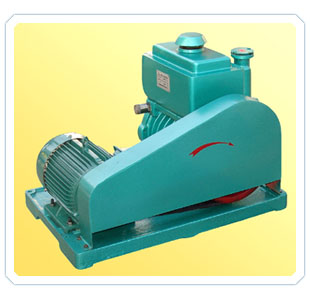
XD saves a cooling-water connection, but still needs an oil and exhaust plan
The XD page describes a single-stage rotary-vane pump with direct motor connection and air cooling. It lists an internal oil-mist eliminator, an oil/gas separator and an inlet non-return arrangement intended to limit oil return when stopped. These features make cooling ventilation and filter maintenance important order details, rather than reasons to treat the pump as maintenance-free.
For packaging, vacuum holding or forming, provide the cycle time and how much time the pump spends at a high inlet pressure. Request the continuous operating envelope, ventilation clearance, exhaust backpressure limit, oil-service instructions and separator replacement access. A manufacturer’s broad statement about operation at different inlet pressures needs an application-specific selection.
If the chamber must retain vacuum after stopping, define the allowable pressure rise and hold duration. Ask whether the supplied non-return arrangement is sufficient for that requirement or whether an external isolation valve is needed. An oil-mist eliminator is not evidence that all exhaust constituents can be discharged into an occupied room.
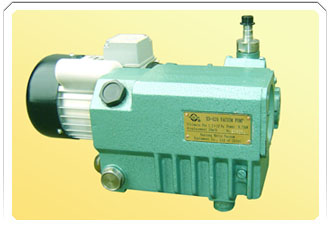
For JZJS, define the seal-water and vapour-handling system
The JZJS entry describes Roots stages backed by a two-stage liquid-ring pump, with vacuum and water-pressure relays for staged operation and protection. It identifies condensable-vapour processes such as vacuum distillation, evaporation and drying as intended uses. This is a product direction, not evidence of an installed customer project or universal corrosion resistance.
Provide the vapour mass load, gas chemistry, condensate carryover and seal-water supply temperature, pressure and quality. Request the liquid-ring performance at those conditions, plus the separator, make-up, discharge and heat-removal arrangement. State whether water is once-through or recirculated, and where any contaminated liquid is collected.
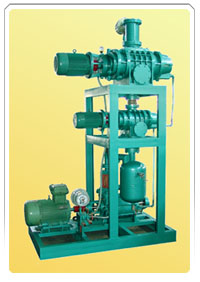
For flammable or otherwise hazardous gas, request the exact equipment and electrical protection basis for the process and destination. An explosion-protected motor alone does not establish that the complete vacuum system is suitable. Agree the condenser or inlet separator, level protection and start/stop sequence rather than inferring them from the package photograph.
Prove performance at the vessel, then hand over a maintainable system
Include pipe diameter, length, bends, valves, filters and condensers between the vessel and pump. Primary vacuum-piping guidance shows that pipe conductance reduces effective pumping speed, with the effect depending on the pressure regime. Ask for the calculated or demonstrated performance at the chamber, not only at the pump inlet flange.
For acceptance, distinguish a blank-off ultimate-pressure test, evacuation time with the agreed vessel and a continuous loaded-process test. Record absolute pressure, gas or vapour conditions, ballast state where relevant, cooling/seal-water conditions and gauge location. Agree the allowable drift and the test sequence before comparing quotations.
For handover, request the final installation drawing, electrical/control diagram, operating sequence, oil and water-service requirements, shutdown instructions and spare-part identifiers. Confirm removal space for guards, filters, motors and pump service; identify which commissioning work and instruments are included.
Send a pressure, gas and utilities brief for a matched vacuum proposal
Use these three groups to request an appropriate Weite pump or vacuum unit through KanBeng. Include the operating stages and acceptance conditions so the proposal can address both evacuation and continuous gas handling.
Review the existing Weite vacuum-pump catalogue reference →
Prepare a structured equipment enquiry →
Process and gas
- Vessel volume, initial/final absolute pressure, evacuation time, continuous gas load and cycle pattern.
- Gas composition, temperature, vapour rate, condensate, particles and oil-contamination limits.
- Present pump/nameplate and measured performance if replacing an installed system.
Installation and utilities
- Vessel-to-pump and foreline pipe sizes, lengths, valves, condenser/filter arrangement and exhaust destination.
- Electrical supply; cooling ventilation or seal-water temperature, pressure, quality and discharge/recirculation.
- Required staging, alarms, shutdown behaviour, restart conditions and service/removal space.
Proposal and acceptance
- Exact main/backing pump models, package components and combined performance at working pressure.
- Gas-ballast state, gauge/test basis, blank-off pressure, loaded capacity and vessel pump-down tests.
- Drawings, operating manuals, oil/filter/water-service schedule, spare parts and commissioning scope.
Submit through KanBeng’s enquiry form with this factory named in your request.