Packaged water supply, pressure maintenance and application-specific boosting
Foshan Puhe Pump Co., Ltd.
Specify the system and its interfaces before choosing the pumps. Puhe’s documentation separates network boosting, constant-pressure controls, HVAC make-up and woodworking dust-system boosting; each needs its own design inputs and acceptance schedule.
- Location
- Lunjiao, Shunde, Foshan, Guangdong
- Water-supply choices
- Direct-network boosting · constant-pressure VFD
- Specialist interfaces
- HVAC make-up/degassing · dust-system water boosting
- Order scope
- Pumps · vessels · controls · pipework · site work
Puhe focuses on packaged water systems and their interfaces
Foshan Puhe Pump Co., Ltd. identifies itself as 佛山浦和泵业有限公司 and lists its location in Lunjiao, Shunde, Foshan. Its company introduction separates domestic water supply, fire-related water supply, central hot-water engineering and water treatment. The useful procurement distinction is between a complete system, its controls and the individual pumps installed within it.
Its product documentation covers direct-network boosting, constant-pressure variable-speed supply and atmospheric pressure-maintenance equipment. A separate application supplies pressurised water in response to a woodworking dust-extraction spark detector. Choose the application first, then request a component schedule identifying pump manufacturers, vessels, valves, sensors and control hardware. A photographed branded pump inside an assembly does not establish that Puhe manufactures that pump.
Direct network boosting depends on the available water supply
Puhe’s tank-type non-negative-pressure equipment connects to a water-supply network and adds the pressure that the incoming supply cannot provide. The described assembly combines a flow-stabilising vessel, variable-speed pumps, a pressure vessel, controls, pipework and instruments. Its stated application is a source with adequate flow but insufficient pressure.
The sequence described in the document uses direct supply when incoming pressure and flow suffice, boosting when more pressure is needed, and protective action when the incoming network reaches its permitted minimum pressure. It also describes low-demand pressure holding and recovery after the source returns. Those are functions to put into the agreed control specification, rather than an assumption that a booster can create water during an interruption.
For quotation, send measured inlet pressure at peak demand, available incoming flow, interruption duration and the outlet duty. Identify the permitted connection arrangement with the water supplier. If storage is required, ask for a tank-fed alternative and its usable volume; do not treat the stabilising vessel as an unlimited backup water supply.
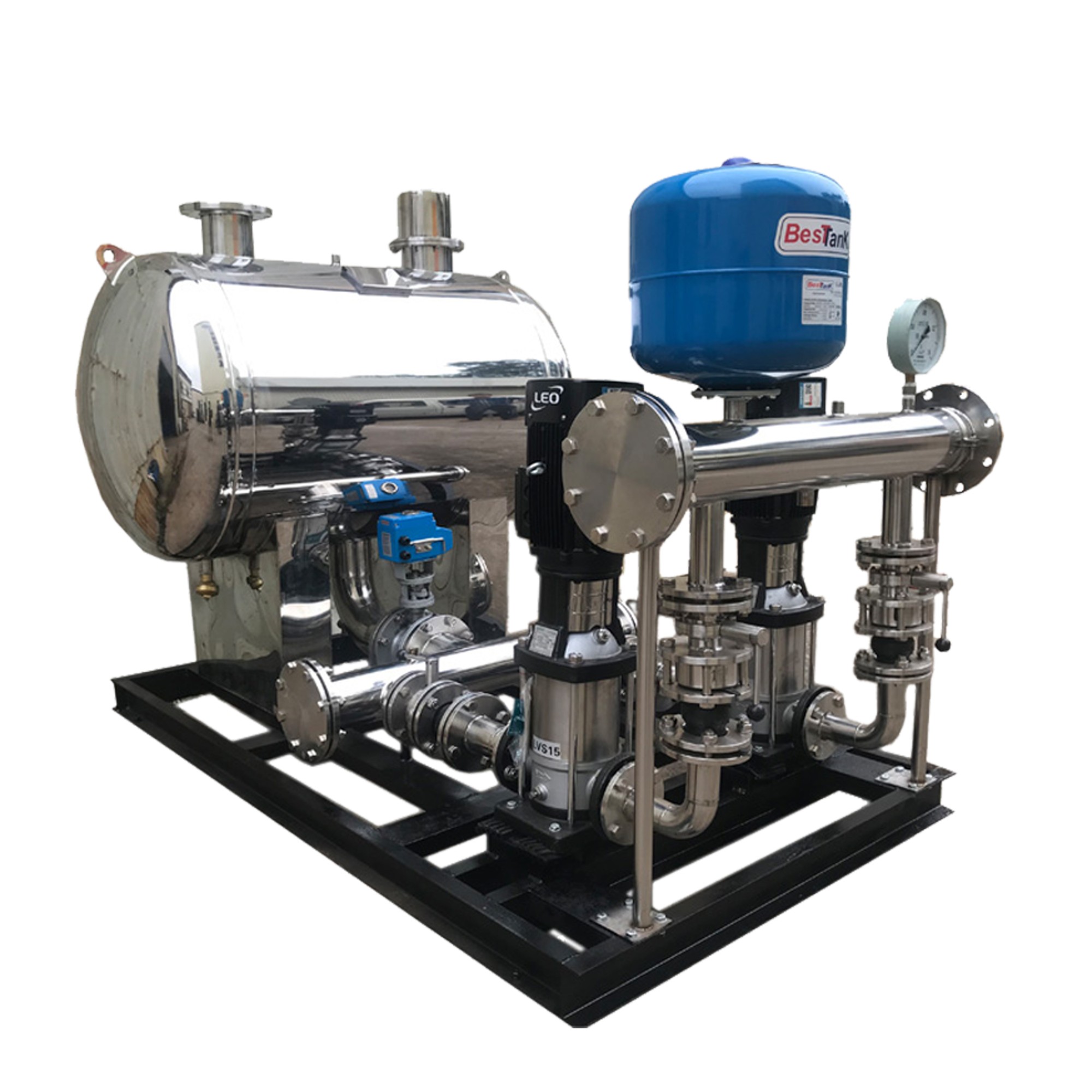
One shared inverter and one drive per pump are different packages
The constant-pressure page describes two architectures. One uses a PLC, inverter and relay circuits to control the pump group; its sequence transfers an operating pump to mains-frequency operation while the inverter starts another. The other uses a dedicated integrated drive for each pump, with CAN communication between controllers. These arrangements affect wiring, standby behaviour and replacement parts.
The same document distinguishes pressure feedback at the outlet header from feedback near the remote end of the network. Specify where pressure must be maintained and where the sensor will actually be installed. For low demand, it describes sleep operation with an auxiliary pump where fitted, or pressure holding by a vessel. A small auxiliary pump is an option to identify, not an automatic inclusion in every quotation.
| Control choice | What the document describes | Decision for the order |
|---|---|---|
| PLC with shared inverter | Pump staging with inverter/mains changeover | Define changeover sequence, standby response and cabinet schematic. |
| Integrated drive on each pump | CAN-linked coordination and individual drives | Identify drive models, communication arrangement and replacement strategy. |
| Low-demand operation | Sleep, auxiliary pump where provided, or vessel pressure holding | Specify wake-up settings, vessel capacity and acceptable cycling. |
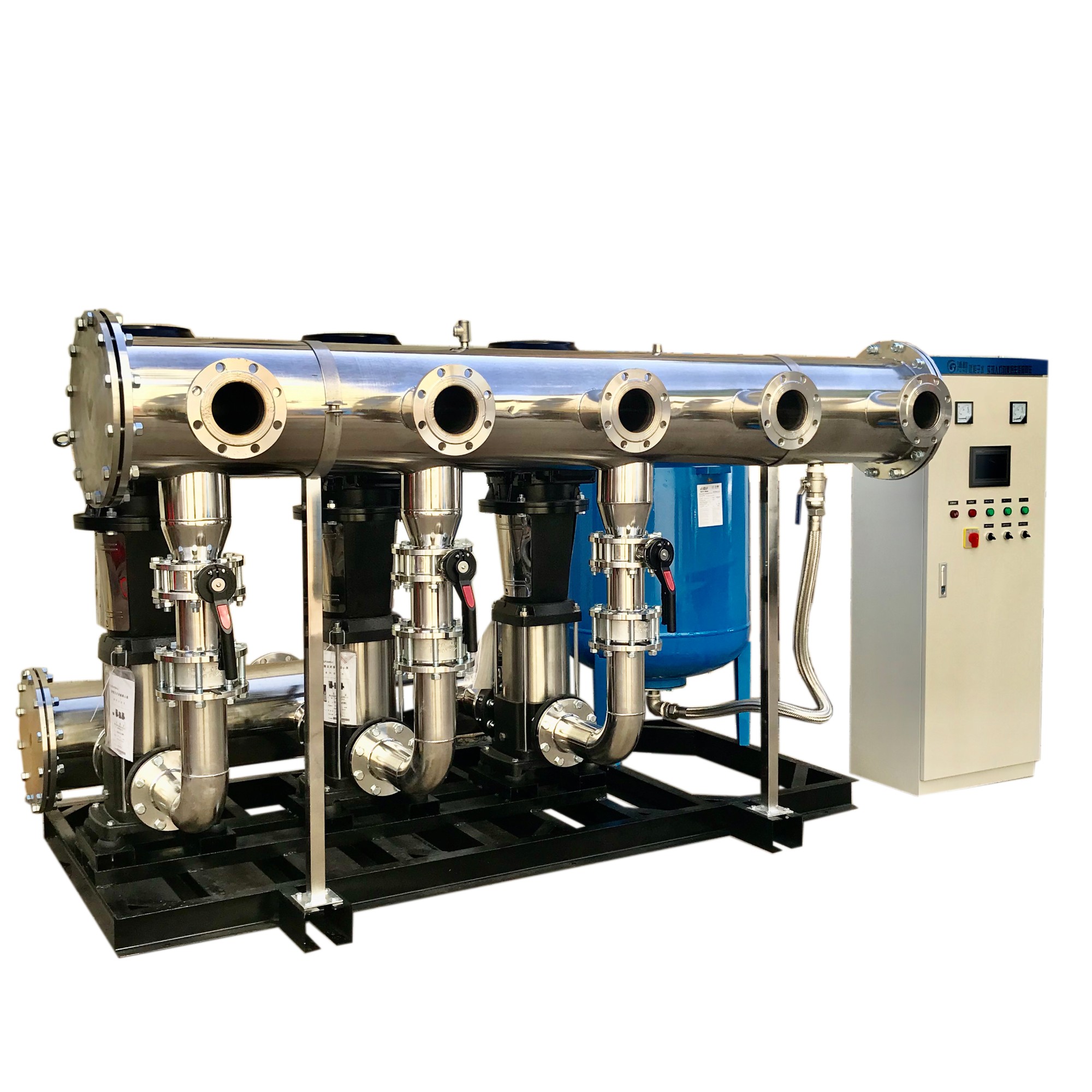
An integrated pump room still needs a workable site
Puhe’s pump-room article describes factory integration of pumps, cabinet, pipework, valves and a stabilising vessel before the assembly reaches site. It discusses new developments, older residential retrofits, rural or irrigation supply and temporary water use. For a retrofit, it specifically calls for checks of dimensions and load-bearing conditions; outdoor installations also need foundations, drainage, frost protection and noise planning.
Send the access route as well as the proposed equipment footprint. A package that fits the room may not pass through its doors or permit removal of a motor. Compare the new duty with current pipe losses and the most demanding outlet, rather than copying only the old motor rating. Agree who supplies external pipe connections, foundations, lifting, electrical feed and commissioning before comparing package prices.
The direct-network document lists 4–40°C ambient conditions, 50 Hz supply and nominal AC 380 V, with altitude preferably below 1,000 m. These are the conditions in that equipment description, not ratings for every outdoor enclosure or HVAC package. Ask for the selected equipment’s actual electrical and environmental specification when the site differs.
HVAC expansion and make-up water need a different design brief
The atmospheric pressure-maintenance page explains pressure sensing, transfer of expansion water to an atmospheric vessel, make-up pumping as pressure falls, and gas separation or degassing. It lists softening of external make-up water as an optional addition. The engineering task is to manage a closed water circuit through temperature changes and water loss, rather than supply a building’s drinking-water demand.
The page also contains a separate pressure-switch and gas-cushion vessel explanation. These are different operating descriptions. Ask for the actual hydraulic schematic, tank type, pressure-control method and degassing method for the offered package; do not combine their illustrations or settings into an assumed standard model.
Provide system water volume, fluid composition, operating temperatures, static height, pressure limits, the intended connection point and make-up water quality. Request the expansion-volume calculation, vessel capacity, pump duty and operating sequence together. Establish drainage and maintenance access, and confirm whether softening and degassing components are included.
Spark-suppression boosting is a dedicated application
Puhe describes its woodworking dust-extraction booster as equipment used with a spark-detection alarm. The stated sequence is detection of a spark in the duct, initiation of the boosting device and water spray into the duct. This is an interface between detection and pressurised-water delivery; the booster listing alone does not establish a complete certified explosion-protection system.
For this enquiry, provide the duct layout, detector and control-system details, required nozzle pressure and simultaneous spray demand. Ask the responsible system designer to define detection-to-spray timing, fault response and the acceptance procedure. Clarify whether detectors, spray valves, nozzles, reserve water and interconnecting cables are part of Puhe’s supply or another contractor’s scope.
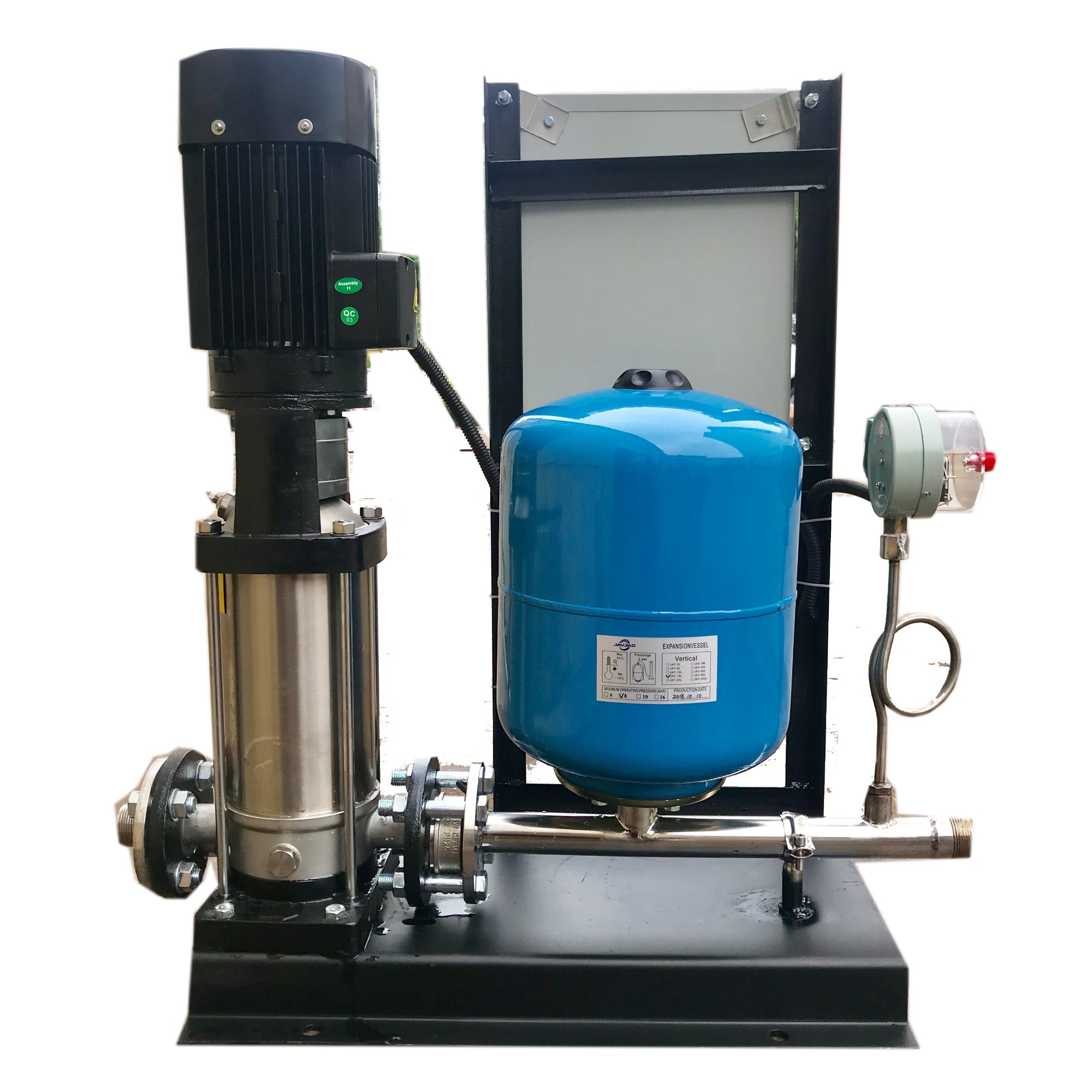
Check configuration, controls and service access together
Puhe’s pump-room acceptance guidance highlights pump nameplates and cabinet configuration, pipe joints and valve direction, vessel matching and pre-charge, grounding and protection, vibration isolation, and pressure-data transmission where remote monitoring is included. Use these as a handover checklist tied to the project drawing and equipment schedule.
Ask for the selected pump curves and duty points, electrical schematic, control settings, vessel documents, spare-part list and maintenance instructions. During the agreed acceptance procedure, check the relevant operating and fault sequences: low inlet pressure, loss of water, pump rotation, low-demand sleep, restart and standby transfer. Record measured results and the tested configuration.
The Guangdong science authority’s 2023 technology-based SME list names this pump-company entity, and its 2022 high-tech-enterprise list records the same name. These historical listings support entity identification; they do not certify the ordered equipment or demonstrate current factory inspection. Certificates shown for the separately named metal-products company are not assigned to this pump company.
Make the scope comparable before requesting a price
Select one of the briefs below and attach the available site drawings. For sewage lifting, prefabricated stations or steam-related equipment listed elsewhere in the catalogue, request a dedicated technical schedule before selection; the short catalogue entries do not supply a basis for inventing duty ranges or approval claims.
Build a structured pump-system RFQ →
Compare other manufacturer profiles →
Building water supply
- Incoming pressure/flow measurements, interruptions, water-supplier connection conditions and storage requirement.
- Peak and minimum demand, outlet pressure or remote critical point, duty/standby arrangement and power supply.
- Control architecture, sensor position, alarm/remote monitoring needs and exact pump/component schedule.
HVAC or dust-extraction application
- HVAC: water volume, temperature range, fluid composition, static height, pressure limits and make-up water quality.
- Dust extraction: detector/control interface, duct and nozzle layout, spray duty and designer-defined response and fault tests.
- Include the offered schematic, vessel arrangement and a clear list of supplied versus excluded components.
Installation and handover
- Room or outdoor-site dimensions, delivery access, load-bearing conditions, drainage and noise/frost requirements.
- Boundary for civil work, external pipework, cables, lifting, commissioning and future component removal.
- Curves, drawings, wiring, settings, spare parts and agreed acceptance records for the actual delivered configuration.
Submit through KanBeng’s enquiry form with this factory named in your request.