
Chemical transfer · magnetic containment · thermal and solids boundaries
Shanghai Bainuo Pump & Valve Co., Ltd.
Shanghai Bainuo’s magnetic-pump range addresses several different liquid-handling problems. Ordinary IMC service excludes hard particles, fibres and magnetic material; heat-retaining and high-temperature constructions have their own thermal requirements; NCH is presented separately for suspended-particle service. Start with what happens to the liquid during transfer, stopping and restarting, then specify the construction and protection that the offered pump actually includes.
- Company identity
- 上海佰诺泵阀有限公司
- Published location
- Jinshan, Shanghai, China
- Reviewed directions
- IMC / IMC-G · jacketed IMC-B · NCH
- Selection priority
- Liquid state, temperature, suction conditions and shutdown protection
Separate a clean transfer from a crystallising or particle-bearing duty
A shared magnetic drive does not make these duties interchangeable. The existing IMC-P page represents the clean-liquid direction. Do not use the NCH title to approve solids or dry running in an ordinary IMC pump, or apply a high-temperature family limit to its 120°C construction.
| Process condition | Direction to discuss | Information needed before selection |
|---|---|---|
| Compatible clean liquid within ordinary temperature limits | IMC / existing IMC-P listing | Composition, concentration, viscosity, suction pressure and required flow/head; no hard particles, fibres or magnetic matter. |
| Liquid needs heat retention or temperature management | Jacketed IMC-B; distinguish IMC-G high-temperature construction | Crystallisation/solidification behaviour, thermal-fluid conditions and startup/stop sequence; exact pressure-temperature approval. |
| Corrosive liquid contains suspended particles or interrupted-flow conditions | NCH-specific review | Particle size, loading, hardness and magnetic character; permitted interruption duration and required protection. |
IMC-P: static containment still needs a compatible, continuously supplied liquid
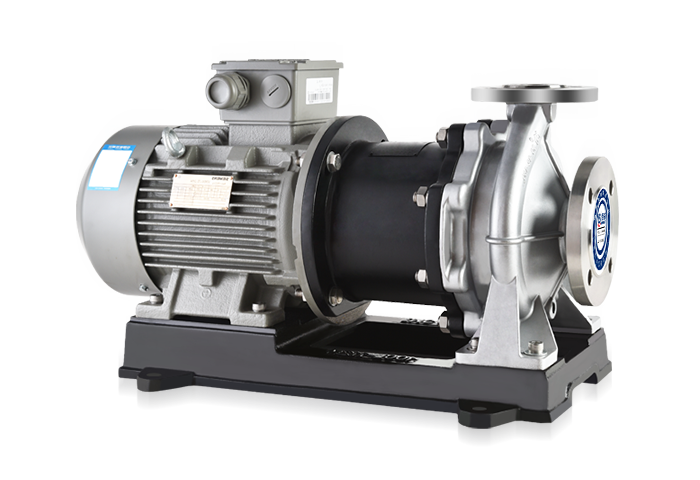
The IMC-P webpage describes a horizontal, single-stage, single-suction, radially split volute pump with foot support, axial suction, radial discharge and back-pull-out construction. Torque passes through a magnetic coupling and static containment boundary. This explains the absence of a conventional rotating shaft seal at that boundary; it does not establish zero leakage under every installation or failure condition.
For ordinary IMC service the page lists suction pressure no greater than 0.2 MPa, working pressure no greater than 1.6 MPa, temperature no greater than 120°C, density no greater than 1,980 kg/m³ and kinematic viscosity no greater than 30 cSt. It excludes hard particles, fibres and magnetic substances. Confirm the definition of the quoted pressures and the actual material/temperature rating for the offered unit.
The same source discusses a separate IMC-G construction up to 350°C and special design above 1.6 MPa. Those statements require their own approved configuration and cannot raise the limits of the existing IMC-P listing. Chemical compatibility also concerns the containment can, bearings, seals and other wetted parts, rather than only the casing’s stainless grade.
View the reviewed product family →
Check suction and vaporisation conditions
Provide tank pressure, minimum liquid level, temperature, vapour pressure and suction-line losses. Request the duty curve, required suction margin and any internal circulation requirements for the actual liquid.
Reserve service space
Request the assembly drawing and back-pull-out clearance before fixing piping, motor access and the base layout. Identify the containment and bearing parts included in the spare-parts offer.
Use the hydraulic row, impeller trim and liquid density together
The first row lists 42% efficiency and a 2 m suction/cavitation parameter. Treat that value as catalogue data requiring the manufacturer’s definition and a duty-specific suction check. It is not a permitted suction lift or an installation guarantee. The table states motor powers for relative density 1.00; a denser or more viscous chemical requires a reviewed absorbed-power and drive selection.
The brochure’s nomenclature distinguishes impeller cuts and material, explosion-protection and high-temperature designators. The jacketed IMC-B webpage also repeats an IMC50-32-160P header, so its title/header alone does not resolve the complete ordered code. Obtain a signed datasheet and drawing identifying the construction and trim. For a quotation, ask which hydraulic row applies to the offered IMC-P construction.
Broad brochure ranges and individual table rows are not interchangeable: flow, differential head, pressure rating and temperature are separate selection limits. Require the full curve, operating region and drive calculation at the actual chemical conditions rather than combining family maxima.
| Catalogue row | Flow / head | Speed | Shaft power / listed motor |
|---|---|---|---|
| IMC50-32-160 | 12.5 m³/h / 32 m | 2,900 r/min | 2.79 kW / 4 kW |
| IMC50-32-160A | 11.3 m³/h / 26.4 m | 2,900 r/min | 2.20 kW / 3 kW |
For IMC-B, define what the jacket does during every part of the cycle
Bainuo describes IMC-B as a jacketed heat-retaining magnetic pump and mentions liquids within 350°C. Its page discusses temperature management to reduce condensation or crystallisation and cooling water when excessive heat must be removed. This is a construction direction, not evidence that every material, magnet, bearing, motor or jacket connection is approved at that temperature.
Give the liquid’s crystallisation or solidification temperature, normal transfer temperature, startup temperature, expected shutdown duration and cleaning conditions. Specify the thermal fluid, supply/return temperatures and pressure, available flow, connections and insulation boundary. Ask for the required warm-up, draining and restart procedure before allowing the pump to run.
The webpage offers an automatic stop on interrupted flow as an option. Specify it explicitly, including the detecting device, trip setting, alarm and reset logic; do not assume it is fitted. Identify which power/flow/temperature protections are included and how the system reacts to loss of jacket circulation or an empty supply tank.
Thermal package boundary
- Which pump regions are jacketed and which utility connections are supplied.
- Permitted process and jacket pressures/temperatures for the offered materials.
- Insulation, cooling, startup and shutdown responsibilities.
Controls and documentation
- Interrupted-flow detection and stop device, if ordered.
- Required permissives, alarms, reset and power-restoration behaviour.
- Assembly drawing, operating procedure and a configuration-specific spare-parts list.
Submit through KanBeng’s enquiry form with this factory named in your request.
NCH particle and unloaded-running claims need measurable acceptance limits
The NCH page presents a stainless magnetic pump for corrosive liquid containing suspended particles and labels it as capable of unloaded operation. Its illustrated nomenclature and hydraulic table identify an NCH65-50-160 row at 25 m³/h, 32 m, 2,900 r/min, 52% efficiency and a 7.5 kW listed motor. The table states motor selection at relative density 1.00. These are hydraulic catalogue values, not particle-size or interruption-duration limits.
The reviewed page does not quantify acceptable particle size/loading or a permitted dry/unloaded-running duration. Describe particle distribution, hardness, concentration, settling behaviour and any magnetic content, then request written approval and the bearing/circulation arrangement for that exact service. Define what “unloaded” means in the offer: loss of inlet liquid, reduced flow or another specific condition must not be assumed equivalent.
For a process that can lose liquid supply, specify the event duration and frequency, monitoring, shutdown/restart requirements and the acceptance procedure. Obtain the manufacturer’s approved operating instructions before treating an interruption claim as permission to operate without liquid. An NCH review remains separate from IMC-P selection.
Match procurement evidence to the product being ordered
The official company profile places Shanghai Bainuo in Jinshan and traces its predecessor, Shanghai Yongjiu Industrial Pump Factory, to 1992. Its product navigation also covers canned-motor, chemical and diaphragm pumps. For a replacement or multi-pump package, identify the exact construction and supplier responsibility for each line item rather than assuming one magnetic-pump datasheet covers the wider catalogue.
A Shanghai market-regulation publication dated 28 December 2023 lists 上海佰诺泵阀有限公司 in the conforming-tested-items table for a 65WQ25-10 sewage-pump sample manufactured in July 2023. That is dated evidence about that sampled sewage pump. It does not certify the IMC or NCH range, establish current conformity of an order, or replace a project acceptance test.
The IMC source refers to API 685 and HG/T 2730-2012. Request the applicable edition, offered compliance scope and any deviations where your specification invokes those documents. A manufacturer’s design reference is not an independent certification badge. Agree hydraulic test conditions, material documents, assembly inspection and protection checks for the supplied unit.
Send the liquid history, duty and configuration in one request
Reviewed on 8 October 2026 from the official company and IMC-P, IMC-B and NCH pages, the linked combined product brochure and the dated Shanghai sampling publication. Catalogue examples and manufacturer claims are scoped to their named constructions. Request current supporting documents for any additional qualification required by your order.
Process and installation
- Chemical composition/concentration, density, viscosity and normal/maximum temperature.
- Required flow/head, tank pressure and levels, vapour pressure and suction route.
- Particles, fibres, magnetic matter, crystallisation and any loss-of-supply events.
Offer and acceptance
- Existing nameplate/full code and drawing for replacement; proposed construction and impeller trim for a new duty.
- Wetted material schedule, pressure-temperature approval, motor/power and any required hazardous-area documentation.
- Jacket utilities, protection devices, included accessories, operating procedures, tests and spares.
Submit through KanBeng’s enquiry form with this factory named in your request.
Report an outdated detail · Return to the enquiry checklist ↑