
Solve the building, wet-well or process-water installation
Shanghai Pacific Pump Manufacture (Group) Co., Ltd.
Compare direct-connected supply, sewage handling, circulation, chemical transfer and fire-water packages. Match the liquid and installation to a selected configuration and clear control responsibilities.
- Listed base
- Shanghai
- Equipment
- Pumps · boosting sets · controls
- Selection priorities
- Inlet · solids · materials · fire duty
- Enquiry documents
- Curve · installation · supply boundary
Buy a defined water-service package from the Shanghai manufacturer
Shanghai Pacific Pump Manufacture (Group) Co., Ltd. identifies itself in Chinese as 上海太平洋制泵(集团)有限公司 and uses the TPY / Pacific Pump Group mark. Its company page dates its foundation to 1998 and locates its headquarters in Shanghai. The official range spans circulation pumps, wastewater equipment, chemical pumps, fire pumps, pressure-boosting equipment and control cabinets.
The most useful starting point is the site problem: an existing building with insufficient water pressure, a sewage pit that deposits sludge, a hot-water circulation loop, a chemical transfer line or a fire-water installation. These jobs require different wet ends, installation methods and control responsibilities. A pump photograph alone does not define a complete pumping system.
Prepare the original nameplate and site drawings for a replacement. For new equipment, identify the source of water or process liquid, the destination, the required operating cases and which civil, electrical and control work belongs in the quotation. Use the exact Shanghai legal entity on the offer; do not confuse similarly named pump businesses.
| Site problem | Direction to discuss | Resolve before comparing prices |
|---|---|---|
| Building needs more supply pressure | T1/T2 direct-connected supply or WZG tank-type boosting | Minimum inlet pressure, utility conditions and peak/low demand |
| Wet well contains solids or settling sludge | WQ/QW, JYWQ or WQ/QG | Solids, cutting/agitation need, coupling and removal route |
| Ordinary circulation or clean-water transfer | TPG/TPW, TPOW or CDL/CDLF | Actual curve, nozzle arrangement, inlet pressure and material |
| Chemical transfer | IH or a documented alternative wet-end design | Liquid composition, seal system and temperature |
| Fire-water service | Exact XBD/XBC package | Rated flow/pressure, approval scope and complete control arrangement |
Choose the inlet arrangement before selecting a booster set
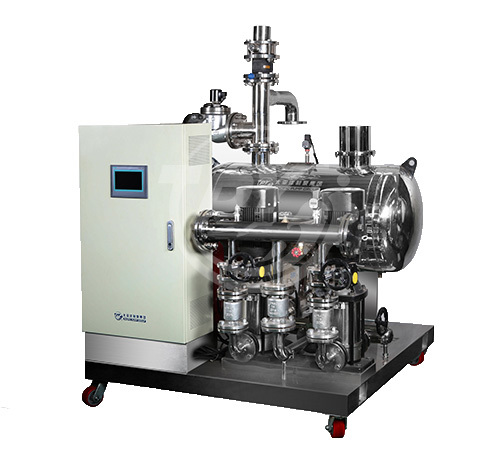
T1/T2 is presented as integrated direct-connected supply equipment for residential renovations, individual buildings, rural/town supply upgrades and local pressure boosting. The manufacturer describes manual/automatic switching, pump alternation, pressure and motor protections, low-demand sleep/wake operation and optional integrated variable-frequency control with multi-pump communication. Ask which functions, sensors and communication interfaces the quoted unit actually includes.
WZG is a different tank-type pressure-boosting package. Its description uses the pressure already available from the municipal main and adds the pressure required downstream. The published family envelope is 10–850 m³/h and 15–260 m head, with supply pressure stated up to 2.5 MPa. Those independent limits are not one operating point or a guarantee of utility acceptance.
For either system, provide minimum and maximum inlet pressure, demand profile, highest outlet elevation, required residual pressure, pipe losses, water quality and available power. Have the supplier identify the tank, pump count, duty/standby logic, bypass, isolation valves, hygiene documentation and maintenance access. Approval to connect directly to a public main depends on the actual installation and local requirements.
The WZG description says supply can continue during a power failure using existing main pressure. That is conditional: a stopped booster does not maintain its additional pressure. Establish what water service remains at the critical outlet without power, and decide whether storage or another resilience measure is needed.
Separate ordinary sewage handling, agitation and cutting
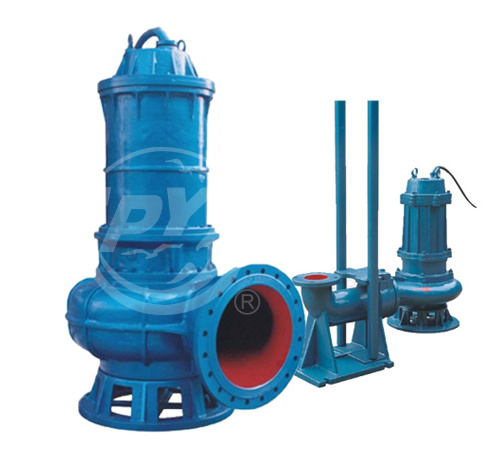
WQ/QW is the ordinary submersible sewage direction, with large passages and tandem mechanical seals described on the product page. The published range is 5–8,000 m³/h and 7–90 m head across the family. Obtain the selected curve and solids-passage information; the page does not provide one universal particle diameter for every unit.
JYWQ adds a discharge-pressure-driven arrangement to stir settled material in the wet well. It offers fixed automatic-coupling installation or mobile free installation and describes double guide rails for removal. That is a different requirement from WQ/QG cutting equipment, whose blade/plate arrangement addresses fibrous waste. Describe the actual solids and sediment rather than choosing an impeller from the word “sewage”.
Specify minimum operating level, start/stop levels, inflow, discharge route and lifting access. Request the coupling, guide rails, chain, cable length, float/level instruments and protective cabinet as separate scope items. The manufacturer describes leak, overload and temperature monitoring as configurable equipment; do not assume the photograph includes the cabinet or that protections eliminate every failure.
The WQ page describes an optional water-jacket cooling arrangement for dry installation. Confirm the selected motor cooling system and permitted operating conditions before using a submersible pump out of water. Published long-running-hour claims are not a maintenance interval or a warranty for the actual wastewater.
Review the existing QW family listing →
Choose maintenance access and pressure boundaries with the hydraulic duty
TPG is a vertical single-stage pipeline pump with equal-diameter in-line inlet and outlet connections. Its page gives 1.5–1,200 m³/h, 5–150 m head, working pressure up to 1.6 MPa and liquid temperature −20 to +120°C across the family. It describes removing the motor/transmission assembly for service without dismantling the pipework. Reserve the clearance needed for that removal in the actual installation.
TPOW is a horizontal single-stage double-suction split-case direction. Its page gives 60–7,500 m³/h and 10–210 m head, describes internal seal circulation and a double-volute arrangement for higher-head variants. These features do not identify the selected size, seal-flush circuit or material. Ask for the full arrangement, nozzle loads, rotor-removal method and bearing/seal access.
For circulation service, compare the actual flow/head curve, speed, efficiency and motor load over the intended operating range. Add inlet pressure to the pressure developed by the pump when establishing the required pressure boundary, and account for liquid temperature and transients. A cold-water curve and a family-wide pressure headline do not establish every hot-water configuration.
For a replacement identified as ISW, supply the full nameplate and original installation drawing. The current TPG/TPW descriptions do not establish interchangeability with that unit; match the quotation designation, nozzle dimensions, duty and drawing revision before ordering.
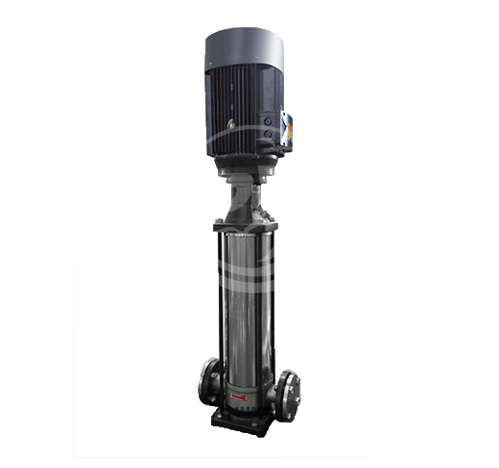
Read the CDL/CDLF material schedule and curve together
The official CDL/CDLF manual provides section drawings, material schedules, performance curves and mounting dimensions. In its small-size drawings, CDL uses a cast-iron inlet/outlet section while CDLF specifies a stainless-steel inlet/outlet section. The schedules also distinguish the wet components from brackets, base and coupling. “Stainless pump” alone is not a complete material specification.
The individual product page gives a broader family envelope of 2–300 m³/h, 24–260 m head and working pressure up to 2.5 MPa, with liquid temperature up to 120°C. The manual includes low-stage examples below that headline head range. Use the exact row and curve for the selected size instead of treating the web summary as the limit of every stage configuration.
The examples below are actual entries from the manual’s 50 Hz tables, illustrative catalogue points, not a confirmed selection for your installation. Both use a 0.37 kW motor but deliver different flow/head combinations. The manual also supplies dimensions, weights and connection options: a hydraulic match still needs the correct flange/thread connection and removal clearance.
A Shanghai market-regulator report dated 28 December 2023 lists a June 2023 CDL 32-10 FSWPR sample from this manufacturer among products whose inspected items met the relevant requirements. It supports that named sample and date; it does not certify all CDL variants or establish the condition of equipment offered now.
| Manual designation | Flow at this point | Head at this point | Listed motor |
|---|---|---|---|
| CDL2-2 | 2 m³/h | 15 m | 0.37 kW |
| CDL3-2 | 3 m³/h | 10 m | 0.37 kW |
Review the existing CDL family listing →
Specify the liquid before choosing an IH construction
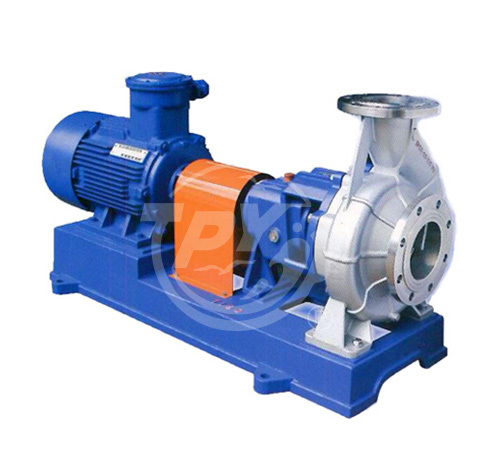
IH is documented as a single-stage single-suction chemical centrifugal pump for water-like corrosive liquids or liquids that must not be contaminated. Its page describes dimensions and nominal performance based on ISO 2858, and a family range of 6.3–400 m³/h and 5–125 m head. That standard reference is not a separate approval of every fluid or seal combination.
The page describes −20 to +200°C liquid service and a working-pressure headline up to 2.5 MPa, with cooling measures needed for higher temperatures. Establish the actual material, seal arrangement, cooling/flush requirements and pressure rating at the selected temperature. Do not transfer these limits to a different fluoroplastic, magnetic-drive or submerged family in the same catalogue.
Include liquid identity, concentration, impurities/solids, viscosity, vapour pressure, temperature range and suction conditions in the enquiry. Ask for the wetted-material schedule, elastomer compatibility, seal leakage/containment requirements and selected performance/NPSH curve. Confirm whether the offer includes the motor, base, coupling guard and auxiliary piping.
Review the existing IH family listing →
Keep fire duty, package scope and certificate status separate
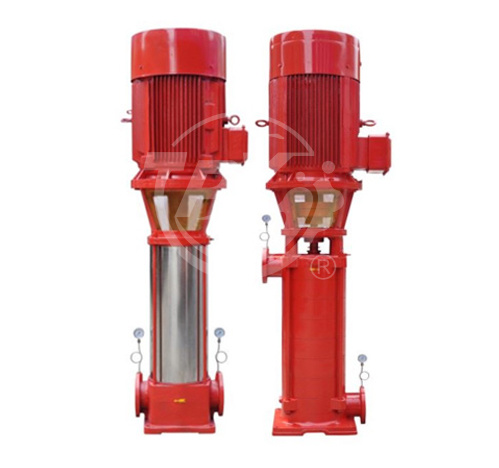
The fire catalogue distinguishes vertical/horizontal single-stage, vertical/horizontal multistage, double-suction, constant-pressure and diesel-driven equipment, plus stabilisation and electrical control equipment. The vertical multistage product page gives 5–100 L/s and 0.2–2.5 MPa across that direction. Compare rated pressure and flow together for the actual designation; an ordinary building booster is not automatically the correct fire package.
The older XBD fold-out lists certificate numbers and marks some designations with an asterisk as applications in progress. Those catalogue statements must not be read as present approval for every unit. Request the applicable current certificate, holder, covered model/rating and complete pump/driver/controller arrangement required by the project.
A Shanghai regulator report published 16 January 2026 lists the October 2025 XBD8.0/10G-GDL samples, batch numbers 25100325 and 25100326, from this exact manufacturer among products whose inspected items met the relevant requirements. It is specific sample evidence, distinct from a certificate or approval of a whole fire-pump room.
Define the water source, suction conditions, rated and additional test points, duty/standby arrangement, controller logic, power or diesel utilities and commissioning responsibilities. Agree the package drawings, witnessed tests where required, spares and maintenance instructions before comparing a bare-pump price with a complete set.
Review the existing XBD family listing →
Turn the site problem into a comparable scope of supply
Ask the Shanghai manufacturer for one selected configuration tied to a complete hydraulic and installation brief. The offer should identify the legal supplying entity, model, drawing revision, motor/power supply, wetted materials, seals and controls; then state the accessories and site work included or excluded.
For renovation work, send photographs of the nameplate and installation with measured connection and access dimensions. For a new building, wet well or fire room, include the operating scenarios and interfaces with the main, tank, pit, electrical panel and supervisory control system. Resolve these boundaries before commercial comparison.
For delivery and maintenance, agree the selected performance/test documents, installation instructions, commissioning responsibility, spare parts and access method. Factory-wide marketing counts, client logos and historical certificates do not replace the records for the equipment being purchased.
Prepare a structured pump RFQ →
Water-service brief
- Supply source, pressure/level extremes and demand profile
- Liquid composition, solids/fibres, temperature and suction conditions
- Required flow/head or fire rated flow/pressure and operating cases
Installation and control boundary
- Tank/pit, pipe connections, removal/lifting clearance and site drawings
- Pump count, standby logic, motor supply, cabinet and monitoring interfaces
- Coupling/rails, valves, cooling/flush lines and utility connections
Selected-equipment records
- Exact supplier, model and drawing/material schedule revision
- Current applicable fire/hygiene documents and their covered scope
- Performance/test records, installation instructions, commissioning and spares
Submit through KanBeng’s enquiry form with this factory named in your request.