
Deep-well water supply · shallow-water intake · mine and mobile drainage
Shanxi Skysea Pump Industry Co., Ltd.
Shanxi Skysea Pump Industry, known as Tianhai and legally 山西天海泵业有限公司, manufactures submersible electric pumps in Yuncheng, Shanxi. Its range connects several water-source situations: a drilled well, a shallow reservoir intake, a mine working face and a temporary flood-drainage site. Selecting between them starts with the available water, installation geometry and electrical supply. The guide below shows what to measure and what to put into the quotation for each route.
- Chinese legal name
- 山西天海泵业有限公司
- Published location
- Yuncheng, Shanxi
- Brands shown
- Tianhai / SKYSEA
- Existing family
- QJW horizontal submersible
Choose a water-source arrangement before choosing a frame size
The catalogue covers well-water pumps, horizontal submersibles, floating assemblies, sewage and mine-drainage equipment, and mobile stations. Its corporate page also identifies specialist businesses for water supply/drainage, industrial/mining equipment, smaller electric pumps and water engineering. Establish the contracting supplier and the complete assembly scope in the offer.
| Water source or task | Direction to investigate | Decisive site information |
|---|---|---|
| Drilled well or borehole | QJ / QJR well submersible | Clear diameter, straightness, tested well yield, pumping water level and water temperature. |
| Shallow water where a vertical unit will not fit | QJW horizontal submersible | Minimum depth, intake clearance, supports, cooling and retrieval route. |
| Broad river, lake or reservoir surface | Floating pump assembly | Level variation, anchoring, discharge connection and safe service access. |
| Mine workings with sand-bearing water | BQS mine drainage | Hazard classification, particle load, selected approval/marking and electrical protection. |
| Temporary drainage with site-to-site movement | Tracked self-priming station | Access and transport, suction/discharge routes, site power and operating duration. |
A deep-well pump must fit the bore and the well’s sustainable yield
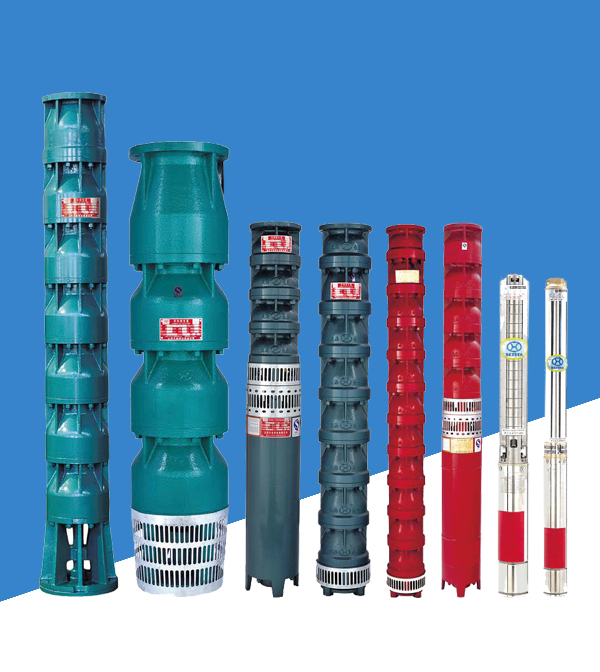
QJ combines a submersible motor directly with a well pump. QJR is the separate hot-groundwater direction, described for water below 100°C. The combined catalogue envelope spans 2–1,000 m³/h, 10–1,000 m head and 0.55–600 kW, with 380 V and 660 V options. These ranges cover different sizes and assemblies; they are not one available duty combination.
Skysea’s dated selection guide starts with well diameter, flow/head, transformer capacity, water quality and environment. Use the actual clear bore and drilling record, including straightness and obstructions. For a deep installation, the maximum assembly diameter, cable allowance, riser arrangement and retrieval clearance need to be checked together.
Choose flow against a pumping test and sustainable well yield. The guide gives the example of a 60 m³/h well being considered for a lower pump flow such as 50 or 32 m³/h. Those numbers illustrate keeping extraction below the source limit; they are not a recommended rate for a different well. Record drawdown and recovery rather than sizing only to the irrigation demand.
For head, use the pumping water level and discharge elevation, then add pipe and fitting losses at the chosen flow. The guide’s worked example totals 100 m elevation difference plus 25.5 m estimated line loss to obtain 125.5 m actual head. Its particular pipe-loss assumptions belong to that example. For a new site, submit the real pipe length, internal diameter, material, fittings and destination pressure, and request the selected curve.
Separate ordinary well water from hot or mildly corrosive groundwater. Give temperature and water analysis for QJR, then confirm motor, cable, seals and wetted materials for those conditions. The hot-water label alone does not establish suitability for every geothermal chemistry.
Keep the duty point inside the selected curve
The selection guide warns that operating head too low can raise flow and motor current, while excessive head reduces flow and changes loading. Agree the permitted operating range and protection with the selected pump-and-motor set.
QJW: horizontal installation solves a geometry problem, not a water-supply problem
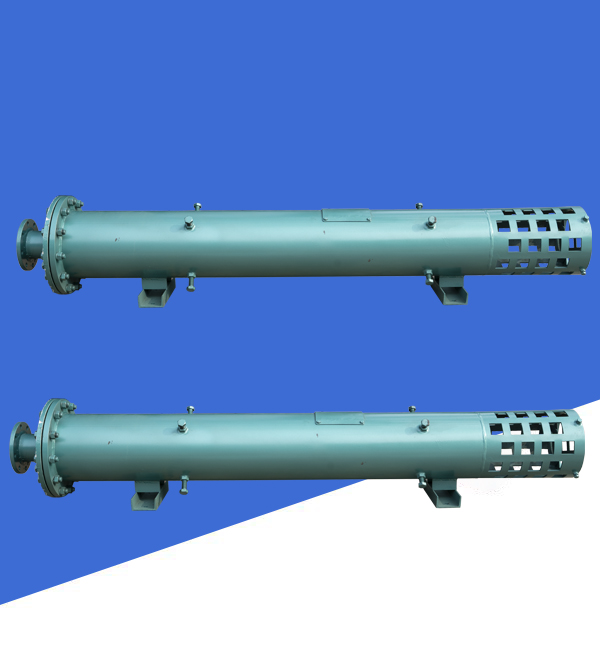
QJW is described for shallow surface water where vertical installation is impractical, including rivers, lakes, reservoirs, pools and canals. The official photograph shows horizontal assemblies on support feet. Begin with the lowest operating water level and the actual space available around the intake and the complete pump.
The family page gives frame sizes of 150–600 mm, flow of 5–2,200 m³/h, head of 5–500 m and motor ratings of 3–600 kW. Match simultaneous flow/head to one selected curve. Obtain the overall dimensions, support locations, minimum submergence and motor-cooling requirements for that unit.
Describe sediment, weeds, floating debris and water quality at the intake. Agree intake protection, bottom clearance and a way to remove the unit without dragging it through the discharge line or electrical cable. If the level changes seasonally, include that range in the drawing and operating brief.
Specify the horizontal supports, pipe flexibility, cable run, lifting points and shore-side control location. A horizontal pump is still a submerged electrical installation: the supplied operating instructions and site electrical design should establish the placement, protection and retrieval arrangements.
View the reviewed product family →
A floating assembly needs a mooring and service plan as well as a pump curve
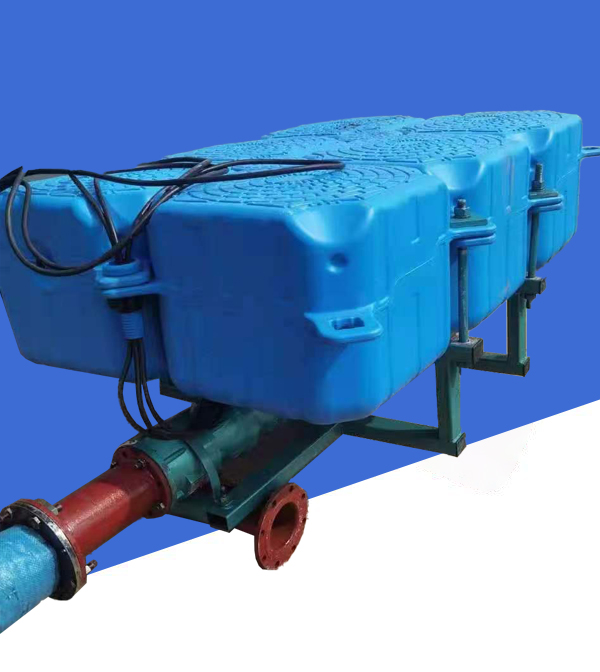
The floating-pump page identifies broad rivers, lakes and reservoirs as its application direction. Its published envelope is 5–2,200 m³/h, 5–500 m head and 3–600 kW across the range. It is an installation direction to discuss alongside QJW when the surface level or shore access affects a fixed intake.
Give the minimum/maximum water levels, intake depth, water conditions and discharge connection. Ask for the selected buoyancy/support design, assembled mass, anchoring arrangement and allowable movement of hoses or pipes. The photograph identifies a floating construction but does not define the mooring for a particular reservoir.
Allocate responsibility for pontoons, supports, anchors, pipe/hose connections, cable routing and shore controls. Agree how the assembly is reached, isolated and removed for maintenance. Seasonal level variation and retrieval access belong in the first enquiry rather than being left to installation day.
BQS: specify the sand duty and the exact mine-use assembly
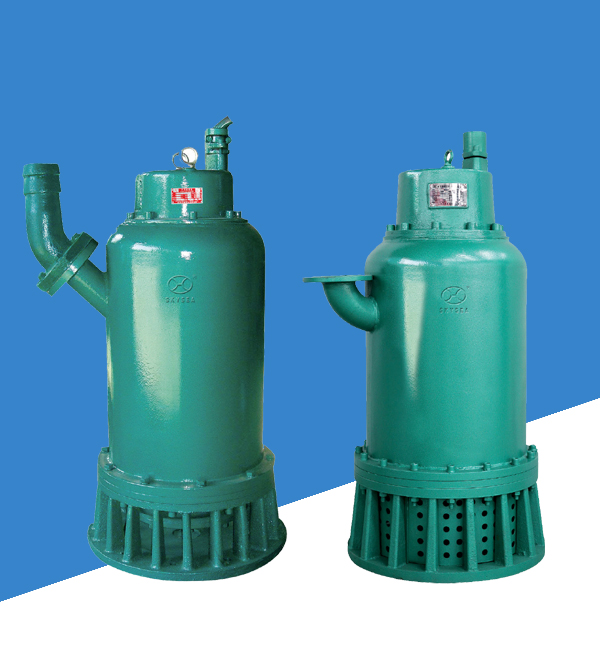
The BQS page describes a lower-suction, mine flameproof submersible sand-drainage construction for working faces and roadways, including water containing suspended powder, rock fragments, coal particles, sand and mud. Its arrangement combines an upper motor, a middle mechanical-seal region and a lower pump on one axis.
The model-code illustration distinguishes rated flow in m³/h, total head in metres, stages and motor power in kW. It also distinguishes internal, semi-internal and external constructions. Send the full designation rather than shortening the requirement to “BQS mine pump”; construction and operating limits must match the installed unit.
The catalogue references MT/T 671 and prints an ExdI designation. For a hazardous mine project, the buyer needs the required local approval route, a current certificate covering the exact model and the corresponding nameplate/marking. Match the electrical supply, cable entry, controls and protection to that approved assembly.
Describe the particle dimensions and loading, water chemistry, minimum depth, working-face access and operating pattern. Request the permitted shallow-water/submerged conditions and the wear/seal maintenance instructions for the selected set. A mine-sand application should not be substituted for a sewage pump purely because both can handle dirty water.
The tracked station’s logistics and power boundary can determine whether it is usable
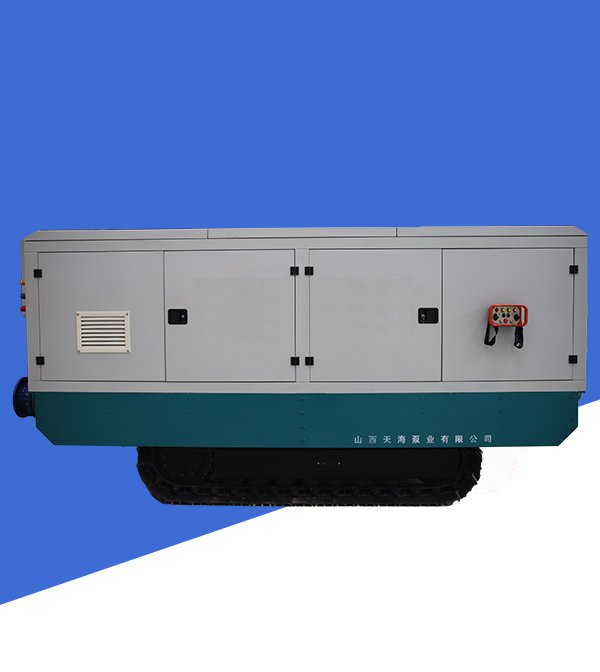
The catalogue’s tracked self-priming station is a specific vehicle package. It lists dimensions of 4.1 × 2.2 × 2.4 m, total mass 9.1 t and maximum travel speed 1.5 km/h. Establish access, transport, ground-bearing conditions, turning space and the required unloading/handling arrangements before choosing it for an emergency route.
The pumping assembly is described as three 37 kW rotor pumps, each with a quoted 330 T/h flow at 30 m head. Keep the source’s mass-flow notation until the liquid density and volumetric rating are clarified. Obtain curves and the operating arrangement for one, two and three pumps; the advertised aggregate maximum is not a guarantee at every hose route.
Separate travel power from pumping power. The text describes batteries, traction drives and external 380 V charging, but this does not by itself establish the supplied pumping-energy arrangement or uninterrupted emergency endurance. Request an electrical/control diagram, actual pump power source, load requirements and the permitted continuous operating duty.
Specify the intake lift, hose lengths and diameters, bends, discharge elevation and debris conditions. The quoted suction and priming claims refer to stated test conditions. Ask for the applicable site limits and a commissioning demonstration for the supplied arrangement, together with controls, wear parts and operating instructions.
| Item | Catalogue figure | Planning decision |
|---|---|---|
| Overall dimensions | 4.1 × 2.2 × 2.4 m | Access, transport and unloading envelope. |
| Total mass | 9.1 t | Handling equipment and ground support. |
| Maximum travel speed | 1.5 km/h | Deployment route and transport method. |
| Pumping assembly | Three 37 kW rotor pumps | Selected curves, site power and the quoted package boundary. |
Tie water-source measurements to the supplied pump, motor and documents
A July 2023 government-published manufacturing report locates Tianhai in Jiezhou, Yuncheng’s Yanhu district, and describes pump-part production, motor winding and product inspection at the company. It also gives a 1950 origin, consistent with the current company profile. This is dated manufacturing context; present lead time and order-specific inspection points should be agreed in the quotation.
The national standards platform lists 山西天海泵业有限公司 among the drafting organisations for GB 32030-2022, the submersible motor-pump energy-efficiency standard, published on 29 December 2022 and implemented on 1 January 2024. Ask which requirements apply to the selected pump and request its corresponding efficiency/test evidence.
Skysea’s service page identifies Tianhai and SKYSEA nameplate marks and asks customers to retain purchase records. For a replacement, provide the complete pump/motor identification, assembly drawing and observed duty. Confirm coupling, axial positioning and service instructions before mixing a new pump section with an existing motor.
Agree the seller, destination, inspection basis, spare parts and service responsibilities in writing. The service page contains domestic sales and local-response commitments; international delivery, warranty handling and return logistics need terms for the actual order.
Well or shallow-water intake
- Pumping-test yield, dynamic water level and variation, clear diameter or horizontal space.
- Required simultaneous flow/head, real pipe route and losses, water analysis and temperature.
- Selected assembly drawing, cooling/submergence limits, cable/power and retrieval arrangement.
Mine or mobile drainage
- Particles, hazard/site classification, water depth and operating duration.
- Exact pump/construction code, applicable approval records, protection and power source.
- Hoses, access, transport/handling, controls and commissioning demonstration.
Acceptance and replacement
- Pump and motor identification, complete supply schedule and inspection/test criteria.
- Applicable efficiency records, operating instructions and seal/wear-part references.
- Quantity, destination and requested date, plus order-specific delivery and service terms.
Submit through KanBeng’s enquiry form with this factory named in your request.