
Coordinate plant duty, pump construction and auxiliary systems
Shenyang Industrial Pump Manufacturing Co., Ltd.
Choose the power-station or refinery route, then resolve inlet conditions, casing access, thrust and seal utilities. Use selected drawings and a documented test plan for the complete package.
- Listed base
- Shenyang, Liaoning
- Plant directions
- Thermal power · petrochemical
- Selection priority
- Duty · inlet · construction · utilities
- Acceptance
- Selected model and test conditions
Shengong selection begins with the plant function and the required construction
Shenyang Industrial Pump Manufacturing Co., Ltd. (沈阳工业泵制造有限公司), trading as Shengong Pump, concentrates on industrial pumps for thermal power generation and petrochemical service. Its company history distinguishes a 1975 operation affiliated with the former Shenyang Pump Factory from becoming an independent legal entity in 1996. Its listed base is the Shenyang Economic and Technical Development District.
The practical choice is between a power-station system duty and a process-pump construction. Boiler feedwater, condensate extraction and circulating water have different pressure, intake and maintenance conditions. Refinery transfer adds liquid properties, pressure containment, seal systems and the required design standard.
Identify the system, normal and exceptional operating conditions, and the project’s mechanical and electrical interfaces before choosing a family. The current product names below describe actual official directions; they should not be substituted for an existing pump merely because a broad DG, AY or S designation looks familiar.
| Plant requirement | Official direction | Resolve before selection |
|---|---|---|
| Boiler feedwater | DG single-shell or a separately selected high-pressure range | Temperature, suction conditions, duty range and thrust/lubrication arrangement |
| Condenser to deaerator | LDTNB vertical condensate | Intake pressure, vessel arrangement, first-stage selection and removal access |
| Cooling-water circulation | H vertical circulating-water pump | Water levels, foundations, shell construction and guide-bearing liquid |
| Refinery process or oil transfer | EH OH2, KSY BB1 or JH BB2 | Casing split, flow/head duty, materials, seals and applicable standard edition |
Specify hot feedwater, thrust balancing and the auxiliary lines together
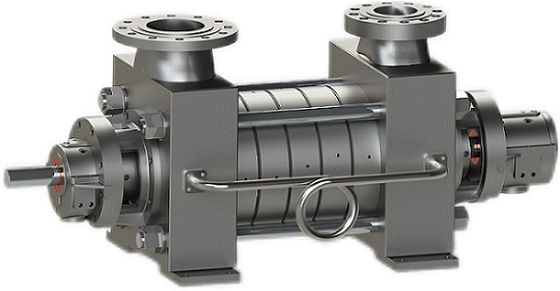
The DG page describes a horizontal multistage single-shell pump with radial splits, upward suction and discharge connections, and centreline support. It identifies drainage and warming lines below the casing. Axial load is balanced by double balance drums, with residual load carried at the non-drive end; lubrication may be self-lubricating or supplied under pressure.
The current web page gives a family envelope of 6–750 m³/h and 300–2,200 m head, with 150–180°C liquid and speed not exceeding 3,000 r/min. These are catalogue selection limits, not a paired operating point or a rating for the old generic DG listing. The exhibition brochure gives different DG(B) head and temperature limits, so the offer needs the exact version and selected data sheet.
For a feedwater project, include deaerator pressure and levels, liquid temperature, startup and minimum-flow conditions, driver speed and operating schedule. Ask the proposal to identify the selected thrust and lubrication construction, warming/drain connections and the required auxiliary arrangement. Confirm responsibility for the minimum-flow circuit and any booster selection rather than assuming these are included with a bare pump.
Review the existing DG family listing →
Treat the condensate intake and the first stage as a dedicated selection
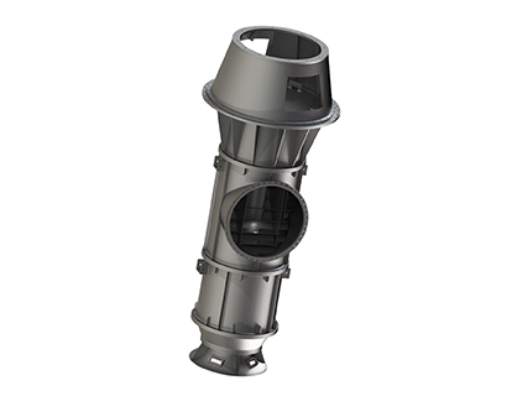
LDTNB is described as a vertical multistage cylindrical condensate pump. Its first impeller has double suction, axial force is carried by the pump body, and the inlet and outlet are horizontal at 180 degrees. The stated plant role is transfer from condenser to deaerator, with other documented cooling and attemperation uses.
For this duty, send the condenser-side pressure, liquid temperature and minimum, normal and maximum liquid levels. The pressure and temperature together affect the inlet condition; request the selected first-stage performance and the available suction margin for each case, including startup and transient operation.
The page describes usual condensate below 80°C but separately lists a 100°C family limit. Obtain a selected-model temperature and pressure rating instead of treating either sentence as a universal promise. Agree the vessel or wet-pit arrangement, nozzle orientation, foundation, thrust support, lifting path and removal length before releasing the civil design.
Choose the H shell arrangement from the maintenance route, not flow alone
The H circulating-water page distinguishes single-shell and double-shell constructions. For the double-shell version, the hydraulic core can be removed together; for the single-shell version, it describes removal of the complete pump. It also allows single or multiple foundations and identifies water-lubricated guide bearings, with rubber, SAILONG or AR bearing options.
This difference affects crane clearance, station openings, support geometry and outage work. Provide the suction basin layout, minimum and maximum levels, intake conditions and the civil loading requirements. Ask which bearing material and lubrication arrangement fit the actual liquid, particularly where suspended matter or seawater changes material selection.
The web page lists 600–50,000 m³/h and 5–75 m as a family envelope and a liquid limit of 80°C; the exhibition brochure lists 90°C. Do not pair the maximum flow with maximum head or assume the higher temperature applies to every construction. Specify the selected duty curve, material schedule, liquid limit and the exact removable-core arrangement.
Compare EH, KSY and JH by casing access and hydraulic arrangement
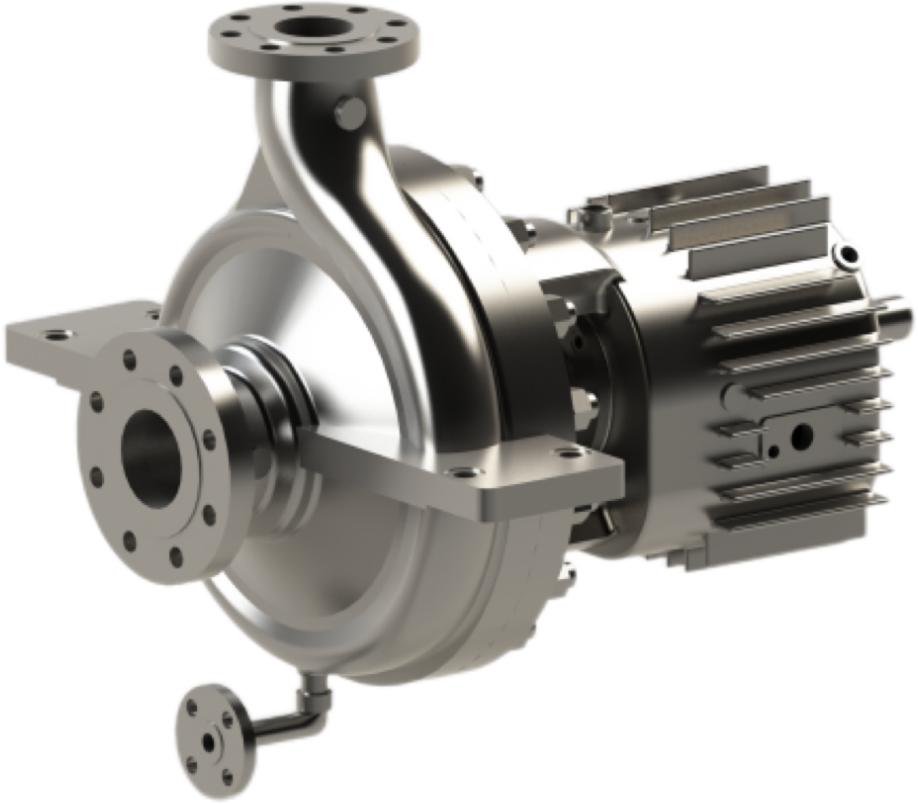
The official process pages describe EH as OH2, KSY as BB1 and JH as BB2, referring to API 610’s 11th edition. Use these stated design directions to discuss the required construction; establish the project’s actual standard edition and exceptions in the offer. A structure label is not a certificate or approval of an individual pump.
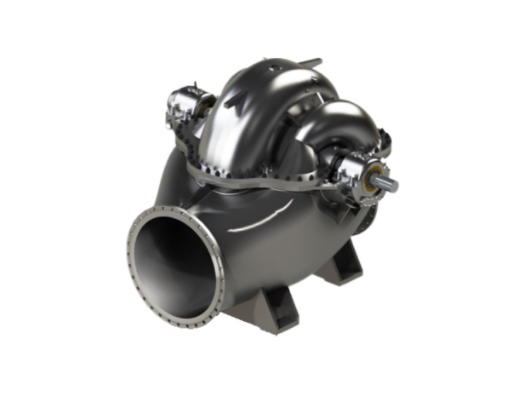
KSY has horizontal connections and a casing split at the centreplane for inspection and maintenance. JH offers three hydraulic arrangements: DJH single-stage double suction, GJH two-stage single suction, and GDJH with double suction in the first stage and single suction in the second. The company associates these with different combinations of flow, head and inlet conditions.
Compare the selected arrangement on duty, suction margin, rotor support, casing access and service space. Provide the refinery liquid composition, density, viscosity, temperature, vapour pressure and solids. Ask for material selection and pressure-temperature ratings for the complete assembly. The EH page’s two different pressure statements and JH’s inconsistent low-temperature figures require a selected data sheet rather than a single extracted maximum.
| Official direction | Published construction feature | Procurement question |
|---|---|---|
| EH / OH2 | Single-stage overhung design with rolling bearings | What selected pressure-temperature rating, bearing lubrication and seal configuration apply? |
| KSY / BB1 | Single/two-stage double suction with horizontal casing split | What removal access, casing-joint design and selected hydraulic arrangement fit the service? |
| JH / BB2 | DJH, GJH and GDJH stage/suction alternatives | Which arrangement satisfies the required flow/head and inlet condition? |
Make the process auxiliaries part of the enquiry and responsibility schedule
The KSY and JH pages describe mechanical-seal options referring to API 682. The product descriptions also identify oil-ring lubrication and possible oil-mist arrangements. These statements open a configuration discussion; they do not define the selected seal system, flush supply or a complete lubrication package.
Provide the available seal and cooling utilities, their pressure and quality, hazardous-area requirements and the intended control interfaces. Ask for the selected seal arrangement, auxiliary schematic, instrument list, startup conditions and alarm/trip schedule. Identify which equipment is supplied with the pump and which interfaces are provided by the plant.
For a replacement or retrofit, send the original general arrangement, baseplate, coupling and nozzle details together with the failure history. Separate a repair using existing interfaces from a new design. Agree the engineering review, installation, commissioning and spare-rotor or seal scope before comparing offers.
Turn the test-centre description into an order-specific acceptance plan
The company’s quality page describes a test centre with OH, BB and VS beds, automatic data acquisition and several voltage options. Its separately stated maximum flow, pressure and motor-power capabilities must not be assumed to occur simultaneously. Confirm that the selected pump, speed, driver and test conditions can be accommodated.
Agree measured flow/head, power, vibration and other specified tests, with tolerances, witness points and report requirements. Include pressure containment and electrical or auxiliary checks where applicable. Ask how instruments, parts and reports are traced to the offered equipment and how deviations will be resolved before shipment.
The Liaoning industrial authority’s 2023 smart-factory list names Shenyang Industrial Pump Manufacturing Co., Ltd.; its October 2021 notice also includes the company in the third group of specialised “Little Giant” enterprises. These are dated official organisational records. They do not certify a selected pump’s hydraulic result, current conformity scope or a customer installation.
Send a feedwater, circulation or refinery requirement with usable interfaces
Begin with the plant function and required operating cases, then identify the construction and supplied auxiliaries. For a retrofit, attach existing drawings and operating history. For a new project, coordinate mechanical, civil and electrical requirements before asking for a final selection.
Request an itemised proposal tying the model, construction, material schedule, curve and standard editions to the supplied equipment. Keep acceptance, spares and installation responsibilities in the same enquiry so that quotations can be compared on the complete project scope.
Prepare a structured pump RFQ →
Process and operating cases
- Plant function, normal/minimum/maximum duty and startup conditions
- Temperature, chemistry, density, viscosity and vapour pressure
- Suction pressure or basin levels, power, speed and standby schedule
Construction and utilities
- Selected shell, stages, bearing/thrust arrangement and maintenance access
- Foundation, nozzles, coupling, lifting route and existing retrofit drawings
- Seal, lubrication, warming, cooling and control-interface responsibility
Contract and acceptance
- Actual manufacturer, model, document revisions and standard editions
- Selected curves, material schedule, auxiliary drawings and test plan
- Witness/report scope, spare parts, installation and commissioning tasks
Submit through KanBeng’s enquiry form with this factory named in your request.