
Mineral slurry · froth handling · thickener transfer · filter-press feeding
Tianmen Qicheng Pump Co., Ltd.
Tianmen Qicheng offers several routes through a mineral-processing circuit. Separate abrasive transfer, frothy flotation discharge, thickener underflow, filter-press feeding and sump recovery before choosing the wet end, installation and drive.
- Chinese legal name
- 天门市启程泵业有限公司
- Published locality
- Yuekou, Tianmen, Hubei
- Catalogue emphasis
- Metal/rubber slurry · sump · froth · thickener · press feed
- Order decision
- Slurry state, process stage, installation and acceptance
Map the pump to the mineral-processing task
Tianmen Qicheng Pump Co., Ltd. publishes horizontal metal and rubber-lined slurry pumps, vertical sump arrangements, submerged-motor slurry pumps, froth pumps, thickener-service pumps and filter-press feed pumps. Its company introduction describes casting, machining, assembly and performance testing. The product directions are more useful to a buyer when connected to the actual state of the slurry, rather than treated as a list of interchangeable centrifugal pumps.
Begin with the process diagram and identify where air, settling, concentration changes or increasing downstream resistance occur. A flotation discharge with persistent froth and a thickener underflow with high viscosity may have similar solids content yet require different pump arrangements. Decide what the pump must receive, where it sits, and how it will be serviced.
| Process task | Published Qicheng direction | Key selection input |
|---|---|---|
| Transfer abrasive slurry beside a tank | ZJB metal / ZBR rubber lined | Wear material, chemistry, inlet and seal services |
| Collect slurry from a pit | ZJL / ZJLR vertical sump | Pit levels, shaft/wet-end length, plate and retrieval |
| Move frothy flotation discharge | AF vertical froth pump | Aerated feed, hopper inlet and overflow return |
| Transfer thickener underflow | ZJN concentration-service pump | Density, concentration basis, rheology and settling |
| Fill and press a filter cake | ZJYL filter-press feed | Flow/pressure over the batch and seal/control scope |
| Recover settled solids underwater | ZQ submersible slurry pump | Depth, supply, temperature, solids and motor protection |
Select the horizontal wet end and its services together
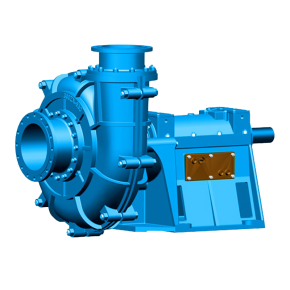
The ZJB page describes a casing, cover, impeller, shaft, liners and bracket, with packing, expeller-plus-packing or mechanical shaft sealing. It lists direct, belt, fluid-coupling and reducer drives, and eight discharge orientations. Specify the drive and discharge position on the layout; do not assume the pictured bare pump includes a motor, coupling, guard, base or seal-water equipment.
ZBR is the separate rubber-lined route. Its description identifies moulded wear-resistant or corrosion-resistant rubber liners, with packing, expeller-plus-packing, mechanical or oil-seal options. It names acidic/alkaline slurry service and below-70°C examples involving hydrochloric, dilute sulphuric or phosphoric acid slurry. Confirm the actual rubber compound against composition, concentration, temperature and particles; the catalogue wording does not establish compatibility with every acid mixture.
ZBR lists pH 2.5–13 and 8,000 ppm chloride for the described liner, plus maximum weight concentrations of 45% ash slurry and 60% mineral slurry. Treat these as stated application limits requiring confirmation for the offered build, not a combined operating point or a universal recipe. Send representative chemistry and particle data and agree the grade of every wetted part and seal component.
The horizontal family ranges are 5–5,000 m³/h and 10–105 m for ZJB, versus 4–2,000 m³/h and 6.5–50 m for ZBR. These spans cover multiple sizes and speeds. Obtain a selected curve, impeller diameter, absorbed power and inlet requirements for the slurry. The catalogue’s comparative efficiency and life claims do not replace an agreed test or a wear assessment.
Use the pit drawing to distinguish the two installation routes
ZJL is described as a vertical cantilever, single-casing sump pump with high-chromium wear-alloy wetted parts, a double-suction semi-open impeller, an inlet screen and a split mounting plate. Its family range is 5–1,250 m³/h and 4–50 m. The installation requires the pit depth, mounting elevation, lowest and highest liquid levels, wet-end length and discharge routing. Specify screen opening and maintenance access instead of assuming the screen guarantees passage of every lump.
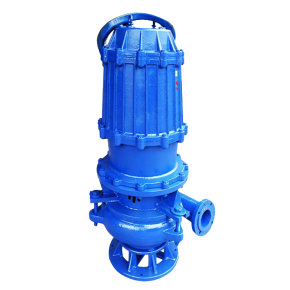
ZQ puts the pump and motor together underwater and includes an agitator below the main impeller. The page describes a dry motor protected by mechanical sealing and an oil chamber, with optional protection functions. Its stated conditions are 50 Hz / 380 V three-phase supply, liquid no hotter than 40°C, no flammable/explosive gas, 1–20 m submergence and vertical continuous operation. Its flow/head envelope is 10–1,500 m³/h and 10–40 m across the family.
The ZQ page gives weight-concentration limits of 45% ash slag and 60% mineral slag. These do not state a maximum particle diameter or prove suitability for every slurry. Request the selected inlet/agitator clearance, curve, temperature and cable/protection configuration. Define how the assembly is lifted from the pit, where the agitator can operate, and which low-level or blocked-pump conditions trigger a stop. Do not import another manufacturer’s 60°C limit into Qicheng’s 40°C listing.
Treat the feed hopper and overflow as part of the offer
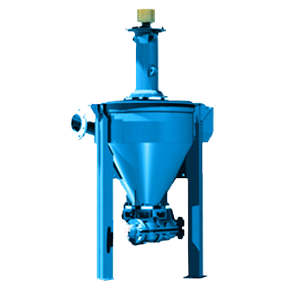
AF is the vertical froth route, with a steel hopper, tangential inlet and overflow box. The catalogue explains that surplus feed can return to the source pool and that the tangential inlet helps separate some froth before pumping. These details affect the plant piping and available space: define the incoming stream and overflow route rather than quoting only the pump head.
The family is listed at 10–650 m³/h and 5–40 m, with metal, rubber or non-metallic wet-end material options. Provide the aerated slurry rate and its measurement basis, solids and liquid chemistry, feed variability, expected hopper level and the return destination. Request the offered hopper volume, inlet/overflow elevations, mounting, drive and curve for the selected size.
The source mentions shared casing/cover/front-liner parts with horizontal slurry products. For spares, confirm the exact series, size, revision and mating dimensions; shared design language is not enough to order an interchangeable part. Likewise, the page’s statement about working with insufficient incoming feed is not an unlimited dry-running guarantee.
Supply rheology and the concentration basis for thickened slurry
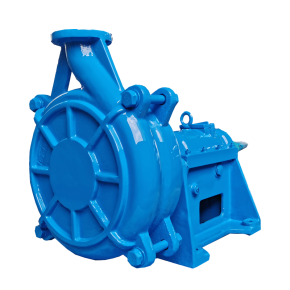
ZJN is described as a modified slurry pump with changes to impeller passages, inlet/outlet dimensions and liners for high-concentration, high-viscosity transfer. The catalogue names thickener and diaphragm-pump feed duties and publishes a 60–72% concentration statement without identifying whether it is mass or volume. Confirm that basis before using the percentage for sizing; it is not a viscosity specification.
Its published family envelope is 10–2,000 m³/h and 40–95 m, with packing, expeller-plus-packing or mechanical sealing and several drive arrangements. Send density, solids concentration with its basis, particle distribution, settling behaviour and rheology at the operating temperature. For underflow that changes during a cycle, provide the expected range and start-up condition, not just one diluted sample.
Ask for the inlet arrangement, selected speed/curve, motor load and seal/cooling requirements with the actual slurry. The catalogue allows series operation within pressure limits, but a multi-pump line needs the pressure profile, casing ratings, controls and transient conditions of every stage. Do not accept a general statement that some products replace diaphragm pumps as proof that a centrifugal pump can meet your pressure and rheology.
Define filling and final-pressure duties separately
The ZJYL description explicitly addresses feeding, filling and filter-cake formation as three stages with different flow and head demands. It describes radial suction, an expeller arrangement, an upward discharge and inlet assembly on either side. Its detail list names packing or mechanical sealing with low-pressure water flushing. Agree the actual shaft-seal arrangement and required water service on the proposed assembly drawing.
The family range is 5–1,200 m³/h and 60–120 m; the catalogue lists 40ZJYL through 200ZJYL size names. Obtain the selected model curve at the proposed speed and an operating sequence for the press. Provide initial filling flow, final feed pressure, slurry density, expected batch time and the control method as resistance rises. Head in metres does not give a fixed pressure in bar for every slurry.
Specify allowable pressure for the particular casing, end-of-cycle stopping/control, protection and any required bypass or auxiliary service. The same ≤3.6 MPa figure appears on several Qicheng family pages; it should be confirmed for the actual selected assembly and duty rather than treated as a universal flange, seal or motor rating. Avoid turning the source’s “no leakage” promotional wording into a guarantee for every seal configuration.
Filling
Give the press volume, target filling rate, inlet state and slurry properties; identify the selected curve and speed.
Resistance rises
Define the final pressure, control response and motor/loading limits as the cake develops.
Finish and restart
Agree stopping, drainage/flush where required, permitted idle conditions and the next-batch starting sequence.
Make identity and acceptance documents order-specific
The company-published business-licence copy names 天门市启程泵业有限公司 and carries a 15 March 2021 establishment date. Its general introduction also contains older history and equipment claims. Use the exact legal name and current contracting details for the order; the published copy is historical identity documentation, not a live registry search, a performance result or an eighteen-year operating history for this entity.
Several product descriptions cite GB5656-1994. The national standards catalogue lists GB/T 5656-2008, Technical specification for centrifugal pumps — Class II, as current and records its replacement of the 1994 edition from 1 March 2009. Agree the required edition and the supplier’s stated compliance/deviations and test scope for your pump, rather than assuming an old product-page reference establishes current compliance.
Qicheng publishes workshop imagery and describes casting, machining, assembly and computer-controlled performance testing. For a new pump, request the approved outline, wet-end materials, curve, supplied drive/seal auxiliaries and acceptance records. For worn components, supply the nameplate, old drawing/revision, measured interfaces and material requirements. Confirm interchangeability before manufacture and define the dimensional/material inspection required for critical replacements.
Pump RFQ guide: drawings, duty and acceptance inputs →
Give Qicheng the variables that distinguish your duty
Use Tianmen Qicheng’s exact name in the platform enquiry. State the series route, whether the requirement is a bare pump, driven assembly, hopper/sump package or replacement wet-end parts, and the destination and quantity. Ask for one consistent model/revision across the drawing, curve, bill of materials and sample/test documents.
For slurry, the solids and liquid must be described together. Include expected concentration changes, inlet level/pressure, pipe layout, required duty and services available at the installation. Define access for wear-part replacement and the spares needed for commissioning. Agree delivery and support in the quotation rather than treating a generic website response promise as an overseas service commitment.
Transfer, pit or submerged assembly
- ZJB/ZBR/ZJL/ZQ route, actual liquid chemistry, temperature, density, concentration basis and particle distribution.
- Tank/pit levels, inlet condition, required flow/head, pipe losses, mounting/retrieval and required discharge orientation.
- Selected material, speed/drive, seal services, motor supply, protection, cable/agitator or mounting-plate scope.
Froth, thickener or filter press
- AF: aerated rate and measurement basis, feed variability, hopper/overflow elevations and return route.
- ZJN: mass/volume basis, rheology, settling and start-up conditions, pressure profile and motor load.
- ZJYL: press fill rate, final pressure, batch stages, control/stopping and required seal-water service.
Drawings, wear parts and acceptance
- Exact model/revision, approved curve and outline, material and test/standard edition requirements.
- For replacements: old nameplate, drawings or mating dimensions, wet-end material and interchangeability confirmation.
- Pump/package boundary, quantity/destination, agreed tests, commissioning spares, lead time and support responsibilities.
Submit through KanBeng’s enquiry form with this factory named in your request.