
Condenser extraction · water-ring packages · vacuum retrofit
Wuhan Weilongte Pump Co., Ltd.
Weilongte’s published range focuses on removing air and vapour from power-plant condensers. The purchase decision is a system decision: starting evacuation, normal extraction, operating-liquid cooling and standby changeover need to work together.
- Chinese company name
- 武汉威龙特泵业有限责任公司
- Published base
- Wuhan, Hubei
- Main application
- Power-plant condenser air and vapour extraction
- Supply decision
- Bare pump, complete vacuum package or parallel retrofit
Choose the extraction task before choosing the pump
Wuhan Weilongte Pump Co., Ltd. presents water-ring pumps, complete circulating-liquid packages, Roots–water-ring systems and condenser-vacuum retrofit arrangements. Its company description includes equipment development, manufacture, sales and technical services. For a buyer, the useful distinction is whether the offer replaces a pump, delivers a new controlled package or supplements an existing condenser extraction line.
A company-published business licence identifies 武汉威龙特泵业有限责任公司 and records establishment on 16 April 2007. Use that exact entity in the quotation and document schedule. A registered address or a website contact address does not establish the location or capacity of a manufacturing plant; define the actual inspection location and supplied equipment in the contract.
| Plant requirement | Published direction | Selection question |
|---|---|---|
| Individual water-ring pump | 2BE1 improved design | Which curve, working liquid and drive are included? |
| Controlled condenser package | 2BW5 power-plant unit | Which cooling, instruments and automatic functions are supplied? |
| Higher-vacuum staged extraction | Roots with water-ring backing | At what pressure and differential pressure may the Roots stage start? |
| Air-cooled unit retrofit | ZS1000 three-cone two-stage system | How will it share the extraction line with existing startup and standby pumps? |
| Two-stage conical pump direction | Published two-cone power-plant arrangement | Which materials, port arrangement and selected duty apply to the offered build? |
A 2BE1 pump still needs a defined working-liquid circuit
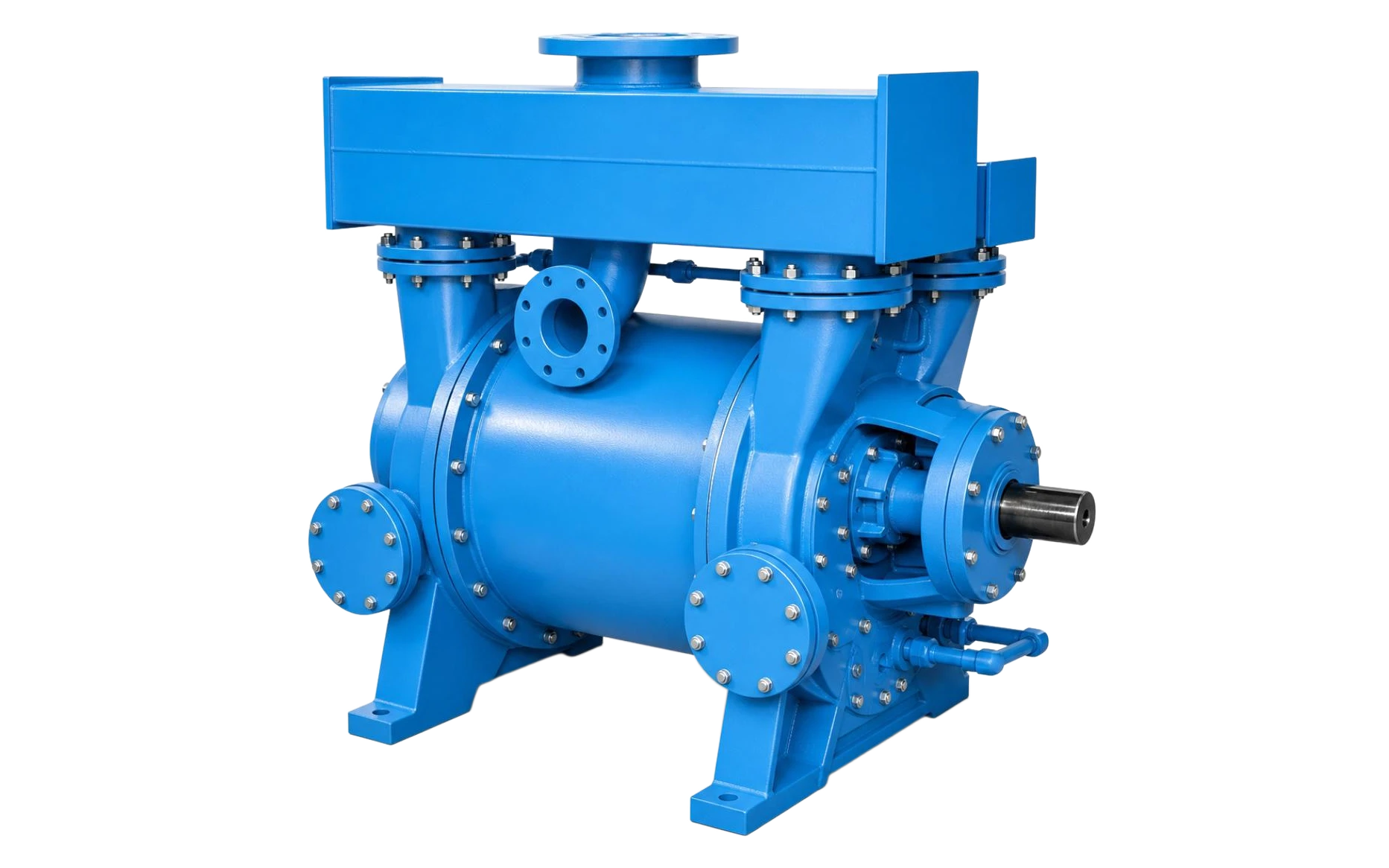
The 2BE1 product description uses water as the operating liquid and describes gas without solids, with low or no solubility in that liquid and without corrosive action. That stated scope is important when evaluating a different gas stream: a water-ring label alone does not approve corrosive gas, solvent mixtures or entrained abrasive solids.
The published image shows an individual pump with a shaft, not a complete motor-driven circulating-liquid station. Ask whether the quotation includes the motor, coupling and guard, base, separator, cooler, valves and instruments. A closed-loop category heading on the page does not establish that all of these items accompany the bare pump.
Obtain the capacity-versus-inlet-pressure curve for the exact pump, speed, gas and working-liquid temperature. Operating-liquid vapour pressure constrains a liquid-ring pump’s attainable inlet pressure; specify the warmest operating condition rather than comparing nominal vacuum figures without their temperature basis. Include inlet gas temperature, condensable fraction, discharge backpressure and the liquid quality available at the plant.
Define cooling and automatic operation for the 2BW5 unit
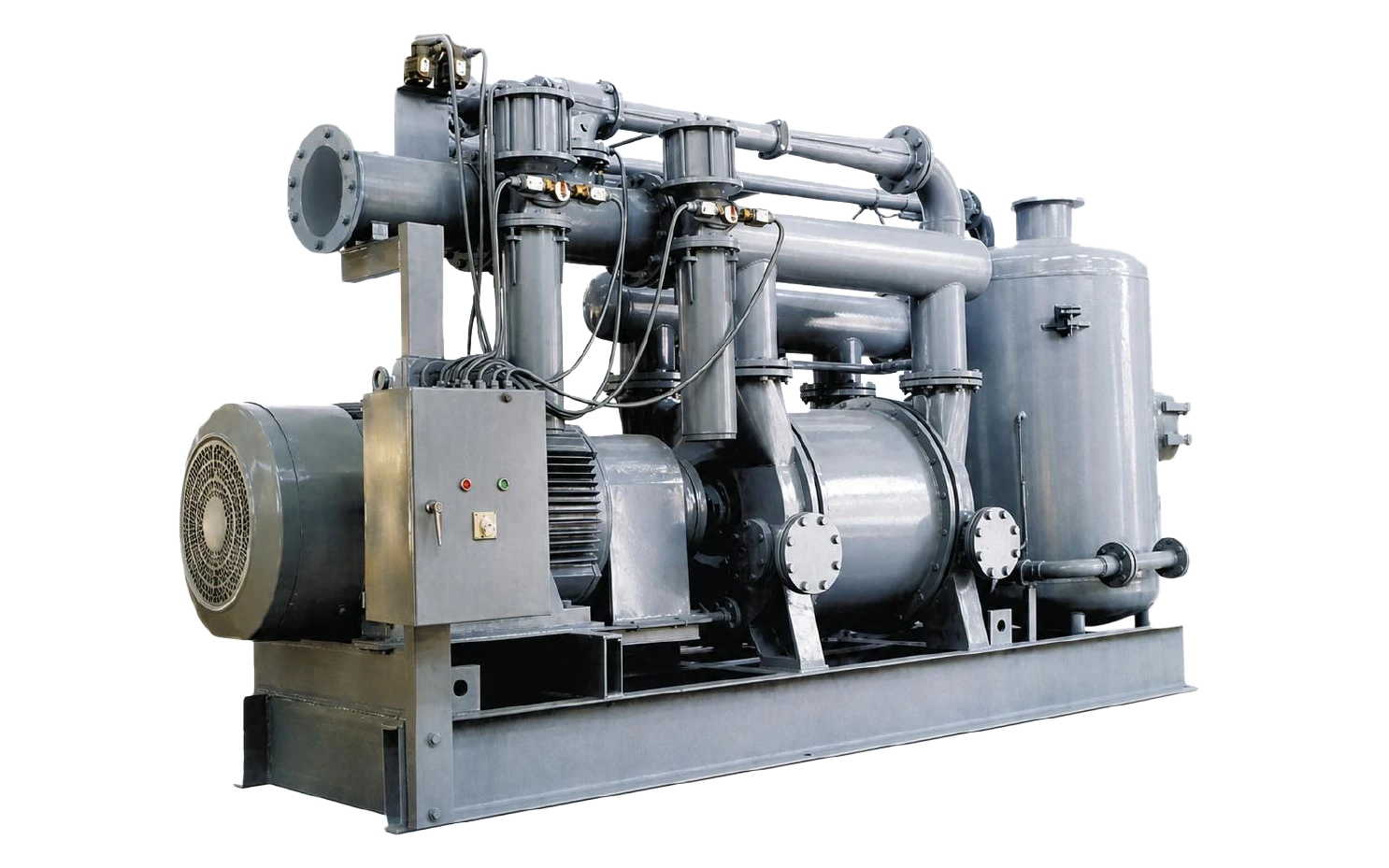
Weilongte describes the 2BW5 as a condenser-extraction package with automatic operation and protection intended to match condenser backpressure. The description discusses startup and self-circulation, but does not supply a complete numerical performance curve or a guaranteed startup time for every plant. Specify both initial evacuation and continuous extraction, including which existing equipment remains available.
For the package drawing, require the separator arrangement, working-liquid inventory, circulation path, makeup/drain points and cooler duty. Record available cooling-water temperature and flow over the year, water quality and the maximum permitted return temperature. The cooler and working liquid are part of the vacuum selection, not merely installation accessories.
Agree which pressure, temperature, level and motor signals trigger alarms, trips or changeover. Request the operating sequence, manual controls and interface to the plant control system. “Automatic” should resolve into a cause-and-effect table and an agreed restart policy after loss of cooling water or power.
Treat the Roots stage, backing pump and heat rejection as one system
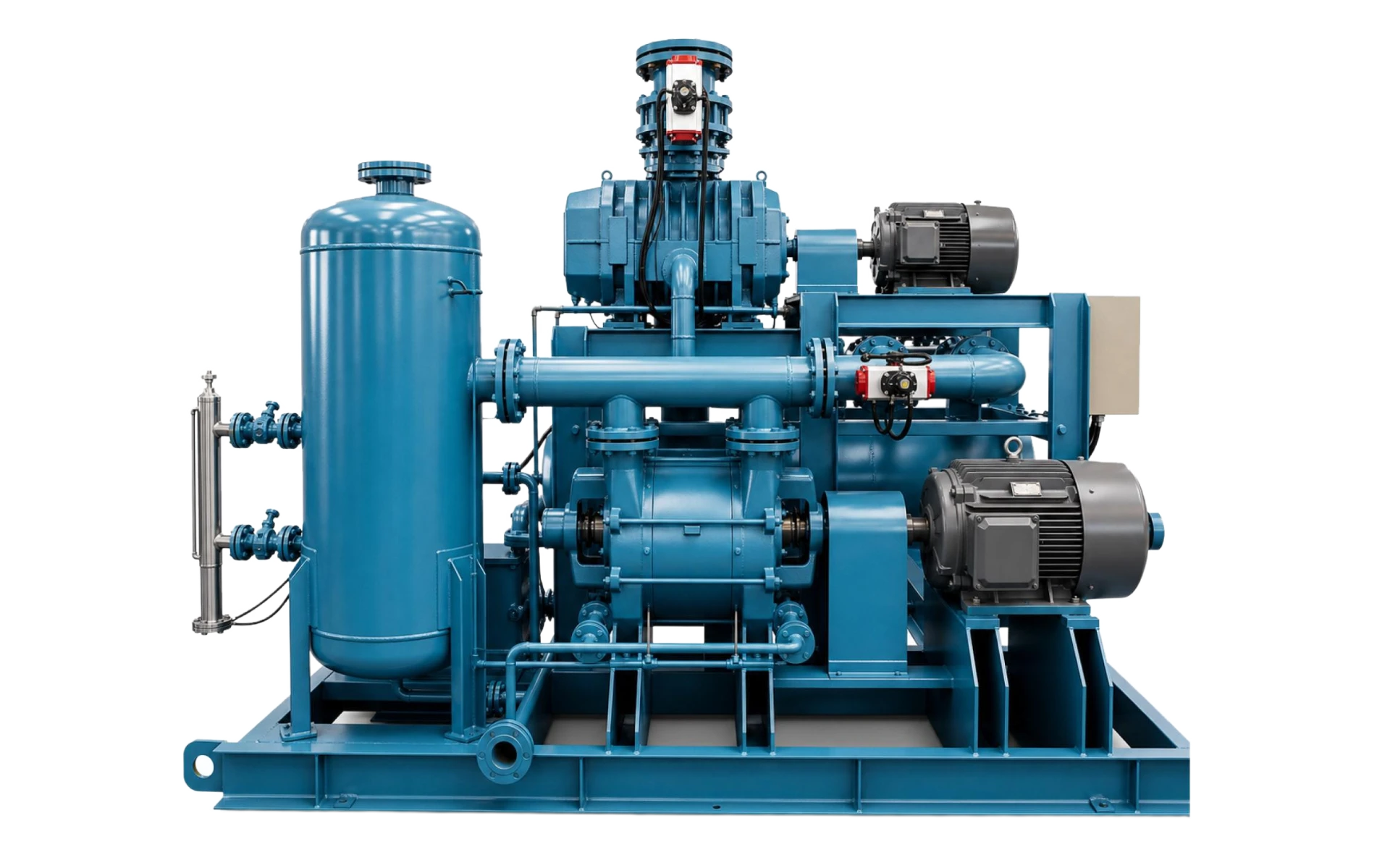
The published Roots–water-ring arrangement uses a gas-cooled Roots main stage and a single-stage, single-acting water-ring backing pump. Its description includes cooling of the hot exhaust/recirculating gas and a working-liquid separator with a plate heat exchanger returning liquid to the water-ring pump. The term gas-cooled Roots therefore does not mean that the complete installation needs no external cooling service.
The stated sequence starts the backing pump first and enables the Roots stage after the required pressure has been reached; stopping takes the Roots stage out before the backing pump. Request the actual start threshold, allowable differential pressure, bypass/protection arrangement and interlocks for the selected machine. A sequence in a sales description is not a replacement for the delivered control logic.
Use the package P&ID to confirm separator venting, cooler duties, water supply, drains, relief/isolation and instrument locations. Agree the rated extraction duty at the specified condenser pressure and gas composition, and the operation available when a stage is unavailable. The two motors and a common frame shown in a photograph do not establish redundancy or automatic standby capability.
Keep startup, normal extraction and standby roles explicit
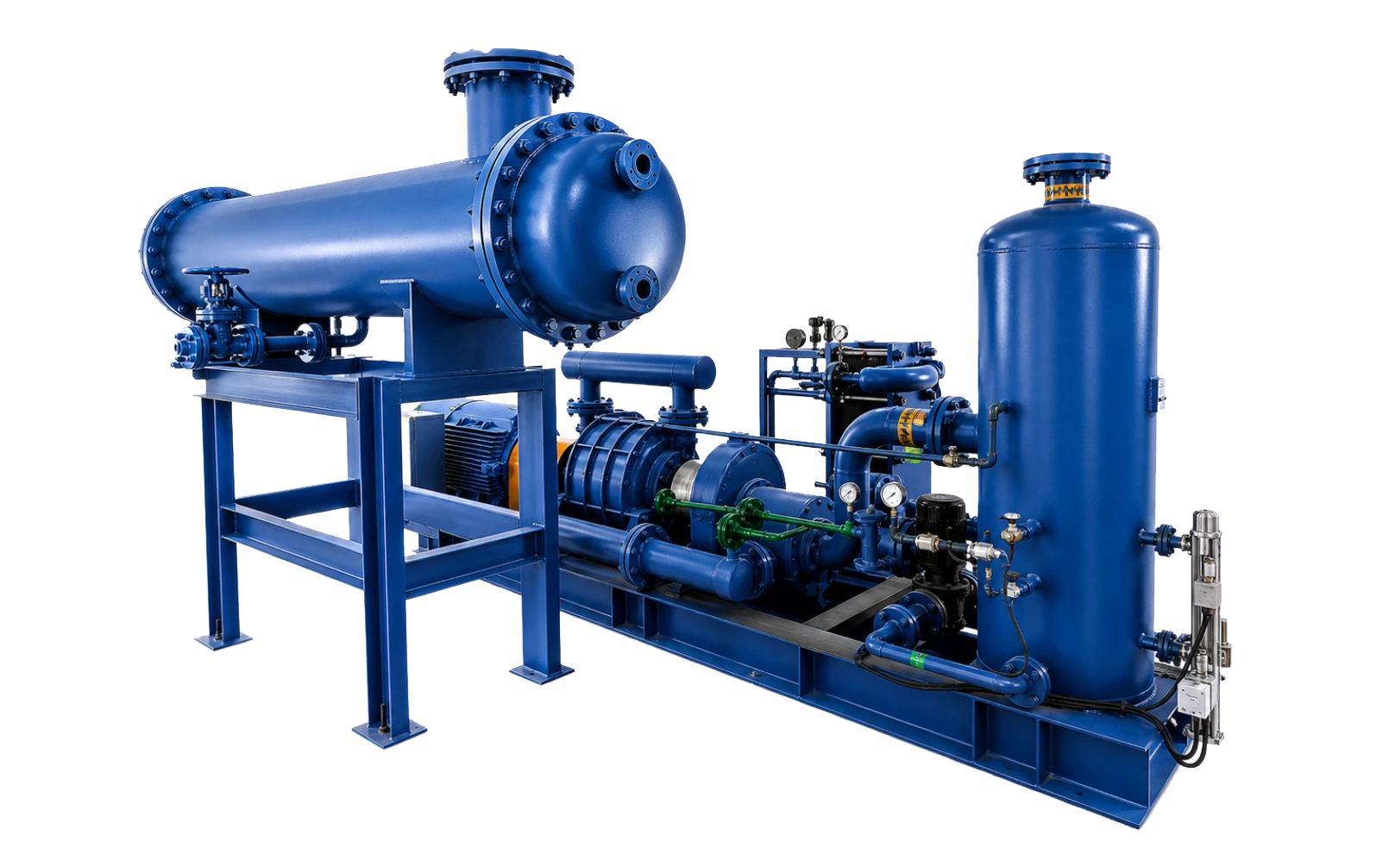
The three-cone two-stage system is presented for air-cooled power-plant condensers with changing vapour and gas conditions. The published arrangement combines a precondenser, water-ring vacuum equipment, separation, valves, a base and intelligent controls. The precondenser condenses part of the incoming vapour before the remaining gas reaches the pump; its heat-removal capability needs to match the actual steam load and cooling conditions.
Weilongte’s retrofit description keeps the original water-ring equipment for startup and standby while the new system handles normal extraction, connected in parallel with the existing main extraction line. Confirm these roles on the plant P&ID, including non-return/isolation valves, line losses, changeover and failure behaviour. A parallel concept is not proof that every site can install or commission without an outage.
The ZS1000 example quotes a 55 kW motor and a minimum inlet pressure of 2.7 kPa. The available description does not establish the pressure reference or a complete gas-capacity curve at that floor. Request the pressure basis, working-liquid and cooling-water temperatures, gas load and measured input power. Comparing a 55 kW motor nameplate with a larger existing motor does not by itself measure the energy saving.
The related two-cone description discusses conical porting, a two-stage arrangement and stainless impellers. Obtain the exact wetted-material grades and build configuration; stainless steel as a general description does not establish resistance to your condensate chemistry or guarantee freedom from cavitation.
Agree a plant-specific baseline and acceptance method
The published retrofit discussions contain energy-saving percentages and case calculations. They are supplier case statements, with different current values appearing in one comparison, and are not a guaranteed outcome for a new condenser. Current alone is not measured real power. Set the baseline and test procedure before choosing the investment case.
Compare actual input kW and operating hours at recorded unit load, condenser pressure, ambient/cooling conditions and extraction arrangement. Record working-liquid temperature, cooling-water supply/return, gas loading where measurable and operation of the existing pumps. A change in turbine load, season or cooling system can change the result independently of the new extraction equipment.
Agree the acceptance points for startup, steady operation, changeover, alarms and loss of auxiliary services, together with instruments and measurement duration. Evaluate condensate recovery and operating cost only with a defined measurement and cost basis. Do not turn a supplier’s modelled vapour reduction or backpressure improvement into a fixed annual saving for your plant.
Record the existing condition
Capture unit load, condenser pressure, running pump combination, actual electrical power and working-liquid/cooling temperatures.
Define the offered duty
Approve the extraction curve, pressure reference, gas/vapour conditions, cooling requirement and equipment/controls boundary.
Test the operating transitions
Witness startup, normal extraction, standby changeover and protection functions under agreed plant conditions; retain the measured results.
Send the plant context, not only a target vacuum number
Start the platform enquiry with the exact Weilongte entity and whether you need a bare pump, new package or retrofit. Send the existing P&ID, pump nameplates and curves, condenser operating range and available auxiliary services. Ask for a proposed equipment list, outline, P&ID, control logic and commissioning responsibilities that refer to the same selected arrangement.
The company publishes patent and management-certificate copies, but these should be considered at their own scope. A utility-model certificate does not validate an energy-saving percentage. The displayed quality-management certificate describes sales and related management activities, rather than certifying every manufactured pump’s performance. Specify any required current certificate and the relevant acceptance/test records for the actual supply.
For maintenance planning, agree access to the separator, cooler, pump and motor; working-liquid quality and cleaning requirements; commissioning spares; and the instructions for seals, bearings and stage sequencing. Confirm delivery, installation guidance and support for your destination in the offer, rather than assuming a general technical-service description establishes overseas response times.
Define the pump RFQ documents and acceptance requirements →
Condenser and existing plant
- Unit/condenser type, load range, normal and startup pressures with absolute/gauge basis, gas/vapour conditions.
- Existing extraction P&ID, pump curves/nameplates, running/standby roles and line losses.
- Retrofit interfaces, available space/lifting access, outage and control-system constraints.
Utilities and offered equipment
- Cooling-water seasonal temperatures/flow/quality, makeup liquid, drains and discharge conditions.
- Selected capacity curve, working-liquid temperature, motor supply and measured-power basis.
- Complete scope: pump stages, precondenser, separator/cooler, valves, instruments, base and controls.
Acceptance and service
- Baseline and test conditions, power measurement, startup and changeover tests and protection functions.
- Material schedule, drawings, commissioning procedures, spare parts and maintenance access.
- Contracting entity, document requirements, destination and agreed installation/support responsibilities.
Submit through KanBeng’s enquiry form with this factory named in your request.