
Match chemistry, solids and utilities to the construction
Yixing Shenhao Pump Co., Ltd.
Shenhao’s ceramic, polymer and water-ring products solve different corrosive-service tasks. Start with the mixture and duty, then define the wetted parts, seal services and installation.
- Company identity
- 宜兴申昊泵业有限公司
- Listed base
- Hufu, Yixing, Jiangsu
- Selection focus
- Chemistry · solids · priming · process gas
- Catalogue examples
- SHTB · FHU-ZK · SFYU · SZ/SK · HTF
Choose the wetted construction before choosing a model number
Yixing Shenhao Pump Co., Ltd. identifies itself as 宜兴申昊泵业有限公司, with its listed base in Zhangyang village, Hufu, Yixing, Jiangsu. Its catalogue centres on ceramic and polymer constructions for corrosive liquid, abrasive slurry and process gas. This is a useful shortlist for an acid-transfer or wet-processing enquiry when chemical compatibility and maintenance matter as much as flow and head.
The material decision changes the shortlist. The SHTB ceramic documentation expressly excludes hydrofluoric acid and hot concentrated alkali, whereas the FHU and SFYU polymer documentation discusses other chemical applications. A general acid-resistant label cannot bridge that difference. Send the complete mixture, concentration, temperature during normal operation and cleaning, solids and any solvent content; request a wetted-parts schedule covering the casing, impeller, shaft sleeve, seal faces and elastomers.
The catalogue describes hydrometallurgical acid and slurry transfer, filter-press service, fertiliser mother liquor, pickling and wastewater. These are application directions rather than evidence of a completed project for a particular customer. Translate your process into a duty and materials review instead of choosing a pump solely because the industry name matches.
Separate liquid transfer, immersed service, vacuum and ventilation
The following directions have different selection inputs. Shenhao’s broader category list also contains jet and stainless-steel pumps, but category names alone do not establish a documented configuration for an order.
| Catalogue direction | Construction or task | Specify in the enquiry |
|---|---|---|
| SHTB / SHTB-III / SHTB-ZK | Ceramic horizontal liquid pumps; non-self-priming III/ZK arrangements | Chemical exclusions, flooded/primed suction and exact seal layout |
| FHU-ZK / FHU-ZK-G | Lined horizontal transfer; slurry and a separate hotter-material construction | Lining grade, solids, process temperature and seal utilities |
| SFYU / SFYU-A | Immersed polymer liquid end; clean-liquid and slurry variants | Tank depth, lowest level, particle size and mass concentration |
| SHTB-SZ / SHTB-SK | Ceramic water-ring vacuum service | Gas load at absolute operating pressure, liquid supply and separation |
| HTF-250 | Belt-driven centrifugal fan for corrosive gas | Gas volume, pressure, speed, condensation and supported ductwork |
Protect the ceramic assembly from pipe loads and handling damage
The SHTB documentation describes a ceramic casing and cover protected by an external cast-iron enclosure. The SHTB-III/ZK entry also describes ceramic impellers with optional polymer or special-alloy alternatives. Therefore, ceramic pump does not mean that every component in every variant has the same material. Obtain the actual part list and identify the seal arrangement on the drawing.
SHTB-III and SHTB-ZK are described as non-self-priming horizontal pumps. Their installation needs a defined priming or flooded-suction arrangement. Ask for the minimum source level, suction-line route and pressure losses, not an unsupported promise that the pump will lift liquid automatically. The instructions call for independent pipe supports and warn that ceramic parts are brittle: lift through the intended base, keep debris out and avoid impact during assembly.
For a replacement, compare nozzle positions, bolt pattern, base dimensions and the space required to remove the impeller or seal. A matching nominal inlet diameter does not prove interchangeability. The catalogue’s ceramic hydraulic tables are based on room-temperature clean water; viscous or solids-bearing duty needs the actual selection rather than an uncorrected water point.
For FHU service, define both the slurry and what happens at the seal
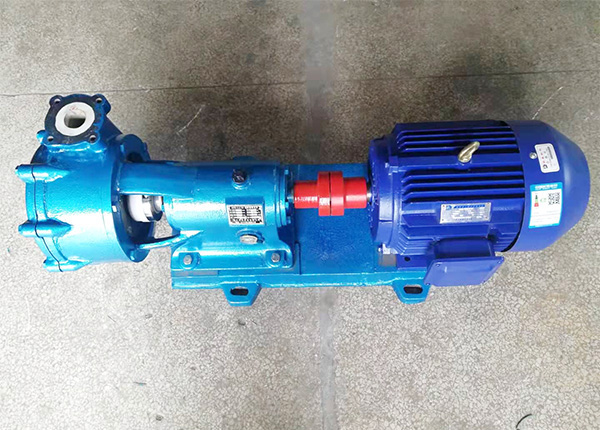
The 62-page selection catalogue describes FHU-ZK as a single-stage, single-suction cantilever centrifugal pump with a steel-supported UHMWPE lining, and offers open or closed impellers. Its ordinary construction is listed for −20 to 90°C; the hotter construction involves different wetted materials. The separate FHU-ZK-G page describes a fluoropolymer-alloy lining. Do not apply the latter page’s temperature claim to an ordinary UHMWPE assembly.
The seal codes affect both running and stopping. K uses an auxiliary-impeller dynamic arrangement together with a stopping seal; K1 adds cooling-water provision. C1 and C2 distinguish single and double mechanical seals, and T/T1 distinguish packing arrangements. Discuss whether dilution by service water is acceptable, what solids reach the seal and what containment is needed while the pump is stopped. The source’s short dry-running allowances should not become a permission to start an unprimed installation.
The catalogue’s B construction uses stepped rear-vane geometry and is discussed for high-pressure, lower-flow operation such as filter-press duty. For that task, send the complete filling-to-pressure cycle, lowest continuous flow and stopping sequence. Request a selected curve, motor sizing for the actual density and seal-service schedule; do not infer a doubled seal life from the promotional comparison.
SFYU-A particle limits do not make every SFYU a slurry pump
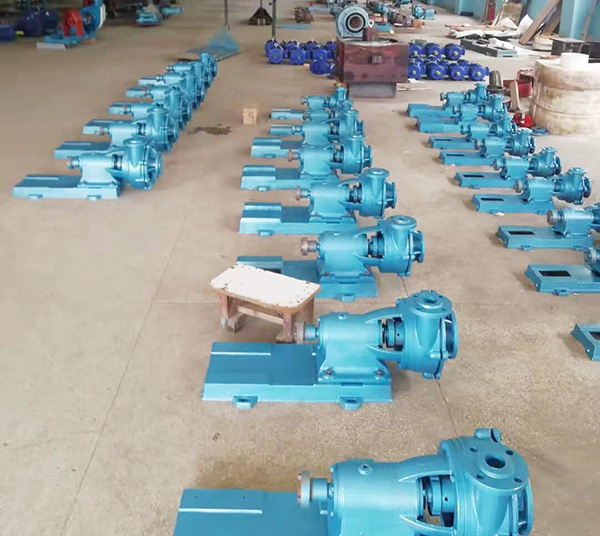
SFYU is described for clean corrosive liquid without solid particles. SFYU-A is the slurry variant: the documentation specifies solids below 20% by weight and particle diameter below 0.5 mm, with an 80°C application reference. Supply the largest particles, particle hardness and whether solids settle during shutdown, as well as the concentration. Do not transfer those limits to another horizontal polymer series.
The catalogue shows distinct 2,900 and 1,450 rpm columns. For the standard 50SFYU-30 entry, one row gives 20 m³/h at 30 m with a 5.5 kW motor at 2,900 rpm; the corresponding slower-speed row gives 10 m³/h at 7.5 m with 1.5 kW. These are two catalogue selections, not one guaranteed variable-speed range. The table note specifies room-temperature clean water and motor selection on liquid density below 1.2.
Include a tank section showing the mounting elevation, insertion depth, minimum operating level and clearance for removal. Identify the exact clean-liquid or slurry suffix and the selected impeller. The manufacturer’s generic immersed category should not be used to assign these particulars to an old catalogue record with no confirmed series.
SHTB-SZ and SK require a gas duty and a liquid-service design
The water-ring documentation distinguishes SZ single-action axial suction/discharge from SK double-action radial construction. It also lists different materials for the impeller, sleeves and distribution components; the ceramic casing does not by itself make the complete unit suitable for every gas. The operating liquid must be compatible with the gas and free of the suspended particles or crystals excluded by the instructions.
The examples below retain the catalogue’s stated test basis: atmospheric pressure 101.33 kPa, inlet air at 20°C and 70% relative humidity, and outlet water at 15°C. Maximum gas capacity and limiting vacuum are separate ratings; the table does not promise the maximum capacity at the limiting pressure. Specify the required gas load at an absolute inlet pressure, including vapour and condensate, and ask for the corresponding curve.
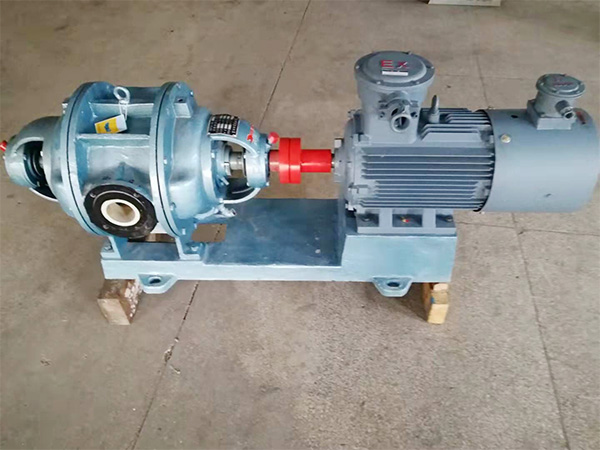
The instructions separate water-ring supply from shaft-seal cooling connections and put their installation with the user. Define once-through or cooled recirculation, gas/liquid separation, corrosion-resistant drains and the discharge destination. Primary vacuum-equipment guidance explains that operating-liquid vapour pressure and temperature affect attainable vacuum, so a warmer or contaminated site loop needs its own selection. A motor photograph or the source’s flammable-gas statement is not a hazardous-area approval for the supplied package.
| Catalogue example | Maximum gas / limiting vacuum | Water / motor / speed |
|---|---|---|
| SHTB-SZ-70 | 3.0 m³/min / −89.4 kPa | 30 L/min / 7.5 kW / 1,450 rpm |
| SHTB-SZ-125 | 9.0 m³/min / −93 kPa | 70 L/min / 22 kW / 980 rpm |
| SHTB-SK-80 | 6.0 m³/min / −89.5 kPa | 35 L/min / 15 kW / 1,450 rpm |
Order the installation and service information that protects the ceramic parts
Shenhao’s operating instructions emphasise priming, rotation checks, lubrication, avoiding inlet throttling, and checking air ingress or blockage when flow falls. Turn these into an agreed commissioning sheet for the ordered liquid pump, including the selected seal services and drainage procedure. Do not use a generic website troubleshooting instruction as authority to alter a seal or motor connection on a different assembly.
The HTF-250 fan is a separate gas-handling product with belt/pulley speed adjustment, ceramic casing and a glass-fibre-reinforced impeller described in its page. For a corrosive-gas extraction enquiry, provide the actual gas temperature, density, condensate and required pressure at flow. Its instructions require supported ducts and a condensate-drain arrangement where needed. Liquid-pump head in metres and fan pressure in pascals are different specifications.
Before accepting a shipment, obtain the assembly drawing revision, parts/material list, hydraulic or gas-performance evidence for the ordered duty, installation instructions and drawing-linked spares. Agree lifting points, corrosion-safe drainage and ceramic inspection after transport. The website’s award photographs and general equipment statement do not establish a current product certificate or a witnessed test on your unit.
Make the enquiry specific to ceramic transfer or process gas
Choose the liquid, immersed or gas route first, then supply the relevant information below. KanBeng’s enquiry records the selected factory and requirement for review; it does not promise an immediate quotation or an independently tested assembly.
Review the existing Shenhao vacuum category record →
Prepare a structured process-pump enquiry →
Chemistry and loading
- Complete liquid or gas mixture, concentrations, normal/startup/cleaning temperatures and corrosive condensate.
- Solids mass concentration, maximum particle size, hardness and settling behaviour; identify SFYU or SFYU-A.
- Requested casing, impeller, sleeve, seal-face and elastomer materials, with exclusions resolved.
Duty and installation
- Liquid flow/head curve or gas load at absolute operating pressure; duty cycle and density/viscosity.
- Source levels, priming method, supported pipework or ducts; tank insertion and removal drawing where applicable.
- Seal and operating-liquid utilities, acceptable dilution, separation, cooling, drainage and pressure limits.
Proposal and handover
- Exact series/suffix, speed, impeller, motor/electrical specification and any hazardous-area scope.
- Documented selected performance, assembly drawing, test basis and acceptance criteria.
- Whole-unit delivery scope, lifting/packing, commissioning instructions and drawing-linked ceramic/seal spares.
Submit through KanBeng’s enquiry form with this factory named in your request.