
Filter-press feed · horizontal slurry · vertical slurry
Zhengzhou Jiacheng Pump Co., Ltd.
Jiacheng’s four published series address different slurry duties and installation layouts. Use the press cycle, slurry properties and required access to choose a direction, then approve the selected curve and drive rather than buying on the series name alone.
- Chinese company name
- 郑州佳成泵业有限公司
- Published locality
- Shangjie, Zhengzhou, Henan
- Four catalogue directions
- ZRS · ZH · Z · ZL
- Key rating boundary
- Z and ZL tables identify clean-water performance
Separate press feeding, horizontal transfer and a vertical installation
Zhengzhou Jiacheng Pump Co., Ltd. identifies itself as 郑州佳成泵业有限公司 and publishes four catalogue directions: ZRS filter-press feed, ZH centrifugal impurity pumps, Z horizontal slurry pumps and ZL vertical slurry pumps. The original product descriptions, drawings and performance tables are largely image-based brochure spreads. The current technical-document menu has no separate downloadable document entries.
The Chinese name uses 佳成. Retain it in the quotation and document requirements rather than substituting a similarly pronounced company name. The published locality is Shangjie in Zhengzhou. General quality slogans and unnamed case cards do not establish a particular production capacity, current certification or a buyer’s tested installation. Define the actual equipment and inspection scope for the order.
| Purchase direction | Jiacheng series | What changes the selection |
|---|---|---|
| Filter-press filling and pressure rise | ZRS | Initial fill rate, final feed pressure, slurry changes and cycle controls |
| Rear-inlet impurity transfer / press duty | ZH | Actual seal build, operating range and rear-inlet pipe access |
| Horizontal abrasive slurry transfer | Z | Slurry correction, inlet conditions, solids and selected drive speed |
| Vertical slurry installation | ZL | Installation length, support, liquid levels and K or closed-impeller build |
Select ZRS against the whole press cycle
The ZRS brochure describes two main impellers mounted in opposite orientations. Its intended operating pattern follows increasing filter-press resistance: higher flow at lower pressure during filling, then lower flow at higher pressure during filtration. Ask for the curve covering both stages and the agreed stopping/control method, with the actual slurry and press requirements marked on it.
The naming example 80ZRS-340 identifies an 80 mm discharge and a nominal 340 mm impeller; R denotes press feed and S the two-main-impeller arrangement. These numbers do not state an approved flow or final filtration pressure. The available direct-drive installation table pairs 80ZRS-340 with a 55 kW motor, while 100ZRS-340 is paired with 75 kW. Treat those as brochure configurations, then check the selected duty and density.
The published section identifies casing/impeller stages, a stuffing-box arrangement, shaft sleeve, bearing assembly and dismantling ring. Request the delivered seal drawing and auxiliary requirements, including behaviour at startup and shutdown. The brochure’s no-leakage and overload-avoidance statements are not a substitute for a specified seal leakage allowance, motor loading check or acceptance test.
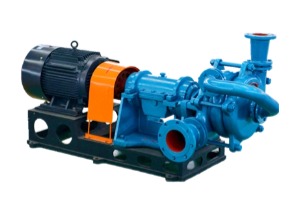
Make the ZH seal and drive configuration part of the model definition
Jiacheng describes ZH as a rear-inlet impurity pump, initially using an expeller and packing arrangement and discussing a revised mechanical-seal design. That is a build distinction: identify which seal comes with the offered pump and whether any seal water or other service is required. The original 100ZH-370 example decodes the first number as discharge diameter and the last as nominal impeller diameter; H denotes rear feed.
The published 100ZH-370 table includes a point of 188 m³/h at 33.2 m and 1,480 r/min, with 27.9 kW shaft power and a 55 kW selected motor. Shaft power and motor nameplate power are separate quantities. Ask for the liquid/test basis and actual slurry correction before applying that point to coal, mineral or press-feed duty.
The ZH charts show several speeds, and the 125ZH-435 label appears in separate 75 kW and 90 kW configurations with different flows. A shared model label is therefore insufficient to identify one performance envelope. Obtain the exact curve, speed, impeller build and approved outline; preserve clearance for the rear inlet as well as coupling and seal maintenance.
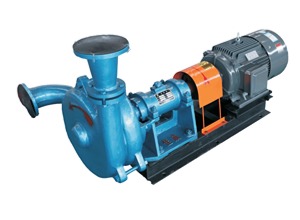
Use the Z table as a water-test reference, then correct for the slurry
The Z brochure describes horizontal slurry equipment for power, metallurgy, coal and building-material processes. It names abrasive and corrosive slurry duties, with stated mass concentrations up to 45% for ash/coal slurry and 60% for mineral slurry and dense medium. These are catalogue application statements, rather than approval of every particle distribution, chemistry or operating point. Specify both the concentration basis and the liquid/solid densities.
The performance table explicitly says clean-water performance. For Z150-100-360 at 1,480 r/min, one published point is 180 m³/h at 44 m, with 34.8 kW shaft power, a 45 kW/380 V motor selection and 4.8 m listed required cavitation allowance. The table lists 24 mm as the maximum particle size passing intermittently. That is not a promise of continuous passage of every 24 mm particle or a slurry-duty motor margin.
The model diagram distinguishes inlet, discharge and nominal impeller diameter. Check the actual flange dimensions and curve revision for a replacement. Some larger-model table and chart labels give different speeds, so require a single approved set before comparing offers. Do not combine the highest head from one speed with the flow or motor from another.
The brochure states series operation may be used according to duty. For a multistage slurry line, supply the pressure distribution and interstage arrangement and ask for allowable casing/seal pressure. Connecting two pumps does not make every casing, seal or pipe suitable for the resulting pressure.
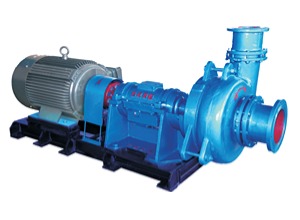
Specify the vertical installation and the actual impeller
The ZL description lists high-chromium wear-resistant cast iron for the impeller, casing and liner, a threaded impeller-to-shaft connection, grease-lubricated bearings and an expeller seal. It offers coupling or belt drive and semi-open or closed impellers. Obtain the exact material grades and supplied seal/drive arrangement; these construction descriptions do not approve any unspecified corrosive slurry.
The K suffix denotes a semi-open impeller; the closed-impeller naming omits it. The distinction affects selection: at 1,480 r/min, ZL150-100-360K has a published clean-water point of 122 m³/h at 42 m with a 37 kW/380 V motor selection, while ZL150-100-360 without K lists 180 m³/h at 44 m with a 45 kW/380 V motor selection. Their similar dimensions in the name do not make them the same pump curve.
Send the installation length, support/platform dimensions, lowest and highest liquid levels, discharge route and retrieval space. Agree the outline for the motor, support, shaft and wet end, including how the unit will be removed for inspection. A vertical slurry layout does not automatically establish permissible dry running or a sealed submersible motor.
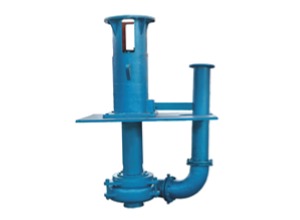
Approve the drive layout and spare interfaces with the curve
Jiacheng’s selection instructions describe direct coupling as the usual starting point, with speed and drive changes when the required duty or available layout calls for them. The illustrated arrangements include DC direct coupling, ZV tail-frame drive, CV motor-above-pump belt drive and CR/CL right/left parallel belt drives. Name the actual arrangement in the order and show access, guards, belt adjustment and motor removal on the outline.
The instructions explicitly say brochure motor models and powers are references and must be recalculated for the conveyed slurry’s specific gravity. Specify frequency/voltage, speed, the full operating range and any speed control. Require motor loading and the agreed slurry correction alongside the water-test curve rather than assuming the table’s motor is adequate at any concentration.
For spares, identify casing/liner, impeller and suffix, shaft attachment, sleeve/seal and bearing arrangement separately. The Z and ZL drawings show dismantling and adjustment features, but similar-looking parts do not prove interchangeability. Retain drawing revision, clearances and material for recurring orders, with commissioning spares and maintenance instructions tied to the supplied build.
Give Jiacheng one consistent process, curve and installation brief
For a press-feed request, include the filling stage and final-pressure stage, slurry changes through the batch and the required cycle time. For continuous transfer, include the duty range, pipeline and suction conditions. For a ZL installation, add levels, support and the complete installation length. State whether you need a bare pump, motor-driven package or replacement parts.
Request one consistent model, suffix, speed and drawing revision across the curve, outline, materials, drive and inspection records. Define the performance test conditions and the actual slurry selection, together with quantity and destination. Agree delivery, installation and spare-part support in the quotation; generic case illustrations and company slogans do not establish those commitments.
Prepare the duty, drawing and test requirements for a slurry RFQ →
Liquid and process
- Slurry chemistry/temperature, solid and liquid densities, mass or volume concentration and particle distribution.
- Flow/head range, suction conditions and pipeline losses; for a press, initial filling and final pressure/cycle.
- Any intermittent coarse particles, gas and corrosion/abrasion requirements.
Selected build and installation
- ZRS/ZH/Z/ZL and complete suffix, speed, approved curve and actual slurry/motor calculation.
- Material grades, seal and services, motor supply and DC/ZV/CV/CR/CL drive layout.
- Flanges, support/base, vertical length and liquid levels, maintenance and lifting access.
Supply and acceptance
- Bare pump/package/parts boundary, exact drawings/revision, spare interfaces and quantities.
- Agreed water test versus slurry selection, inspection records and acceptance conditions.
- Exact contracting entity, destination, delivery and commissioning/service responsibilities.
Submit through KanBeng’s enquiry form with this factory named in your request.