
Evaporation & crystallisation loops · axial and mixed flow · Jingjiang
Jiangsu Longsheng Pump & Valve Manufacturing Co., Ltd.
Longsheng’s ECP, HZW-II and SPP ranges give a buyer different hydraulic directions for process circulation. The practical choice depends on the loop’s required flow and resistance, the liquid at the suction connection, and the materials and maintenance arrangement. A large nominal connection or a family’s highest flow is not a complete selection.
- Company identity
- 江苏隆昇泵阀制造有限公司
- Published location
- Xinqiao, Jingjiang, Jiangsu, China
- Reviewed circulation ranges
- ECP mixed flow · HZW-II axial flow · SPP mixed flow
- Selection inputs
- Loop resistance, suction conditions, liquid and drive
Start with the evaporator loop, then choose the hydraulic direction
Send the heat-exchanger and pipe-loop arrangement with the required circulation rate. Identify losses through heaters, fittings and any control elements, and distinguish normal operation from cleaning, start-up and changing concentration. If an axial-flow selection cannot provide the required head at that flow, ask the supplier to compare a mixed-flow selection using actual issued curves.
| Direction | Published application | Information that decides selection |
|---|---|---|
| HZW-II axial flow | High-flow, low-head forced circulation; caustic-soda and salt evaporation among the stated applications | Loop losses, liquid condition, required operating range and drive arrangement. |
| ECP mixed flow | Evaporators with greater circulation resistance, including multiple heater passes and viscous-liquid concentration | Required head at circulation flow, viscosity and solids, temperature and suction conditions. |
| SPP mixed flow | Process circulation and other high-flow, low-head transfer duties | Impeller selection, speed, density-dependent motor requirement and available suction head. |
ECP: a higher-head direction for a more resistant circulation loop
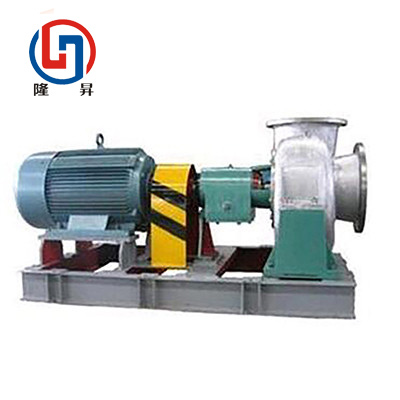
The ECP description specifies a single-stage cantilever mixed-flow construction. It identifies series-connected or multi-pass heating chambers, reverse-circulation and low-level evaporation arrangements, viscous concentrates and corrosive liquids containing some particles as application directions. The publication does not establish a quantified solids or viscosity allowance for every ECP size; provide those properties with the duty.
The published family envelope is 200–8,610 m³/h and 6–22 m head, with working pressure up to 1 MPa and temperature up to 170 °C. These are separate catalogue limits, not a single 8,610 m³/h at 22 m operating point or a guarantee that every material and seal can operate at all limits together. Request the selected curve, operating range and pressure–temperature rating for the offered construction.
ECP250 is explained as the family designation plus a 250 mm inlet/outlet size. The catalogue lists a connection-size direction from 150 to 800 mm and several metal/material options, including stainless steels, duplex, nickel-alloy and titanium directions. Specify corrosion chemistry, concentration, impurities, temperature and abrasion before agreeing an exact grade and the material of each wetted component.
View the reviewed product family →
HZW-II: speed and maintenance access are part of the selection
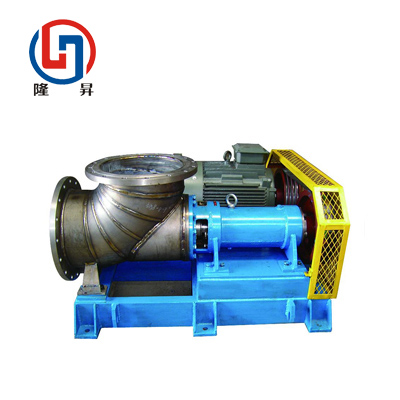
The HZW-II page describes a cantilever rotor and front-opening maintenance arrangement intended to allow access without removing the pump body and connected pipework. It also describes a replaceable suction guide for abrasive service and packing or double mechanical-seal directions. Obtain a sectional drawing and confirm the offered seal, service access and replacement parts for your liquid.
Direct coupling, belt transmission and gearbox drive are listed across the HZW range, along with horizontal, vertical and suspended arrangements. The HZW-II page and family photograph emphasise belt transmission. Ask which construction is actually offered, its pulley ratio and pump speed, guards, foundation and alignment requirements; do not infer that every arrangement is interchangeable.
The two HZW-250 rows below show why the model designation alone is insufficient. The last column is shaft power, not a stated motor rating. Agree motor allowance against actual density, viscosity, starting conditions and operating range. Neither row is a promise for a different speed or process liquid.
| Catalogue pump speed | Listed flow | Listed head | Listed efficiency | Listed shaft power |
|---|---|---|---|---|
| 1,450 r/min | 680 m³/h | 4.5 m | 39% | 21.37 kW |
| 980 r/min | 400 m³/h | 3.5 m | 39% | 9.78 kW |
View the reviewed product family →
SPP: keep impeller, speed, NPSH and density together
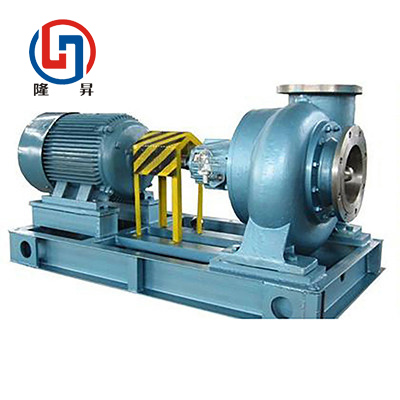
SPP is described as mixed flow between axial and centrifugal directions, with a pull-out maintenance arrangement and oil-lubricated bearings. The catalogue includes process circulation and high-flow, low-head transfer of neutral or corrosive liquids, with some-particle service mentioned. State actual particle distribution, concentration, corrosion and viscosity, rather than interpreting that description as a universal slurry rating.
For SPP20-25, impeller A at 1,450 r/min is tabulated with a 270 mm impeller, 530 m³/h, 11.2 m head and 4 m required NPSH. This is one model/impeller/speed row. Required NPSH is a pump characteristic; it does not establish that the plant has enough available NPSH or that a 4 m suction lift is permissible.
That same row gives different motor powers for different liquid densities. Include the normal and highest density and concentration with the operating range. Obtain the selected motor and issued curve, and confirm flange standards, oil system, seal auxiliaries and assembly dimensions for the offered pump.
| Reference liquid density | Listed motor power |
|---|---|
| 1,000 kg/m³ | 22 kW |
| 1,350 kg/m³ | 30 kW |
| 1,840 kg/m³ | 30 kW |
View the reviewed product family →
Resolve the hot-liquid suction conditions before accepting a curve
An evaporator circulation pump may receive liquid near its boiling condition. Provide vessel absolute pressure, liquid temperature and vapour pressure, minimum liquid level above the pump centreline, and the suction route and losses. Ask the supplier and process designer to check available NPSH against the selected pump’s required NPSH with an agreed margin over the operating range.
Describe start-up, concentration changes, crystal growth, cleaning and shutdown. These conditions can change liquid properties and seal requirements. Request the actual solids and temperature allowances, seal support and stopping/restart procedures for the offered configuration. The family’s application list is not an acceptance test for your process.
Large hot pipes also need their own support and thermal-expansion design. Obtain allowable nozzle loads and agree the support and alignment responsibilities. Broad catalogue statements about carrying pipeline loads should not replace a mechanical review of the complete installation.
Agree what the order includes beyond the pump casing
The company profile identifies 江苏隆昇泵阀制造有限公司 in Xinqiao, Jingjiang and describes pumps, valves, pipeline parts and associated industrial components. It states casting, machining and material/testing capabilities. For a purchase, request the actual material traceability and inspection records relevant to the offered pump; the equipment list alone does not establish testing of an individual order.
Define the supply boundary for pump, motor, drive, baseplate, guards, seals and auxiliaries. Agree drawings, operation instructions, spare-part identification and installation/commissioning responsibility. Where certification or a witnessed test is a contract requirement, obtain current documents naming the actual contracting entity, site, scope and selected product.
An enquiry pack that the process designer and pump supplier can both use
Process-loop sketch
- Required circulation flow and loop-loss calculation at normal and limiting conditions.
- Vessel pressure, heater passes, suction/discharge connections, levels and pipe route.
- Operating, cleaning and shutdown sequence; any changes in concentration or crystals.
Liquid and construction
- Composition, density, viscosity, temperature, vapour pressure and measured solids.
- Required wetted-material grades, seal/support system and corrosion allowances.
- Proposed ECP/HZW-II/SPP direction, selected speed, drive and electrical supply.
Selection and acceptance
- Issued duty curve, NPSH requirement, agreed margin and motor selection.
- Dimensional drawing, allowable nozzle loads, supports and maintenance envelope.
- Quantity, destination, schedule, inspection/test requirements and spare-parts scope.
Submit through KanBeng’s enquiry form with this factory named in your request.
Review date and limits of these catalogue examples
Reviewed on 8 October 2026 from the company profile and dedicated ECP, HZW-II and SPP pages, including their original performance-table images. The suction guidance was cross-checked against Hydraulic Institute material. Historic certificates and platform listings are not treated as current registry or certification decisions. The examples keep speed, impeller and density conditions separate. Final suitability depends on the supplier’s issued selection for the actual process.
Report an outdated detail · Return to the enquiry checklist ↑